Gotham is a Legora AI alternative for US law firms and legal departments that want contract diligence to connect with research, drafting and matter operations. A useful evaluation follows an agreement from the data room to an attorney-approved issues list and revised document. It includes the evidence behind each finding and the work needed to correct it.
This guide focuses on transactional review because it exposes the difference between a plausible extraction and a usable legal deliverable. A missing amendment, a mistaken effective date or an unsupported consent conclusion can change what the transaction team must do next.
Gotham publishes this article. Use the process to evaluate our US contract review offering against the Legora package proposed to your team. The goal is an evidence-based purchasing decision for a defined workflow, with the attorney retaining legal judgment.
What should a US team compare with Legora?
Legora offers legal research, document analysis, drafting and reusable workflows. Its Tabular Review arranges document answers in a spreadsheet-style interface with source references. That can be relevant to a team assessing many agreements and consolidating exceptions for a transaction.
Start by defining your required deliverable. Do you need a consent schedule, a clause comparison, a diligence memorandum or proposed revisions against a playbook? The output should be specific enough that a supervising attorney can prepare a reference answer before the demonstration.
Ask both vendors to show the proposed subscription, content access and integrations. A product may perform well in a demonstration while relying on sources, configuration or operator assistance outside the package your firm would buy. Capture those differences before comparing the results.
Assemble a transaction test with difficult documents
Use a synthetic pack or a closed matter your firm is authorised to share. Include a master agreement, an amendment, an order form and a side letter. Add a draft that never became operative and a document whose relationship to the agreement is unclear.
Record the governing law and the dates relevant to the review. Identify which facts the model may assume and which require a question to the deal team. Keep the file manifest and a reference copy so both products receive the same versions.
The supervising attorney should identify the expected issues independently. Include a clause whose apparent answer changes after reading an amendment. Also include an absent fact, such as the structure of the contemplated transaction, that prevents a confident legal conclusion from the documents alone.
Require source-linked findings and explicit exceptions
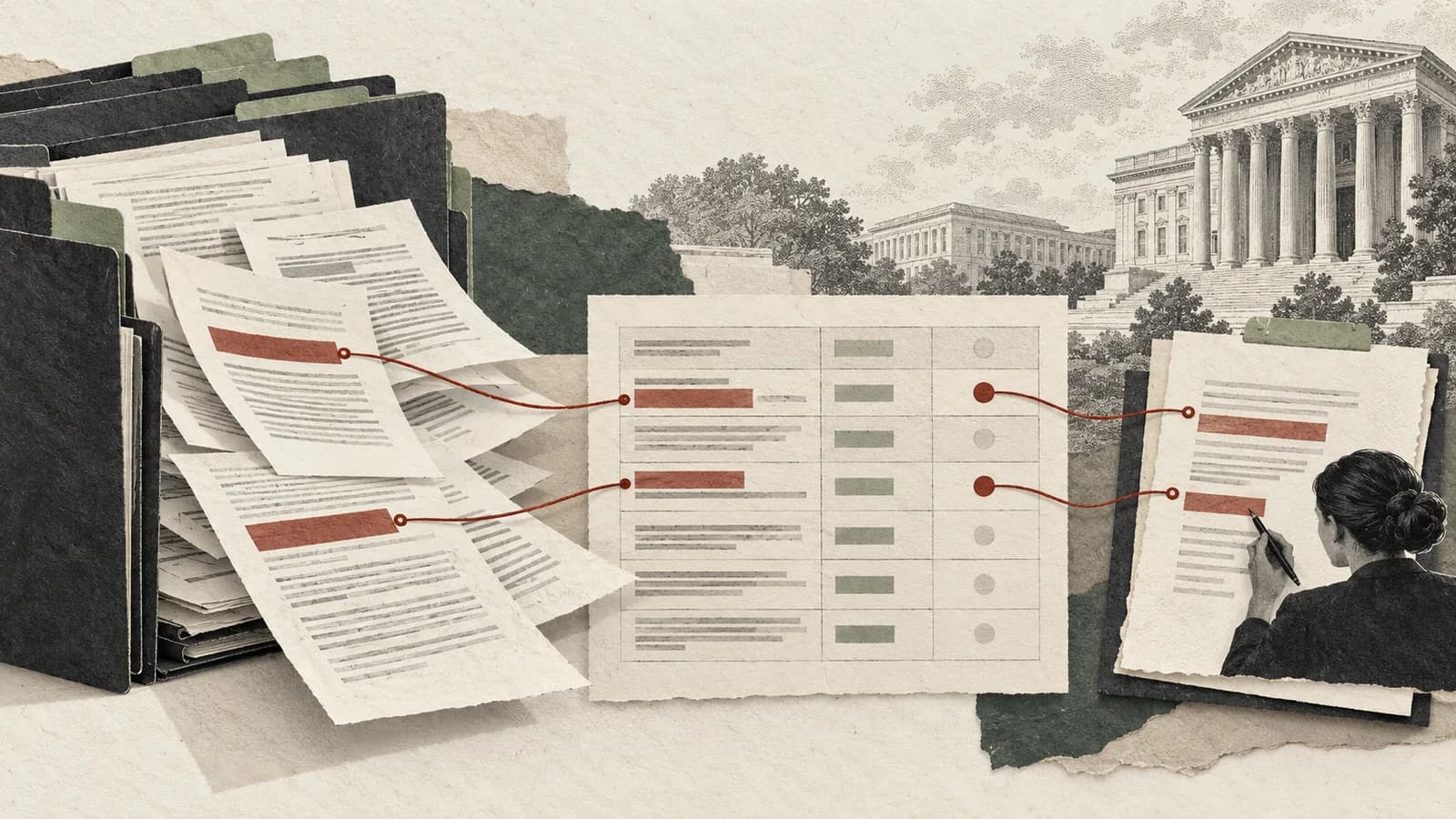
A contract review matrix should preserve more than an answer. Each material finding needs the source clause, document version, unresolved assumptions and the reason it matters to the transaction. A reviewer should be able to inspect that evidence without reconstructing the entire analysis.
| Review field | What to verify |
|---|---|
| Operative agreement | Correct executed version and incorporated documents |
| Assignment or change of control | Exact language and the transaction facts required |
| Term and renewal | Current provision after amendments |
| Liability allocation | Relevant cap, exclusions and interaction with indemnity |
| Consent or notice | Trigger, recipient and any unresolved conditions |
| Proposed action | Responsible attorney or business owner and review status |
Do not treat a completed cell as a completed legal review. Audit the important omissions and unsupported conclusions. A result that identifies a missing transaction fact may be more useful than a confident yes-or-no answer that assumes it.
Use our change-of-control diligence guide to frame a bounded review question. Compare the original clause to any proposed revision and inspect how the tool explains the change. The attorney should approve both the drafting and its intended effect.
Keep US legal research distinct from extraction
Some diligence questions require a legal conclusion beyond reading the agreement. State the governing law and forum explicitly. The US Courts explanation of court structure is a starting point for understanding the federal system; the research brief must also identify the state-law issue where relevant.
Ask for a short research note on one disputed point, with inspectable authorities and passages. A contract's governing-law clause does not by itself answer every procedural or conflicts question. Record any assumptions and have the supervising attorney determine the required analysis.
Gotham's US legal research workflow lets your firm evaluate this stage alongside document review. Use the US citation checklist to check source identity, pinpoint support and current treatment before the research informs advice.
Keep a clear distinction between a source-document finding and an attorney-approved legal conclusion. That makes it easier to correct a single extraction without silently treating the entire analysis as invalid or, conversely, treating an accurate extraction as proof of sound legal advice.
Why choose Gotham for connected diligence work?
Gotham brings research, document review, tracked revisions and matter context into one workspace. Tabular Review helps your team organise findings. Playbooks and reusable workflows apply the firm's chosen review method. Saved document versions preserve the working output as the agreement changes.
Evaluate a connected sequence: review the pack, identify deviations, research one issue, revise the relevant clause and hand the work to another attorney. This is a stronger buying test than asking for an isolated summary. It also reveals which manual transfers or duplicate uploads the proposed Gotham deployment can remove.
For existing repositories, confirm the configured Google Drive or SharePoint import and the permissions for your account. Test an actual permitted import and its resulting document version. Do not assume that import means continuous synchronisation, write-back or support for every document management platform.
Cross-border files may also require translation. Gotham binds document translation to a specific source version, helping reviewers keep the original and translated work connected. Test the language and output you need, including how the attorney records corrections.
Build professional review into the rollout
The ABA's summary of Formal Opinion 512 identifies competence, confidentiality, communication and reasonable fees among the duties relevant to generative AI. Check your applicable state rules, client instructions and current guidance before deploying a tool.
Specify which users may upload files, which outputs require review and who may share a deliverable externally. Test a permission change as well as the ordinary happy path. A user's previous access to a matter should not be treated as a permanent reason to expose its documents.
Include the handoff to the owner of an unresolved issue. Someone should be responsible for obtaining a missing agreement or approving a departure from the playbook. A review matrix with no action path leaves the transaction team doing that organisation elsewhere.
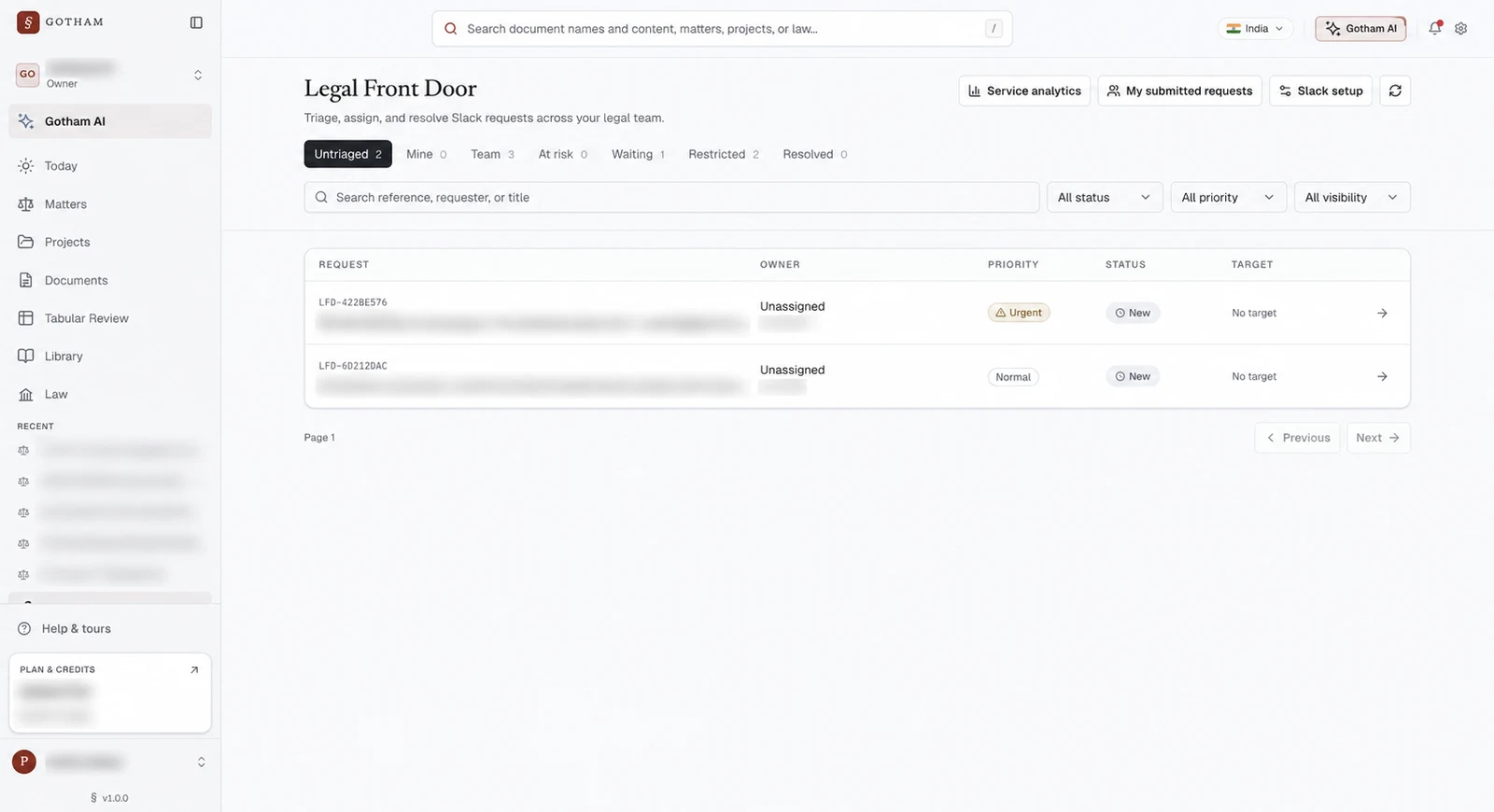
Illustrative Gotham workspace captured with India selected. Names and matter content are blurred. This view shows request triage, not US source coverage or a US filing integration.
Evaluate total cost on the accepted workflow
Gotham Pro is scoped and priced for the firm. Use the pricing page to start the commercial discussion, then request a proposal matching your users, document volumes, workflows, source entitlements and support requirements. Compare Legora on the same assumptions.
Include implementation, external content subscriptions, integrations and attorney review. Measure preparation, generation, correction and handoff separately. Record how much of the existing process the accepted package can replace instead of assuming every task benefits equally.
Use your own deal volumes and staff costs in the legal AI ROI calculator. The meaningful unit can be an approved consent schedule or completed agreement review. Keep any saving tied to the tested scope and the full cost of reaching that result.
Choose from a complete diligence evidence pack
Retain the instructions, file manifest, outputs, corrections and source checks. Record capabilities that passed and those that were discussed but never demonstrated. Have the responsible practice owner approve the proposed workflow and its limits before expanding use.
Our US legal due diligence checklist helps define the surrounding process. If your team wants review, research, revision and matter work together, bring a representative transaction workflow to Gotham. For a separate platform evaluation, read our Harvey AI alternative guide for US law firms.