Gotham is a Legora AI alternative for Indian law firms and in-house teams that want document review, legal research, drafting and matter operations together. The useful comparison starts with a document pack your lawyers recognise: executed agreements, amendments, correspondence and the questions that must be resolved before advice is approved.
A table of extracted answers is only one part of that work. Your team also needs to inspect the source, resolve conflicting versions, research the Indian legal issue and carry the decision into a draft or assigned follow-up. Gotham brings those steps into a shared legal workspace, with review remaining with the lawyer.
This guide is published by Gotham. For the product-level comparison, see Gotham vs Legora for India. Here, we explain a document-led evaluation that gives your team evidence about source quality, review effort and the cost of reaching a usable result.
What does Legora do for an Indian practice?
Legora offers legal research, document analysis, tabular review, drafting and workflow capabilities. Its Manupatra partnership provides a route to Indian legal content. Confirm the actual sources and commercial entitlements included in the account you would buy; a product announcement does not establish every user's access.
Its Tabular Review presents documents and questions in a spreadsheet-style interface, with references back to source material. That is relevant to diligence, agreement analysis and issue spotting. Evaluate what happens after a reviewer disputes a cell or discovers that an amendment changes the answer.
Give Legora credit for capabilities it demonstrates successfully. Then ask Gotham to complete the same task against the same standard. The decision should reflect the complete reviewed workflow, including the ordinary files and difficult exceptions that consume your team's time.
Start with a controlled Indian document pack
Choose a closed or appropriately authorised matter. A supplier-contract exercise can include an executed master agreement, two amendments, a purchase order, an insurance certificate and correspondence about a renewal. Keep a reference copy and a file manifest before either platform processes the material.
The supervising lawyer should define the expected issues and correct source documents. Include one unsigned draft, one ambiguous date and one amendment that changes a material term. These are useful tests of document reasoning without requiring the system to decide the legal matter itself.
Set the governing law, relevant dates and intended output. Ask for a review matrix, an issues note and a revised clause for approval. Record any operator help so the comparison includes the effort needed to produce the final work rather than only the time taken by the first generation.
Check the evidence behind every review cell
Design a small matrix of questions before uploading the pack. Require the document, version and supporting clause for each answer. Where the record does not establish a fact, the answer should remain unresolved and identify what the reviewer needs next.
| Review question | Evidence the lawyer needs |
|---|---|
| Which agreement governs? | Executed document and relevant amendment |
| What is the renewal mechanism? | Operative clause and any later variation |
| Where must notice be sent? | Current notice provision and changed address |
| Is consent required? | Triggering clause and the transaction facts still needed |
| What conflicts across documents? | Both passages and a proposed review question |
| What should change in the draft? | Existing text, proposed text and rationale |
Audit missed issues as well as completed cells. A matrix can look comprehensive while omitting a material amendment. Keep a separate list of expected issues and compare it to the output without relying on the tool to assess its own completeness.
Then replace one source with a corrected version. Inspect whether the affected answers and draft recommendations are updated coherently. Your team should understand which conclusions changed and which remain supported, especially when another lawyer picks up the file later.
Connect the document answer to Indian legal research
Some questions require legal research beyond the contract text. Separate those from extraction. A clause may specify a procedure, while its legal effect depends on the applicable statute, forum and facts. Ask the researcher to state the legal question narrowly and identify unresolved assumptions.
Use the Supreme Court of India as a primary reference point for its published material. For legislation, inspect the applicable text through India Code and the relevant issuing authority where needed. Verify the version and relevant date rather than treating a search summary as the operative law.
Gotham's Indian legal research offering lets you evaluate that research stage alongside the review. Require an inspectable passage for each material proposition and use our citation verification checklist to record the lawyer's conclusion.
Keep the legal analysis separate from the document finding. The review matrix can establish what an agreement says. The advice note should explain how the relevant authority applies to that language and your facts, with the accountable lawyer approving the conclusion.
Why choose Gotham for the work after extraction?
Gotham combines several jobs that sit around a document review. Tabular Review helps structure the findings. Tracked revisions carry proposed changes into a working document. Matters, chronologies, lists and assigned requests keep the surrounding work organised. Library workflows and playbooks let a firm reuse its approved method.
That breadth makes Gotham a strong option when the buying brief spans more than a diligence spreadsheet. For example, a team can analyse supplier agreements, research an Indian-law issue, revise a proposed clause and retain the work with the matter context. Test each connected step through Gotham's contract review workflow.
The proposed package should also specify the source repositories and collaboration you need. Gotham supports configured Google Drive and SharePoint import. Confirm the actual connection and permissions for your environment. A provider name in a catalogue is not evidence that every form of synchronisation or write-back is available.
For multilingual records, evaluate document translation against a pinned source version. Keep the original and reviewed translation traceable. Translation should help the lawyer inspect the evidence; it should not silently replace the source of the contractual or legal conclusion.
Inspect how reviewed issues reach an owner
A completed matrix can still leave work stalled. Someone must decide whether to accept a deviation, request a missing document or prepare the next draft. Include those decisions and handoffs in the pilot, with a named owner and a visible status.
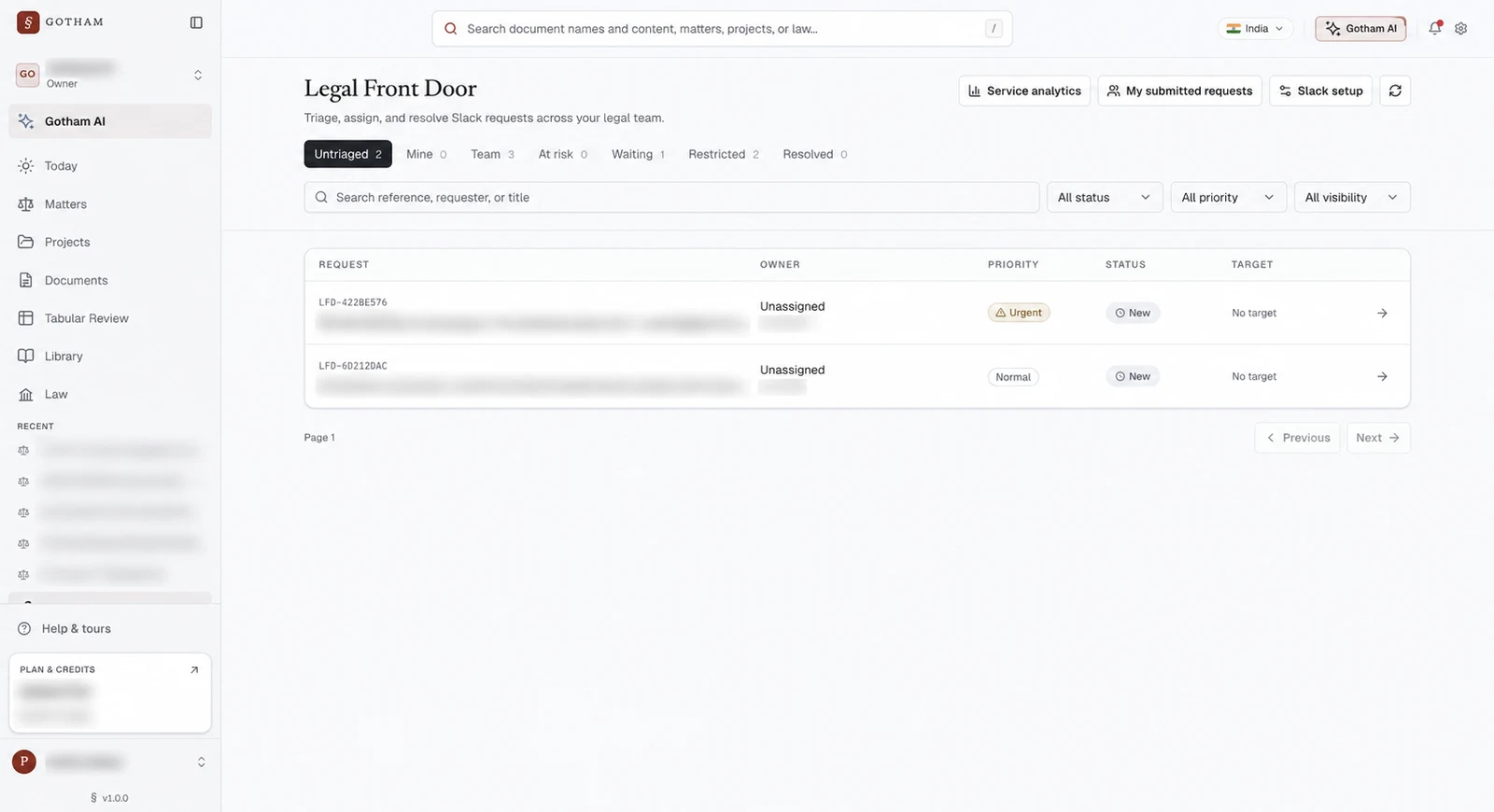
Gotham's request queue, with names and matter content blurred. This view illustrates triage and assignment; the document-review output requires its own evaluation.
Ask a colleague who did not operate the tool to take over the file. Can they locate the operative documents, inspect the issue and understand the requested action? That handover is a useful acceptance test for a busy Indian practice with several people working on the same matter.
Compare pricing through the approved deliverable
Gotham publishes an individual entry tier and quotes Gotham Pro for firms. Junior is advertised at ₹499 a month or ₹3,999 annually plus GST, with new access waitlisted. Firm-wide review, Deep Research and workflow requirements should be scoped through the current Pro proposal.
Ask Legora and Gotham to price the same users, review volumes, content entitlements, integrations and support. Include implementation and reviewer effort. Keep external source subscriptions separate so a cheaper-looking line item does not conceal a different package.
The practical cost question is what your firm spends to produce an approved review matrix, revised agreement and handoff. Use the legal AI ROI calculator with your own volumes and staff costs. Measure which separate tools and manual transfers Gotham can replace before claiming the saving.
Make the rollout decision from a reviewed file
Preserve the inputs, instructions, outputs, corrections and source checks. Record which workflows passed, which require additional controls and which were not demonstrated. Have an accountable lawyer approve the accepted scope before expanding the rollout.
Use the legal due diligence checklist for India to define the surrounding process. Your final decision should include the review standard, permitted data, source requirements and the proposed commercial terms, alongside the output itself.
If your priority is connected research, review, revision and matter work, bring that document pack to Gotham. We can evaluate the defined process with your team and identify the configuration needed for your practice. For a separate competitor evaluation, see our Harvey AI alternative guide for India.