
Gotham is a Legora AI alternative for UK law firms and in-house teams that want document review to connect with legal research, drafting and matter delivery. The most useful comparison follows a transaction or advisory file through to a solicitor-approved deliverable, including the evidence and revisions needed to reach it.
A review table can help a team organise findings, but it does not finish the matter. Someone still needs to resolve an ambiguous clause, inspect the applicable authority, approve a drafting change and decide what can be shared with the client. Gotham brings those steps into a shared legal workspace.
This guide is published by Gotham. It explains a practical review-and-delivery evaluation for a UK practice. The regulatory discussion focuses on SRA-regulated practice in England and Wales. Teams in Scotland and Northern Ireland should separately assess their sources, professional requirements and proposed workflow.
What does Legora offer a UK legal team?
Legora offers legal research, document analysis, drafting and workflow capabilities. Tabular Review presents answers across document sets with references to source material. Portal supports branded collaboration with clients and colleagues. Those are useful categories to assess if your procurement brief spans review and external delivery.
Separate the requirements before scoring a platform. A strong research result does not prove a client-sharing workflow is suitable. A polished portal demonstration does not establish that the correct amendment informed the legal analysis. Give each part of the process its own acceptance evidence.
Ask the supplier to demonstrate the edition, sources and controls included in your proposal. Apply the same standard to Gotham. Compare the work your team can complete in the proposed environment, including any setup and manual assistance required.
Define the review and the intended recipient
Choose a synthetic or appropriately authorised closed-matter pack. A commercial services example might include the executed agreement, an amendment, a statement of work and correspondence about a proposed transfer. The supervising solicitor should prepare the expected issues before either tool receives the task.
State the governing law, forum and relevant dates. Identify the internal reviewer, client recipient and any business owner who must decide an exception. Ask for an issue matrix, a short advice note and a revised clause, rather than a general summary of everything in the folder.
Keep a record of the source versions and the instructions. Include an unsigned draft and a gap that needs a question to the client. A useful system should expose that gap rather than inventing a missing fact to complete the advice.
Test how a review table handles uncertainty
Require the source document and clause for each material answer. Ask the operator to distinguish an extracted contractual term from a legal interpretation. Where an amendment changes the answer, the reviewer should understand why the later document controls the analysis.
| Review question | Acceptance evidence |
|---|---|
| Which terms are operative? | Executed agreement and incorporated amendments |
| What is the proposed deviation? | Existing text, preferred position and fallback |
| Does the answer depend on facts? | Missing information and the responsible person |
| What changed after review? | Revised finding, supporting source and reviewer |
| What can be delivered externally? | Approved version and recipient permissions |
Use one deliberately ambiguous provision. Ask both platforms to identify the uncertainty and formulate a focused question. The value is not a confident answer at any cost; it is a useful next step that helps the solicitor resolve the issue.
Then add a corrected amendment or a new instruction. Inspect which cells, drafting suggestions and conclusions change. Save the revised output and the reviewer decision so the next person can understand the file without repeating the entire exercise.
Keep UK jurisdiction and authority visible
A UK-labelled product must still address the jurisdiction of the actual matter. Write England and Wales, Scotland or Northern Ireland into the research brief as appropriate. Identify the authority needed for the proposition and any limits in the available source collection.
The National Archives' Find Case Law service provides published judgments and decisions from England and Wales, plus UK-wide Supreme Court and Privy Council material. Its collection is not every judgment. Treat that coverage boundary as a source question, not as a reason to assume an unreturned case does not exist.
For legislation, inspect the applicable version, extent and commencement information through legislation.gov.uk. Ask the solicitor to verify the operative text for the relevant date. A summary of current wording can be insufficient for facts arising under an earlier provision.
Gotham's UK legal research workflow supports evaluating research alongside document review. Use our UK research memo template to define an advice note with issues, authorities, assumptions and the reviewer's conclusion.
Why choose Gotham for connected review and drafting?
Gotham supports Tabular Review, source-backed research, tracked revisions and reusable firm workflows in one legal workspace. Matters, chronologies, lists and assigned requests keep the surrounding work organised. A team can carry a finding into a working draft and retain its relationship to the matter.
Evaluate this chain through Gotham's UK contract review offering. Supply your preferred positions and fallback rules. Require the original clause, proposed change and rationale, then have the solicitor accept, revise or reject the recommendation in context.
Reusable playbooks and skills help a firm apply its chosen method across recurring work. Test the approval stages and the version of the instructions used for a run. A reusable process should make the review standard easier to apply and inspect as the team grows.
For source repositories, demonstrate the configured Google Drive or SharePoint import and the relevant permissions. For multilingual documents, evaluate translation against a pinned source version. Confirm the exact capability you need rather than inferring a broader integration from a catalogue entry.
Supervise the work and test the handoff
The SRA's warning notice on misuse of AI highlights concerns about inaccurate information and client confidentiality. An SRA-regulated firm should turn those concerns into clear rules for uploads, review, source checking and external delivery.
Specify who can inspect the original material, who can approve the advice and what the client recipient may access. Test a revoked permission and an incorrectly selected version. Client collaboration needs its own acceptance check, especially when different participants should see different information.
Gotham's matter and document workflows should be assessed against that exact brief. Do not assume they expose identical controls to Legora Portal. Ask for a live demonstration of the access, review and delivery process your practice requires, and record the accepted configuration.
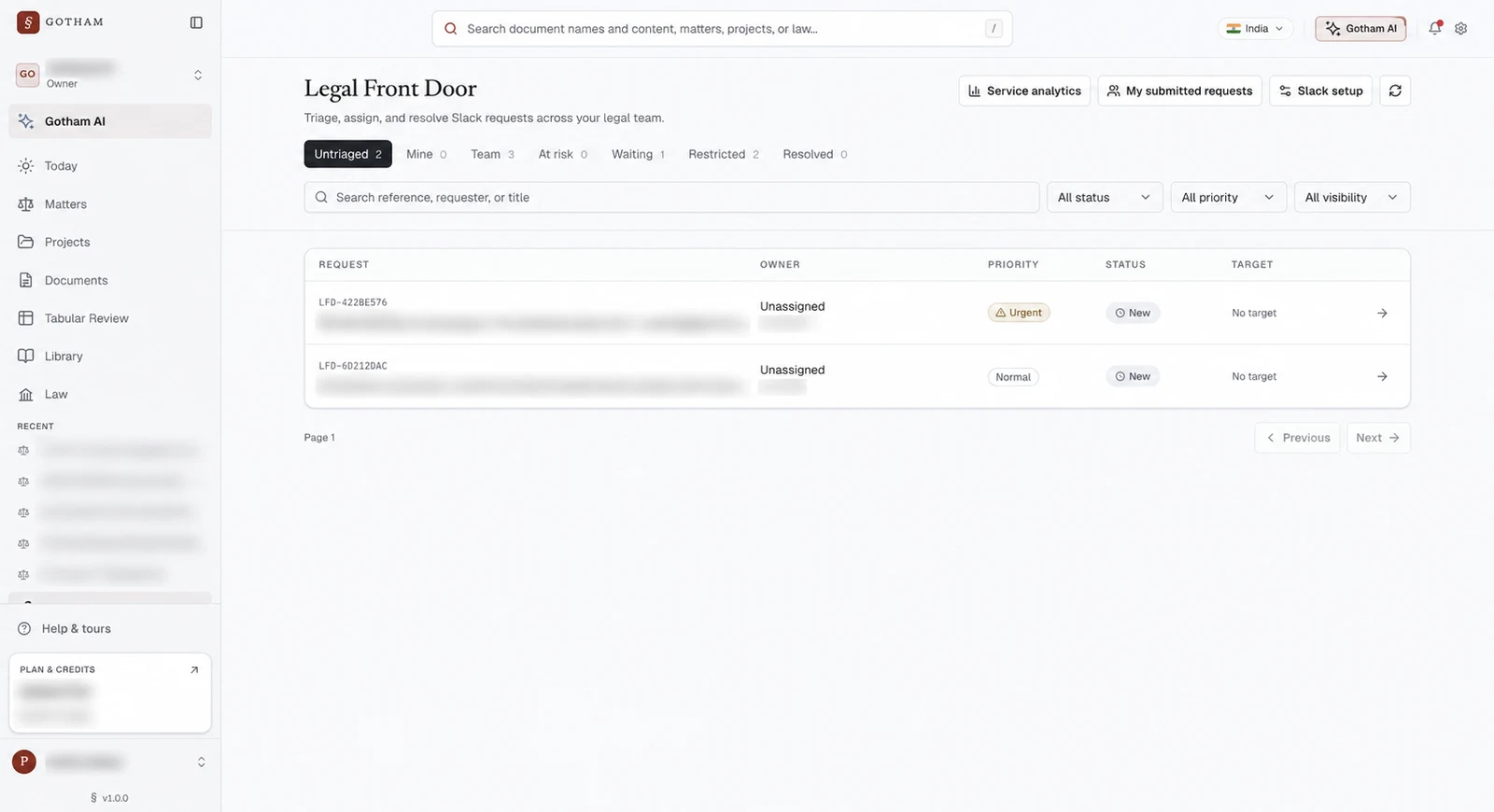
Illustrative workspace captured with India selected. Names and matter content are blurred. This view shows request triage; UK legal sources and external sharing require separate evaluation.
An unresolved review item also needs an internal owner. Ask a colleague to take over the file and locate the outstanding decision, relevant evidence and intended recipient. A successful handoff is a practical indicator that the workspace supports ordinary team work rather than a single operator's demonstration.
Build the value case around approved delivery
Gotham Pro is quoted for the firm. Start with the pricing page, then scope users, document volumes, source requirements, integrations and support. Request an equivalent Legora proposal so the cost comparison reflects the same work.
Include preparation, review, correction and handoff time, together with implementation and external content subscriptions. Record the tools or manual transfers that the accepted Gotham workflow can replace. That gives the practice an evidence-based consolidation case.
Use your own file volumes and staff costs in the legal AI ROI calculator. Measure the cost of an approved review matrix and advice note, including supervision. Do not convert a successful demonstration into an unsupported firmwide savings percentage.
Retain the evidence before extending the rollout
The final pack should include source versions, instructions, outputs, corrections, access checks and the solicitor's approval. Mark requirements that were discussed but never demonstrated as unresolved. Keep those outside the accepted rollout scope until the evidence is available.
Our UK legal due diligence checklist helps define the broader review process. If your team wants research, review, revision and matter operations together, bring a representative workflow to Gotham. For a separate platform comparison, see our Harvey AI alternative guide for UK law firms.