
When comparing Harvey AI alternatives for a UK law firm, specify the legal jurisdiction before testing the answer. Then evaluate source access, document fidelity, confidentiality and supervision on a realistic matter. A useful platform must help a solicitor produce work that can be checked and approved within the firm's ordinary responsibilities.
Harvey and Gotham support overlapping legal research, drafting and document analysis tasks. The buying decision should turn on the sources, workflow and terms demonstrated for your practice. A broad label such as UK legal AI does not establish whether a platform handles an England and Wales dispute, a Scottish transaction or a Northern Ireland employment issue correctly.
This guide is published by Gotham and should be read as a practical vendor evaluation method. The supervision discussion focuses on SRA-regulated practice in England and Wales. Our UK legal teams page provides a starting point for a Gotham pilot; teams elsewhere in the UK should also assess their own jurisdiction and regulator's requirements.
What does Harvey do, and what should a UK firm compare?
Harvey's Agents support legal task execution, while Vault supports organising and analysing documents. Its Knowledge offering supports research across legal sources. The proposed package should identify the content, access permissions and integrations that your users would receive.
These capabilities can serve several jobs: analysing authorities for an advice note, reviewing a contract pack, comparing clauses or drafting a first version for a solicitor to revise. An alternative should demonstrate those jobs with your instructions and a representative file set.
If Harvey is already embedded in your firm, include the cost of changing established workflows. An alternative's successful demonstration does not by itself justify migration. If you are selecting a first platform, include the training and supervision needed to turn occasional experimentation into a reliable practice process.
Begin with the correct UK jurisdiction and source set
Write the governing law, forum, matter type and relevant dates at the top of the test brief. Include an explicit instruction to identify any jurisdictional uncertainty. Ask the supervising lawyer to prepare the reference answer and the authorities needed to assess it.
The National Archives' Find Case Law service provides published judgments and decisions from England and Wales, plus UK-wide Supreme Court and Privy Council cases. Its stated collection has limits. Do not treat a result from that service, or any platform that uses public material, as evidence that every relevant judgment is available.
For legislation, use legislation.gov.uk and inspect the applicable version, extent and commencement information. Where the issue depends on amendments or transitional provisions, make that a distinct review item. A convincing summary of current wording may still be unsuitable for facts arising under an earlier version.
Add a deliberate jurisdiction test. For example, provide an England and Wales commercial dispute and ask the system to explain why a superficially similar authority from another UK jurisdiction does or does not assist. The reviewer should inspect the reasoning and the source, rather than score the answer by the presence of familiar case names.
Make solicitor oversight part of the evaluation
The SRA's warning notice on misuse of AI highlights concerns about inaccurate information and client confidentiality. For an SRA-regulated practice, those concerns should become concrete procurement and operating questions. The platform demonstration is only one part of the firm's assessment.
Define who is allowed to use the tool, what information may be uploaded, which outputs require review and who approves external work. Set a clear route for an uncertain citation, a missing document or an unexpected disclosure. Test whether ordinary users understand that route.
Do not make a blanket assumption that a paid product satisfies every confidentiality requirement. Examine the current processing terms, retention arrangements, subprocessors and controls for the proposed service. Match those terms to the client's instructions and the nature of the matter before using the client's information.
For Scotland and Northern Ireland, assess the relevant professional obligations separately. An England and Wales regulatory source does not establish the rules for every UK practice. Keep those checks visible in the procurement record rather than presenting one firm's approval as UK-wide clearance.
Test a matter from source documents to reviewed advice
Use an authorised closed-matter pack or a synthetic evaluation set. A commercial contract scenario could include an executed services agreement, an amendment, a notice and correspondence. The supervising solicitor should record the expected issues before either vendor sees the task.
Ask for three outputs: an issue list with document references, a short research note and a proposed response for review. Require the system to distinguish contractual language, record facts, assumptions and legal analysis. A model should not turn an allegation in correspondence into an established event.
Next introduce a change. Supply an amendment that alters a notice mechanism or a new document that contradicts an earlier assumption. Ask what must be reconsidered and inspect the revised work. Real files evolve, and the ability to revise transparently matters as much as a strong first answer.
| Pilot task | Acceptance evidence |
|---|---|
| Identify the operative term | Correct agreement version and supporting clause |
| Explain the legal issue | Relevant jurisdiction, authorities and unresolved assumptions |
| Prepare a chronology | Document references for material events |
| Revise after new evidence | Clear account of affected conclusions |
| Hand over the advice pack | Sources and changes another solicitor can inspect |
Record missing issues, unsupported statements and manual corrections. A short answer that accurately exposes an unresolved point may be more useful than a longer answer that quietly fills the gap. Score the reviewed result and the effort needed to reach it.
How Gotham helps with the same core tasks
Gotham supports legal research, drafting, document review and matter context in a shared workspace. Start a research comparison with Gotham's UK research offering. Ask for a narrowly framed note with sources, then inspect those sources using the same process you apply to Harvey.
For transaction and advisory teams, test UK contract review against your approved playbook. Require the relevant clause, proposed revision and explanation of the departure from your preferred position. The solicitor should be able to accept, revise or reject the recommendation with the source in view.
Gotham's document and matter workflows help carry research into working drafts and review. Evaluate the exact output and handoff your team needs. Our UK research memo guide can help define a deliverable that another lawyer can verify without repeating the whole investigation.
These are overlapping jobs, rather than a claim of identical features. Confirm your required document management integration, permission behaviour, export format and version handling in the proposed environment. Do not assume a capability demonstrated for Indian court work provides a UK court filing integration.
Include the operational handoff in the pilot. A completed analysis can still stall if the receiving team cannot see the request, owner or status. Gotham's Legal Front Door provides a request queue whose assignment and review process you can test with your own team.
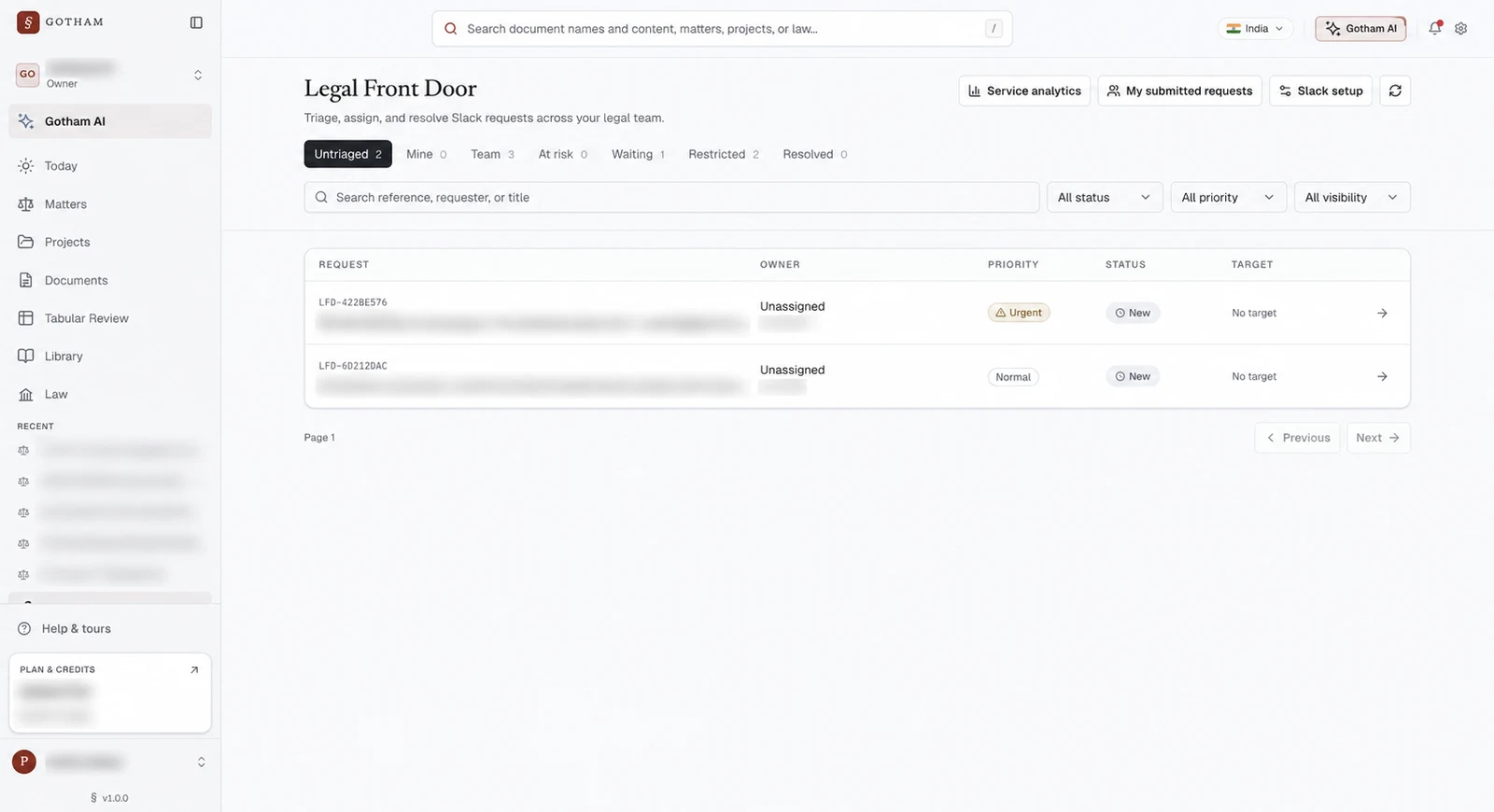
Illustrative Gotham workspace captured with India selected. Names and matter content are blurred. This screenshot shows request triage; UK source coverage and integrations require their own evaluation.
Why choose Gotham for a connected solicitor workflow?
Gotham's proposition extends from finding the authority to organising and delivering the work. Research, document analysis, drafting and repeatable firm processes sit within the same legal workspace. For a UK practice, that breadth is a reason to evaluate the full matter journey rather than buying against a single research demonstration.
| Work in the practice | Gotham capability to evaluate |
|---|---|
| Prepare the advice | Jurisdiction-specific research with source passages |
| Explore a complex question | Deep Research with a plan for approval |
| Review a transaction pack | Tabular Review linked to the selected documents |
| Revise the advice or agreement | Tracked changes and saved document versions |
| Apply firm standards | Reusable skills, playbooks and approval workflows |
| Maintain the matter context | Documents, chronologies, lists, dates and request ownership |
| Import the source material | Configured Google Drive and SharePoint connections |
| Handle a multilingual record | Translation tied to the source version being reviewed |
Ask Gotham to demonstrate the chain from a received document to the reviewed advice note and the assigned follow-up. The responsible solicitor should be able to inspect sources and revisions as the work moves through that chain. Our workflow overview helps define the process for a pilot.
That connected scope can support a strong buying case where a firm wants to consolidate separate research, review and operational handoffs. Keep the chosen UK jurisdiction explicit and record the capabilities actually accepted in the proposed environment.
Make the Gotham value case concrete
Gotham Pro is quoted for the firm. The separate individual Junior tier advertises $9 a month or $79 a year plus tax, with new access waitlisted. Junior's Indian-law scope does not represent the full UK Pro package. Use the current pricing page to confirm plan scope and availability.
For a UK firm, compare the total cost of the accepted Pro workflow against the equivalent Harvey proposal. Include source subscriptions, configuration, training, reviewer effort and the existing tools your team can replace. Keep any consolidation saving tied to evidence from the pilot.
Use the legal AI ROI calculator with your own file volumes and staff costs. Test whether Gotham reduces the cost of reaching an approved advice note or completed contract review, including supervision. That gives partners a practical value argument grounded in their practice.
Check data handling, pricing and exit arrangements together
Prepare one written requirements sheet for both suppliers. Include users, practice groups, sources, document formats, retention requirements, integration scope and support expectations. Ask each vendor to identify what is included, what requires a separate subscription and what remains unverified.
Review Gotham's security materials and pricing, then confirm the contractual terms for the package you would purchase. Request an equivalent scoped proposal from Harvey. Keep storage location, processing location and backup arrangements as separate questions rather than assuming a single regional label answers all three.
Include onboarding, configuration, external content and ongoing review time in the cost model. Ask about usage limits, renewal, seat changes and the process for retrieving work if the contract ends. Test a sample export so the exit plan is based on a usable file rather than a promise.
Have the appropriate firm owners review privacy, confidentiality and contractual requirements for the actual processing. This guide does not establish that either platform meets a particular firm's obligations. A technically successful pilot and an acceptable contract are separate procurement milestones.
Decide from an evidence pack, then expand carefully
Start with a narrow supervised pilot and a conventional baseline. Measure preparation time, generation time, solicitor review, correction and handoff. Keep the number and type of tasks alongside the results so a small sample does not become an unsupported firmwide performance claim.
Use a simple decision for each workflow: accepted for the tested use with ordinary review, accepted with additional controls, or not accepted. Record the reason and the accountable owner. Keep unresolved connector, source and permission questions out of the accepted scope until they have been demonstrated.
Our evaluation scorecard can hold the comparison. Preserve the inputs, prompts, outputs, source checks, corrections, proposed terms and final decision. Recheck the accepted workflow when material product, source or practice requirements change.
Harvey may remain the stronger fit where the demonstrated content, existing integrations and firm rollout meet the brief. Gotham may fit where its demonstrated research, contract review and matter workflow meets it better. To compare the latter on your own terms, request a Gotham evaluation with the jurisdiction and expected work product already defined.
Questions about Harvey alternatives for UK firms
Does a UK legal AI label establish coverage for all UK jurisdictions?
No. Ask the supplier to demonstrate the sources and reasoning needed for England and Wales, Scotland or Northern Ireland, as appropriate to the matter. Verify any coverage limitations before rollout.
Can Gotham support research and drafting tasks similar to Harvey?
Yes, the products address overlapping research, drafting and document review needs. Compare the precise workflow, entitlements and output you need before concluding that one can replace the other in your practice.
What should a solicitor check before trusting an AI-generated answer?
Check the record facts, supporting passages, applicable jurisdiction and unresolved assumptions. Keep an accountable reviewer and confirm the firm's confidentiality and supervision requirements before the answer becomes external advice.
For a separate comparison with another platform, read our Legora AI alternative guide for UK legal teams.