If you are evaluating Harvey AI in India, start with the Indian authorities, documents and handoffs your lawyers actually use. A useful alternative should help you research a proposition, inspect the supporting passage, review matter documents and prepare work that another lawyer can check. Compare the complete reviewed result, including corrections and source verification.
Harvey supports legal research and document analysis, and Indian content is part of its offering through its SCC Online partnership. Gotham is another option for teams seeking research, drafting, document review and matter work in one workspace. The buying decision depends on your sources, subscription entitlements, operational requirements and results on representative files.
This guide is written by Gotham. It explains a practical evaluation method rather than declaring a universal winner. For the product comparison table, use our Gotham vs Harvey page for India. Here, the focus is designing a pilot that reveals whether either platform fits an Indian practice.
What does Harvey do for Indian legal teams?
Harvey's Agents offering supports delegated legal tasks. Its Vault product supports document organisation and bulk analysis. These are overlapping use cases with Gotham's research, drafting and document review workflows, although the underlying implementation, content rights and integrations differ.
For India, SCC Online's partnership announcement describes bringing its legal content into Harvey for mutual customers. Ask which subscriptions, permissions and sources your proposed package includes. An integration announcement does not establish your firm's entitlement to every publication or feature.
Avoid starting from the assumption that Harvey has no Indian law. Instead, ask both vendors to demonstrate the same proposition with the sources available in your proposed account. Check the original judgment, the relevant passage and the explanation of how it applies to your facts.
Build the pilot around an Indian matter
Choose a closed or appropriately authorised matter with a known answer. Prepare a clean evaluation copy and remove information that the evaluation team is not permitted to share. Keep an untouched reference set, a file manifest and a record of what each platform receives.
An arbitration dispute is one possible example. The pack could include the executed agreement, amendments, a notice, correspondence and several authorities selected by the supervising lawyer. Do not ask the platform to decide the dispute. Ask it to produce a narrow research note, a document chronology and an issues list for review.
State the forum, governing law, relevant dates and disputed proposition in the instructions. Identify which assumptions are fixed and which facts remain unresolved. A platform should expose missing information rather than silently inventing a service date, a signed amendment or a contractual term.
Use the same instructions, files and review rubric for both tools. Save the prompts and outputs. Otherwise, a better-prepared demonstration can look like a better product even when the difference comes from the operator's preparation.
Test Indian research sources and citation verification
Make source inspection a separate stage of the pilot. The Supreme Court of India's official website provides a primary reference point for the Court's published material. For legislation, start with the current India Code service and check the relevant issuing authority where necessary. Confirm the operative text and date rather than assuming a search excerpt contains every amendment or commencement provision.
Give the reviewer a source ledger with one row per proposition:
| Evaluation question | Evidence to preserve |
|---|---|
| Is this the intended case? | Case name, court, date and citation cross-reference |
| Does it support the proposition? | Exact paragraph or page and the surrounding context |
| Is the authority relevant to this forum? | Court hierarchy and the reason the decision matters |
| Has later authority affected it? | Later decision, supporting passage and reviewer conclusion |
| Is the statutory text applicable? | Version, relevant date, amendments and commencement check |
Include an authority that is relevant but unhelpful to your preferred argument. Ask each platform to explain it. A result that only produces favourable cases can create more review work than a shorter answer that identifies the difficult point early.
Our Indian citation verification checklist provides a repeatable checking process. Do not convert a successful citation lookup into a claim that every proposition has been validated. Identity, quotation accuracy, relevance and later treatment are separate checks.
Compare document review on the files your team receives
Indian matter files often combine native documents, scanned annexures and correspondence with inconsistent names. Include those formats in the evaluation. A clean vendor sample cannot show whether the tool preserves a clause across a poor scan or distinguishes an executed agreement from a later unsigned draft.
Ask both platforms to extract a small set of agreed fields: document date, parties, governing law, notice mechanism, amendment history and unresolved inconsistencies. Require a source reference for each extracted answer. An empty field should remain unresolved when the document does not establish it.
Review the missed items as carefully as the extracted ones. If an amendment changes a notice address, the reviewer should be able to understand which document supplied the newer address. If a page is unreadable, the output should not conceal that limitation behind a confident summary.
Then test revision. Add one corrected document and ask for the affected parts of the analysis to be updated. Measure whether reviewers can see what changed and why. This is closer to real matter work than repeatedly generating a fresh summary from the same static file set.
How Gotham helps with the same legal work
Gotham brings legal research, drafting, document review and matter context into a shared workspace. Its Indian legal research workflow is a starting point for finding authorities and inspecting cited material. A researcher can develop an answer and pass a source-backed note to a supervising lawyer rather than treating the chat response as the final deliverable.
For transactional work, evaluate contract review in Gotham against a written playbook. Use the same preferred positions and fallback rules that you give the alternative platform. Ask for the source clause, identified issue and proposed revision so your reviewer can assess each recommendation in context.
Matter organisation matters after research. Documents, chronologies and reviewed drafts need to remain understandable to the next person on the file. Gotham's matter management offering should be tested alongside the research result if that handoff is part of your buying decision.
These capabilities address the same broad jobs that lead teams to consider Harvey: research, document analysis and drafting. They do not imply feature-for-feature parity. Ask Gotham to demonstrate the exact connector, document format, permission model and output your practice needs before including it in a procurement score.
For an operational handoff, inspect how an incoming request retains an owner, priority and status alongside the legal work. The privacy-blurred Gotham view below illustrates that queue; it does not establish the outcome of a research or document-review test.
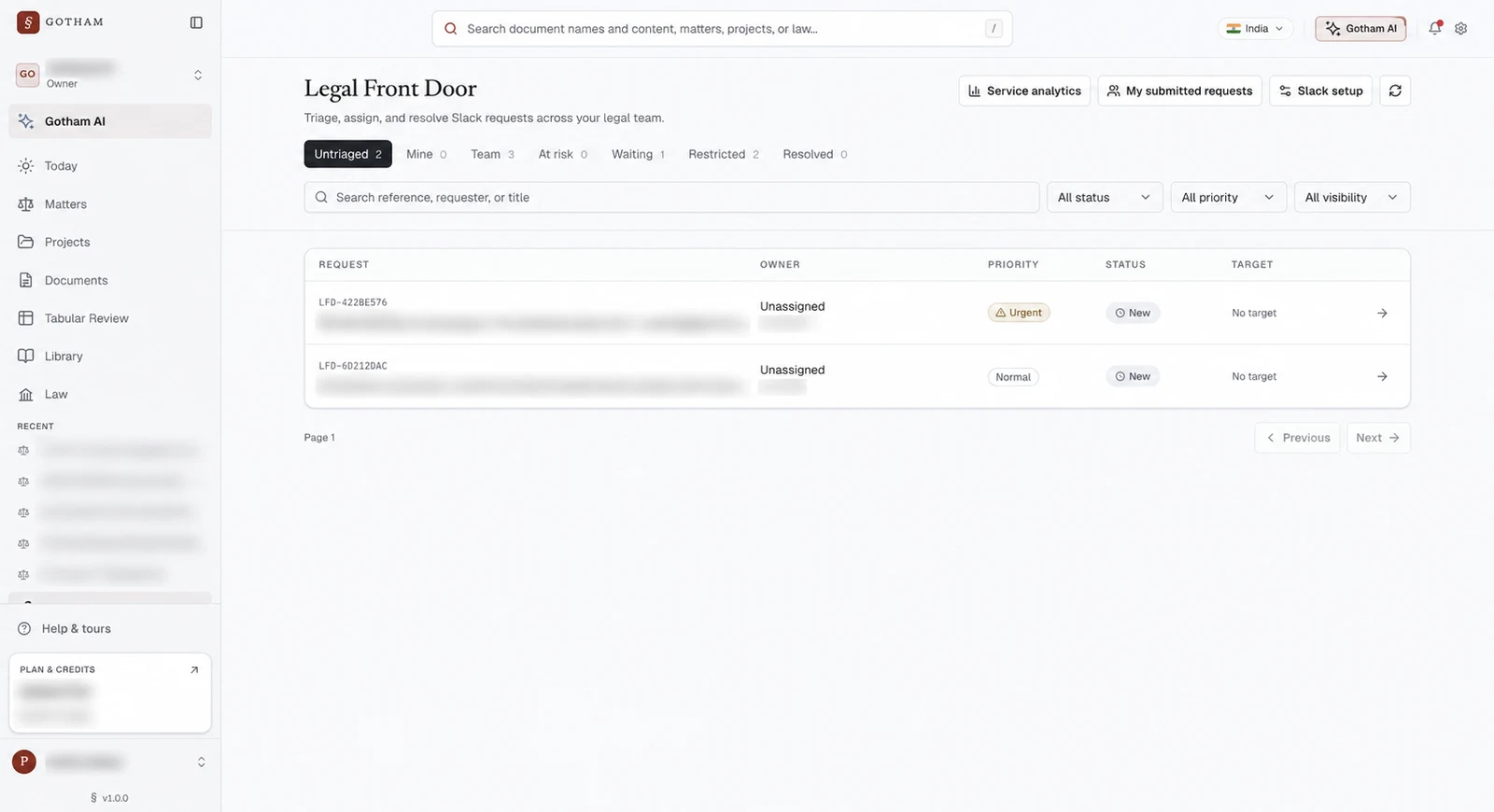
Gotham Legal Front Door. Names and matter content are blurred; the screenshot illustrates request triage.
Why choose Gotham: research through to running the matter
Gotham's value is the breadth of work your team can keep together. You can research the legal issue, analyse the documents, draft and revise work, organise the matter and run repeatable review processes in the same product. For an Indian practice, evaluate that full operating workflow alongside the quality of an individual answer.
| Work your firm needs to do | What to evaluate in Gotham |
|---|---|
| Research the law | Source-backed answers, original legal material and jurisdiction selection |
| Investigate a difficult issue | Deep Research with a plan for review and approval |
| Review many agreements | Tabular Review with document references and a review history |
| Revise an existing document | Saved versions and tracked changes tied to the source document |
| Reuse firm expertise | Library workflows, playbooks and skills with approval steps |
| Keep the file moving | Matters, chronologies, lists, dates and accountable request owners |
| Bring in source files | Google Drive and SharePoint import, subject to configured connections |
| Work across languages | Document translation tied to the original source version |
| Prepare Indian court work | Court-format drafting and CNR-based case workflows in the agreed scope |
This is a concrete reason to consider Gotham as your firm's legal operating workspace. A purchase that covers the research answer but leaves the chronology, document revisions and follow-up work scattered across separate tools may solve only part of your problem. Use our workflows overview to choose the process you want to demonstrate.
A cost-effective route into legal AI
Gotham publishes an individual entry price: Junior is advertised at ₹499 a month or ₹3,999 a year plus GST, with 300 AI credits a month. New Junior access currently uses a waitlist. Gotham Pro is separately priced for the firm; confirm the current plans and availability.
For a firm comparing Harvey and Gotham Pro, put software, content subscriptions, implementation and reviewer effort in one cost model. Gotham's integrated workflow gives you a practical consolidation opportunity: measure which separate tools and manual handoffs the proposed package can actually replace. Keep the saving tied to that demonstrated scope.
Use the legal AI ROI calculator with your own volumes, loaded staff cost and pilot results. Compare cost per approved research note or reviewed agreement, including corrections. That gives procurement a defensible value case and gives the practice lead an operational reason to choose Gotham.
Ask for a written commercial and data-handling proposal
Searches for Harvey India pricing often arrive before the buyer has defined the required package. A useful comparison needs written proposals based on the same scope. Include users, practice groups, source subscriptions, document volumes, integration work, support and the duration of the evaluation.
Separate software charges from external legal-content subscriptions. Record usage limits, renewal terms, onboarding costs and export arrangements. An attractive headline price can be difficult to compare when one package includes content that another requires separately.
Ask both vendors where matter content, backups and processing occur, which subprocessors are involved, what retention settings apply and how deletion is handled. Review the actual contract and current security materials. A marketing sentence about location or training is not a substitute for the agreed processing terms.
Use Gotham's pricing and security pages to prepare questions, then confirm the requirements for your proposed deployment. Client instructions and the nature of the file should determine what may enter the pilot.
Score the reviewed result and make a narrow decision
Record elapsed time from file preparation to a lawyer-approved output. Also record reviewer effort, missed issues, unsupported propositions, corrections and failed handoffs. Keep raw counts with the sample size; a handful of correct answers does not justify a general accuracy claim.
Use a simple outcome for each task: acceptable after ordinary review, acceptable only after substantial rework, or unsuitable for the tested workflow. Agree those categories before the demonstration. Have a lawyer who did not operate the tool review the final pack where practical.
Choose Harvey when its demonstrated sources, existing firm integrations and workflows best meet the brief. Choose Gotham when its demonstrated research, review and matter workflow fits the same brief better. A mixed rollout may also be sensible if different teams have materially different requirements.
Before expansion, retain a signed-off evaluation pack: instructions, input manifest, outputs, source ledger, corrections, access requirements, commercial assumptions and the decision owner. Then request a Gotham evaluation using that pack. The next conversation can focus on proving a defined workflow rather than repeating a generic demonstration.
Questions about Harvey AI alternatives in India
Does Harvey support Indian legal research?
Its SCC Online partnership provides a route to Indian content. Confirm the subscriptions, permissions and live sources available to your account, then verify an actual Indian research result against the underlying authority.
Can Gotham help with the same tasks as Harvey?
Gotham supports overlapping research, drafting, document review and matter workflows. Test the specific task and output you need; shared use cases do not establish identical features, content licences or integration behaviour.
What should an Indian firm test first?
Start with one source-backed research note and one document review task on an authorised matter pack. Check the original passages, missed issues and reviewer effort before evaluating a wider rollout.
For a separate comparison with another platform, read our Legora AI alternative guide for India legal teams.