
To evaluate Harvey AI alternatives for a US law firm, test a complete legal work product against the federal or state law that actually governs the matter. Require inspectable sources, reliable document references, a workable review process and acceptable client-data terms. Compare the effort needed to reach an attorney-approved result.
Harvey and Gotham address overlapping needs in legal research, document analysis and drafting. The better choice depends on your firm's content subscriptions, document systems, practice mix and supervision process. A polished answer to a general question tells you little about whether either platform can support a state-law issue in federal court or review your client's negotiated contracts.
This article is published by Gotham. It is a practical buyer's guide, with a US-focused test plan, rather than an independent ranking. Use it to evaluate us as closely as you evaluate Harvey. Our US legal teams page explains where to begin a Gotham discussion.
What Harvey offers and what an alternative must prove
Harvey's Agents support legal task execution, Vault supports document organisation and analysis, and Knowledge supports legal research. Ask which capabilities, sources and integrations are included in the proposal for your firm.
An alternative should demonstrate the tasks that make those capabilities valuable to you. For a litigation team, that may be a research memorandum tied to controlling authority and the record. For a corporate group, it may be a source-linked comparison of indemnity clauses against a playbook. For in-house counsel, it may include routing a reviewed answer to the business owner.
Start from the workflow, then compare products. If your firm already uses Harvey successfully, account for migration, training and existing integrations before proposing a replacement. If you are buying for the first time, test ordinary users rather than relying entirely on vendor-operated demonstrations.
Separate federal and state law in the research test
The US is not one undifferentiated research collection. The US Courts explanation of court structure is a useful primary starting point for the federal system. Your evaluation instructions should separately identify the deciding court, governing law, relevant dates and the proposition to be researched.
Construct two research tasks. One should involve a federal question in a named circuit. The second should involve a specified state's law, with the forum clearly stated. Have the supervising attorney prepare a reference answer and identify the sources the reviewer should expect to inspect.
Ask the tools to distinguish binding and persuasive authority, identify unresolved assumptions and explain any gap in available sources. Do not reward a long list of cases when the analysis misses the relevant jurisdiction. Our guide to finding binding precedent in US courts can help structure the review.
For every material proposition, preserve the authority, supporting passage, jurisdiction and reviewer's conclusion. Verify later treatment through a process appropriate to your practice. A tool's ability to locate a citation does not establish that the proposition remains sound or applies to your facts.
Use professional duties as procurement requirements
The ABA's summary of Formal Opinion 512 identifies competence, confidentiality, communication and reasonable fees among the duties relevant to generative AI. Treat that guidance as a starting point. Check your applicable state rules, current ethics guidance, court orders and client requirements before selecting or deploying a tool.
Translate the firm's responsibilities into concrete questions. Who may upload client files? Who reviews a generated citation? When must a client discussion occur? How is time spent checked and recorded? Procurement should leave those questions with named owners rather than assuming the technology supplier resolves them.
Keep client material out of a pilot until the required permissions and processing terms are settled. Use a synthetic or authorised closed-matter pack where appropriate. Ask about retention, model use, subprocessors, access controls and deletion, and record the contractual answers separately from the vendor demonstration.
The evaluation should also include a failure exercise. Give the operator an incomplete record and ask how they handle an unsupported factual assertion. The desired result is a visible unresolved question and a review path. Confident prose that conceals the missing evidence is a poor outcome regardless of how quickly it appears.
Compare a US litigation or contract review workflow
For litigation, use a small authorised pack containing a pleading, correspondence and a few exhibits. Ask for a chronology, an issue list and a short research memo. Require the model to distinguish allegations from established record facts and to cite the source document for each dated event.
For a transactional team, use an executed agreement, an amendment and a proposed revision. Supply your approved positions in writing. Ask for a clause comparison, deviations from the playbook and proposed drafting for attorney review. The system should identify which version supplies the operative term.
Use this scorecard for either task:
| Test | What the reviewer checks |
|---|---|
| Source fidelity | Each factual or contractual statement has an inspectable document reference |
| Completeness | Material issues in the reference answer are found, with misses recorded |
| Legal reasoning | Governing law and authority are applied to the stated facts |
| Uncertainty | Missing pages, facts and permissions remain visible |
| Revision | A changed source produces an understandable update |
| Handoff | Another attorney can verify and use the final output |
Keep file order, instructions and reviewer expectations consistent. Log operator interventions, including follow-up prompts and manual corrections. Those interventions are part of the work needed to produce a useful result, even when the final answer looks clean.
How Gotham supports the same core work
Gotham combines research, drafting, document review and matter context in a workspace for legal teams. For a US research evaluation, start with Gotham's US legal research offering. Ask for a narrowly framed memorandum with cited sources and check the references using the same rubric applied to Harvey.
For commercial work, test US contract review against your own written playbook. Ask the reviewer to inspect the original clause, suggested change and rationale together. This reveals whether the output can support negotiation decisions rather than merely flagging that a clause exists.
Gotham also provides document review and drafting workflows that can carry the analysis into a working matter. Evaluate the exact file types, review handoffs and permissions you need. Do not assume an India-specific filing or case-tracking capability supplies a US court integration. Any required US connector or filing workflow needs its own demonstration and written scope.
Shared use cases do not establish identical source licences, export formats or integration coverage. If your team needs a particular document management system, test permission boundaries, version handling and export with that system. Make successful operation a condition of acceptance rather than a future assumption.
An intake handoff is another useful acceptance check. Gotham's Legal Front Door presents requests with owner, priority and status fields. Evaluate how your team would assign and review a request after the research or document task is complete.
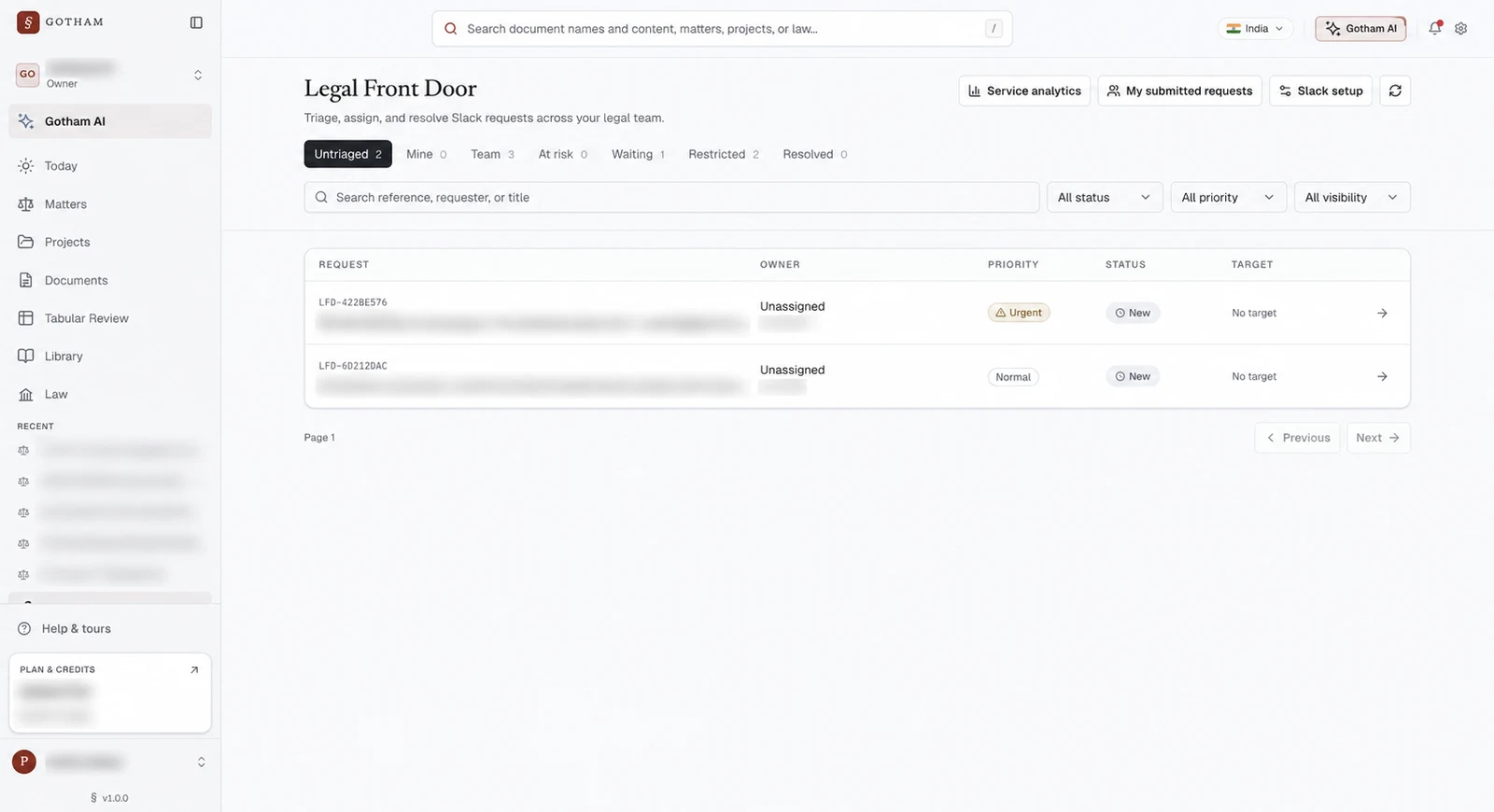
Illustrative Gotham workspace captured with India selected. Names and matter details are blurred. This view demonstrates request triage, rather than US research coverage or a US court integration.
Why choose Gotham for the whole US matter workflow?
Gotham connects the research task to the documents, revisions and matter work that follow it. That makes it worth evaluating as a legal operating workspace for a US practice, particularly when the buying brief spans both substantive legal work and the handoff to the next lawyer or business owner.
| Practice requirement | Gotham capability to demonstrate |
|---|---|
| Federal or state research | Jurisdiction-scoped research with inspectable source passages |
| A deeper investigation | Deep Research with an approval stage for the research plan |
| Agreement analysis | Tabular Review across the selected document set |
| Draft revision | Tracked edits and saved document versions |
| Firm methodology | Reusable workflows, skills and contract playbooks |
| A coherent matter file | Documents, chronologies, dates, lists and assigned requests |
| Existing source repositories | Configured Google Drive and SharePoint import |
| Cross-border document work | Translation bound to a specific source version |
For example, a contract team can review an agreement pack, inspect the underlying clauses, revise the draft and retain the work with its matter context. A litigation team can organise the record and develop a source-backed memo for attorney review. Test those connected steps through Gotham's workflows, using the jurisdiction and permissions required by your practice.
The value case is strongest when the same package supports several accepted workflows. Record which tools, duplicate uploads and manual transfers your firm can retire after the pilot. That is a measurable reason to choose Gotham, alongside the quality of the legal output.
How to build a cost-effective Gotham deployment
Gotham Pro is priced for the firm. Gotham also advertises a separate individual Junior tier at $9 monthly or $79 annually plus tax; new access is waitlisted. Junior's Indian-law offering is a different scope from a US firm's Pro deployment. Confirm the current plans before comparing packages.
Build the Pro business case around accepted US workflows. Include the cost of the software, source subscriptions, onboarding, integrations and attorney review, then measure the tools and handoffs the proposed package replaces. A lower cost per approved memo or reviewed agreement is more useful than a headline estimate based only on generation speed.
Use your own matter volumes in the legal AI ROI calculator. Keep attorney time, reviewer time and implementation costs visible. This lets your firm demonstrate Gotham's value on its own practice rather than rely on an unsupported percentage-saving claim.
Compare total cost and operational fit
Request written proposals for the same users, practice groups, content entitlements, usage assumptions and support level. Review Gotham's pricing as a starting point, then confirm the package you would actually buy. Ask Harvey for an equivalent scoped proposal.
Include onboarding, external subscriptions, integration work and ongoing review time. Record how each platform handles usage limits, overages, seat changes, renewal and data export. A price comparison without these assumptions can obscure the operational cost of making the tool usable.
Use a small weekly sample to measure time to an approved result. Separate preparation, generation, legal review and correction time. Compare the work to a conventional baseline on a similarly difficult task. Avoid converting a successful demonstration into a firmwide productivity percentage.
Client billing requires separate judgment under the rules applicable to the matter. An internal time-saving estimate is not an automatic basis for a client charge. Keep the billing policy with the responsible partner or firm function and train users on the approved approach.
Run a staged pilot and keep the decision record
First settle the brief and permitted data. Next run a supervised evaluation with a reference answer and a fixed rubric. Then allow a limited set of trained users to test the accepted workflows. Expand only after reviewing the errors, operational friction and access requirements found during ordinary use.
Use the legal AI evaluation scorecard to record results. A useful decision packet includes the test files, instructions, outputs, source checks, corrections, cost assumptions and named approver. Mark capabilities that were discussed but never demonstrated as unverified.
Harvey may fit a firm whose existing deployment, integrations and content package already work well. Gotham may fit a team that wants its demonstrated research, document review and matter workflows in the proposed package. Select by the evidence from your use cases and the terms you can accept.
To test Gotham, bring a defined US workflow to our team. Specify the state or federal jurisdiction, practice group, source requirements and expected deliverable. That makes the evaluation concrete enough to reveal both strengths and limitations.
Questions about Harvey alternatives for US law firms
Is there one best Harvey alternative for every US firm?
No. A litigation boutique, a multi-office corporate practice and an in-house department may need different sources, integrations and approval processes. Compare results on the actual practice workflow.
Does an AI answer replace citation checking?
No. The reviewer still needs to verify the supporting passage, applicable jurisdiction and current treatment. Inspectable citations make that work possible; they do not complete the review by themselves.
Can we compare Gotham and Harvey without uploading client files?
A synthetic or appropriately authorised evaluation pack can test core capabilities. Once the data-handling requirements are satisfied, a controlled pilot can examine the operational conditions that a generic demonstration cannot establish.
For a separate comparison with another platform, read our Legora AI alternative guide for US legal teams.