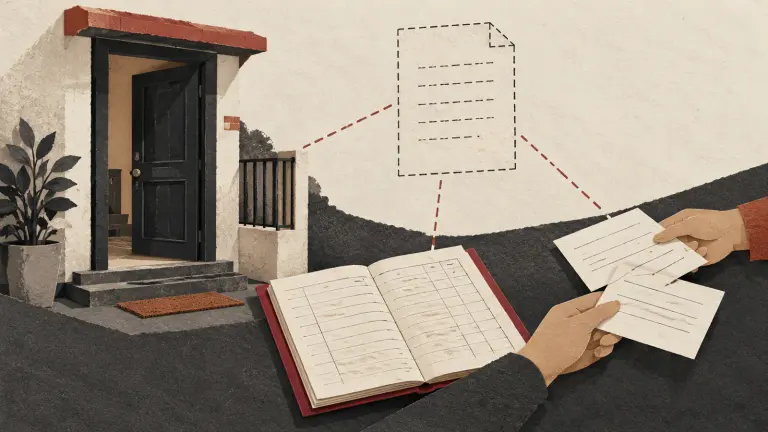
Short answer: A tenant may still establish an oral tenancy and seek a security deposit without a signed agreement. The tenant needs evidence of the arrangement, amount paid, occupation, handover, agreed deductions and the landlord’s failure to refund. The route depends on state rent law, tenancy duration and type, property, and evidence. First organize the record, then make a written demand and seek local legal advice before choosing a forum.
There is no single India-wide deposit rule for every residential tenancy. This guide organizes facts without assuming the deposit is automatically refundable in full.
Does an oral tenancy count?
The lack of a signed document does not itself prove that no landlord-tenant relationship existed. Transfer of Property Act, 1882 (TPA) section 105 defines a lease. Section 107 says a lease from year to year, for a term exceeding one year, or reserving yearly rent can be made only by a registered instrument. Other leases may be made by registered instrument or oral agreement accompanied by delivery of possession, subject to the section and local law.
State rent legislation may add requirements, create specialized forums, regulate deposits, or apply only to certain premises or parties. Registration and stamp rules also depend on the document and state. Avoid both shortcuts: “no writing means no tenancy” and “all oral tenancies have identical enforceable terms.”
TPA section 106 gives default notice rules absent a contract, local law or usage to the contrary. It treats certain leases as month-to-month or year-to-year with specified notice. It is not a universal notice period for every rental dispute. Check whether local law or the parties’ arrangement changes the position.
Read the official Transfer of Property Act, especially sections 105–107, then identify the state tenancy statute. A national guide cannot replace a local law that governs the premises.
The central Registration Act, 1908, section 17(1)(d), separately lists leases from year to year, for a term exceeding one year, or reserving yearly rent among instruments requiring registration, subject to statutory text and amendments. State amendments can matter, so read both central and applicable local provisions. The official Limitation Act, 1963 is relevant to limitation questions discussed below.
What evidence can prove tenancy and deposit?
Create one chronology from the first conversation to key handover. Combine independent evidence rather than relying on memory alone.
| Issue | Possible records | Questions |
|---|---|---|
| Occupancy | Messages, society entry, utilities, delivery records | Who occupied and when? |
| Rent and terms | Transfers, UPI records, receipts, messages | What rent, duration, notice and deductions were discussed? |
| Deposit payment | Bank record, reference, receipt, acknowledgment | Was it security, advance rent or another payment? |
| Condition and handover | Dated photos, inspection notes, key receipt | When was possession returned, and in what condition? |
| Deductions | Bills, estimates, inventory, messages | Is each deduction supported and tied to a term or damage? |
| Demand and response | Letter, email, tracking, reply | What was requested and how did the landlord respond? |
Download bank records directly and keep unedited copies. Preserve original messages and photos with dates and surrounding context. A saved contact label is not independent proof of identity. If a relative made the payment, explain why and connect it to the tenancy.
Keep rent and utility records too. The landlord may say a payment was rent or an advance rather than a deposit. Reconcile each amount: deposit received, refunds, rent or bills claimed, supported deductions and net request. A clear ledger prevents parties from arguing over different totals.
What should a tenant request in writing?
Send a calm, specific request identifying the premises, rental period, deposit amount, payment date and method, move-out and handover date, and refund sought. Ask for payment by a reasonable date or an itemized deduction statement with supporting records. Provide bank details securely if necessary.
Use a method that leaves evidence, such as registered post or courier, email and a messaging channel already used. Retain the final letter, enclosures, dispatch receipt, tracking and response. Sending a demand does not guarantee service under every legal rule, and a notice does not automatically extend limitation.
A formal notice can help after informal requests fail, where the amount is substantial, or where law or contract requires a step. It is not universally required for every deposit claim. State verifiable facts and a specific remedy; avoid unsupported threats of criminal proceedings. Gotham’s legal notice management guide explains how a legal team can preserve evidence and delivery.
Which deductions can be disputed?
Terms and local law control. Common disputes concern rent, utilities, missing items, cleaning, damage or a stated penalty. Ask for the clause or legal basis, invoices or photos, and a distinction between damage and ordinary use. A tenant should not assume every deduction is valid, but should not assume a full refund is due despite documented liabilities.
Compare move-in and move-out condition, item age, inspection notes and prior defect messages. If the landlord claims unpaid rent, compare the complete payment history. Make a net calculation rather than a general demand for “everything.”
Worked example: a deposit paid through UPI
Asha rents a flat for eleven months by oral agreement, pays ₹25,000 monthly by transfer and pays a ₹50,000 deposit through UPI. She messages the landlord confirming it; the landlord replies, “Received; I will return it after inspection.” She moves out, returns keys and keeps dated room photos. The landlord later says ₹18,000 will be retained for repainting but sends no bill.
Asha should preserve the transfer and conversation, organize rent records, record key handover and request an itemized basis and invoices. She can state why she disputes the deduction and request the balance by a date. If the landlord provides a contractual term or evidence of damage, she should assess it. The example does not decide whether repainting is chargeable; local law, terms and condition evidence matter.
Where can a tenant take the dispute?
Depending on state, premises, parties and claim, the forum may be a rent authority or tribunal, civil court, small-causes court or another forum. There may be thresholds, preconditions, limitation rules and distinct procedures. Do not assume a consumer forum has jurisdiction over every landlord-tenant dispute.
Ask local counsel to confirm the state and city law; whether premises or parties are covered or exempt; claim value and forum thresholds; whether notice, mediation or an authority application is required; limitation and its starting date; outstanding rent or counterclaims; and whether TPA section 107 registration rules apply.
Do not let correspondence continue indefinitely. A demand notice alone generally does not restart limitation. Limitation Act section 18 concerns a qualifying written acknowledgment signed before the current period expires; section 19 addresses qualifying part-payment. Ask counsel before relying on a message or payment.
See the official Limitation Act text for the statutory wording. Section 18 and section 19 have distinct requirements; this article does not determine which limitation article applies to a particular deposit claim.
What if there is no receipt?
A receipt is helpful but may not be the only evidence. Look for bank statements, UPI records, messages, emails, brokerage or move-in records, landlord account entries and later acknowledgments. Ask the landlord in writing to reconcile the amount. Never fabricate or backdate a receipt.
For cash, identify witnesses and contemporaneous notes. A later admission can matter, but a neutral reconciliation request is preferable to a message that puts words in the other person’s mouth. Preserve the reply exactly as received.
How can the tenant keep the claim credible?
Be accurate about dates, amounts, terms and condition. Separate firsthand knowledge from what others said. Include unfavorable facts such as late rent or an agreed cleaning fee, then explain why a deduction lacks support. A transparent calculation is easier to assess than a sweeping accusation.
Use the source discipline in Gotham’s litigation readiness guide, legal deadline workflow, and India legal research workflow. The legal research overview describes workflow context. Contact Gotham or visit the home page to discuss process needs.
Frequently asked questions
Can I recover a deposit without a written rent agreement?
Possibly. Evidence must support the tenancy, payment, terms and amount due. State law and forum matter. Bank records, messages, occupancy, receipts and handover records can help establish the facts.
Is an oral tenancy invalid if the landlord never signs?
Not necessarily. TPA section 107 permits some leases by oral agreement accompanied by delivery of possession. Longer or year-to-year leases and those reserving yearly rent generally require registration. State law may add requirements.
Can the landlord deduct repainting or repair costs?
It depends on the agreement, local law, condition and proof. Request an itemized calculation, invoices and before-and-after records. Ordinary wear can be treated differently from damage, but the outcome depends on facts.
Must I send a legal notice first?
A written request is useful. A formal notice may be required in a particular case, but is not a universal prerequisite. Ask local counsel about forum, statute and limitation.
Does a notice stop limitation?
Do not assume so. A demand generally does not restart or suspend limitation. The Limitation Act has separate rules for qualifying acknowledgments and part-payments, with conditions.
What if the landlord denies receiving the deposit?
Preserve payment records and messages; make a chronology and request reconciliation in writing. Do not alter records or rely only on a saved contact name.
Next step
Collect evidence of the arrangement, payment, condition and handover, then make a factual request with an itemized calculation. Ask a lawyer in the property’s state to verify forum, local requirements and limitation before escalating.
This article provides general legal information, not legal advice. Tenancy, deposit and court procedures vary by state and agreement. Obtain local legal advice before issuing a demand or filing a claim.
How Gotham researches and reviews field guides