Before sending a money-recovery legal notice in India, assemble the evidence that shows who owes what, why it is due, when payment was expected, and what has already been paid or disputed. A notice can set out a demand and invite resolution, but it is not a court order and does not guarantee recovery. The cost of sending one varies with the lawyer, complexity, amount, documents, service method and any later proceedings. There is no reliable nationwide fixed fee or one universal recovery timeline.
First confirm the debt and the right claimant
Start with identity and authority. Confirm the creditor's legal name, the debtor's correct name and address, the contracting entity, the person authorised to issue the demand, and any assignment, merger or agency arrangement. A demand sent by the wrong group company or an individual without authority can create avoidable objections.
Then prepare a ledger. List each invoice, due date, payment, credit note, withholding, tax amount, interest claim and disputed line. Reconcile the ledger with bank statements and the customer's account. Separate principal from interest and costs. If a part of the amount is genuinely disputed, do not describe the entire balance as undisputed.
The legal basis may come from a contract, purchase order, accepted quote, loan agreement, goods delivered, services rendered, settlement, or other obligation. The Indian Contract Act, 1872 includes section 73 on compensation for loss caused by breach and section 74 on reasonable compensation when the contract stipulates an amount or penalty. A demand can include interest only if a contract, statute or other legal basis supports it. Read the official Contract Act and obtain advice before adding a penalty or compounding calculation.
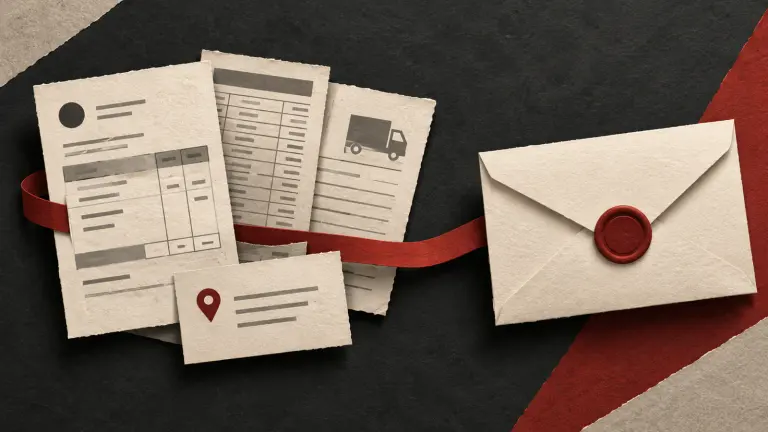
Documents to collect before drafting
| Document | What it helps establish | Check before relying on it |
|---|---|---|
| Signed contract or accepted terms | Parties, scope, price, due date, interest and dispute process | Correct version, signatures and amendments |
| Purchase orders and change requests | Work requested and approved scope | Who issued them and whether authority is clear |
| Invoices and tax records | Amount claimed and billing period | Correct entity, tax treatment and calculation |
| Delivery or completion evidence | Performance, shipment, milestones or acceptance | Dates, recipient and any defects or conditions |
| Emails and messages | Variations, approvals, extensions and acknowledgments | Preserve full threads and metadata |
| Bank records and receipts | Payments, part payments or refunds | Match transfer to invoice and payer |
| Ledger or account statement | Running balance and credits | Reconcile with the other party where possible |
| Prior reminders and replies | Demand history, dispute and settlement discussions | Avoid mixing privileged or without-prejudice material |
| Assignment or authority document | Right to collect for another party | Scope, effective date and notice to debtor |
| Delivery proof for the notice | Whether and when demand was served | Use a reliable address and trackable channel |
Do not send more personal or confidential information than necessary. Keep originals in a controlled file, preserve the exact version sent, and label disputed evidence neutrally. If the account includes personal data or trade secrets, ask counsel how to share it safely.
What should the demand notice say?
A clear notice identifies the parties, relationship, relevant contract or transaction, work or money advanced, amount claimed and calculation, payment due date, prior attempts to resolve, and a reasonable next step. It should identify whether interest or costs are claimed and the basis for each. Avoid overstating criminal liability for a commercial payment dispute; a civil debt is not automatically a crime.
A practical notice generally includes:
- the creditor's full legal name and service address;
- the debtor's full name and last known service address;
- the contract, invoice or transaction date and reference;
- a concise chronology of performance, delivery, due date and reminders;
- a table of principal, credits, interest and total as of a stated date;
- copies or descriptions of key supporting documents;
- a request for payment or a reasoned response by a stated date;
- payment instructions verified through a separate channel; and
- a reservation of rights drafted by counsel where appropriate.
The notice should not threaten actions that are unavailable, promise a guaranteed recovery, or expose confidential documents publicly. Have a lawyer check whether the contract requires arbitration, mediation, a specific notice method, place of service or cure period.
What happens after sending it?
The recipient may pay, dispute the amount, request documents, propose instalments, negotiate a settlement, ignore the letter or initiate its own claim. Keep the response and update your ledger. If payment arrives, issue a receipt and allocate it according to the agreement and law. If a settlement is reached, record the amount, schedule, consequences of default, release scope and whether the agreement resolves all claims.
If the recipient does not pay, the next route depends on the claim. It may be a civil suit, a commercial suit, arbitration, a statutory recovery process or another remedy. A notice alone does not compel payment. The court will examine jurisdiction, limitation, evidence, contract terms, amount and available remedy.
For specified-value commercial disputes, section 12A of the Commercial Courts Act provides for pre-institution mediation where the suit does not contemplate urgent interim relief. Government/public-officer suits may require section 80 CPC notice in particular circumstances. Neither is a blanket procedure for every private invoice. Review the official Commercial Courts Act and Code of Civil Procedure with counsel.
Limitation: act before the deadline, not after a notice cycle
The applicable limitation period depends on the type of debt, contract, due date, demand terms, acknowledgment, part-payment and any special statute. Do not assume that repeatedly sending notices preserves the claim. Under sections 18 and 19 of the Limitation Act, a signed written acknowledgment before expiry or a qualifying payment on account can affect calculation, subject to statutory conditions. A creditor's unilateral notice generally does not restart the clock.
Create a limitation worksheet showing the event that made the amount due, each payment or acknowledgment, the proposed filing date and the authority reviewed. An acknowledgment of a debt may have consequences, so do not ask a debtor to sign a casual balance confirmation without advice. Read the official Limitation Act.
What does a money-recovery notice cost?
There is no single nationwide price for drafting and sending a legal notice. Fees are set by the individual advocate or firm and may depend on:
- the claim amount and number of invoices;
- whether the contract and ledger reconcile;
- whether multiple entities or guarantors are involved;
- whether the lawyer must review a large document set;
- complexity of interest, tax, delivery or quality disputes;
- whether negotiation or settlement drafting is included;
- travel, translation, notarisation, courier or service expenses; and
- whether later litigation, mediation or arbitration is separately charged.
Ask for a written fee scope: review, drafting, revisions, dispatch, follow-up and any hearing or suit work. Clarify whether taxes, postage and additional counsel conferences are included. A low notice fee may not cover a later suit; a high fee does not guarantee payment. Court fees and litigation expense can vary by state, forum, claim type and valuation. Do not rely on online “fixed price” claims as a national tariff.
Worked example: unpaid service invoice
Anand's consultancy completed a three-month project for a business customer. The signed statement of work sets a ₹4 lakh fee, payable in two milestones. The first ₹2 lakh was paid. Anand invoiced the second milestone after delivery, but the customer says a feature is incomplete and refuses the full amount. Anand also wants to add 18% interest and legal charges.
Before sending a notice, Anand should collect the signed scope, accepted change requests, delivery links, client review messages, invoice, payment record and any defect list. He should identify whether the milestone was due on delivery or acceptance, whether the customer raised the issue within a contractual period, and whether Anand offered a cure. His ledger should show ₹4 lakh total, ₹2 lakh paid and the remaining principal, without treating disputed interest as principal.
The contract should be checked for an interest clause, cure process, arbitration, mediation or forum provision. Anand should not add 18% simply because it is common in an invoice template unless the contract, statute or other legal basis supports it. If the dispute is commercial and within the specified-value regime, counsel should assess section 12A pre-institution mediation unless urgent interim relief is contemplated. A notice may help focus negotiations, but it does not make the customer liable by itself.
Common pitfalls
- Sending a demand before reconciling credits and payments.
- Addressing a group company that did not contract or receive the service.
- Claiming interest or lawyer's fees without identifying a basis.
- Treating a disputed quality issue as proof of bad faith.
- Threatening criminal proceedings to collect an ordinary debt.
- Assuming a notice extends limitation or is equivalent to filing suit.
- Publishing the dispute or customer data on social media.
- Quoting a nationwide legal-notice fee that does not exist.
FAQs
Does a legal notice guarantee that I will recover the money?
No. It communicates a demand and may help resolve or document the dispute. If payment is not made, you may need to pursue a legal remedy and prove the claim.
How many days should I give the debtor?
There is no universal period for every private money demand. Check the contract, applicable statute and forum requirements. A reasonable response date should allow the recipient to review the documents, but it cannot replace a mandatory statutory period.
Can I claim interest and legal costs?
Only where there is a legal basis, such as contract or statute, and subject to the court's assessment. Separate principal, contractual interest, claimed costs and amounts not yet determined. Do not assume every advocate fee is automatically recoverable from the debtor.
What if the debtor partly disputes the invoice?
Reconcile the undisputed and disputed items. Provide evidence of scope and delivery, invite specific particulars and consider whether a cure or credit is appropriate. A notice should not obscure a genuine issue.
Does sending multiple reminders keep the claim within limitation?
Generally, do not assume so. Sections 18 and 19 of the Limitation Act identify particular events that can affect limitation. A unilateral reminder is not usually the debtor's signed acknowledgment.
Do I need mediation before filing a recovery suit?
It depends on the dispute. Section 12A of the Commercial Courts Act applies to specified-value commercial disputes that do not contemplate urgent interim relief. Other claims may follow different procedures. Ask counsel to classify the claim and forum.
How much will a lawyer charge for a notice?
Fees vary by lawyer, location, complexity, document volume, claim amount and included work. Request a written scope and confirm whether service, revisions, negotiation and later litigation are extra. There is no single India-wide fee schedule for ordinary private notices.
Before sending the demand
- Confirm creditor, debtor, contract and authority to collect.
- Reconcile invoices, deliveries, credits, payments and taxes.
- Separate principal, interest, expenses and disputed amounts.
- Review notice, cure, arbitration, mediation and forum clauses.
- Calculate limitation from the actual cause of action.
- Ask counsel to confirm the route and any special pre-suit step.
- Obtain a written fee scope and preserve proof of service.
For related workflow guidance, see urgent legal notice email workflow, legal notice management workflow, and the India legal due diligence checklist. Explore contract review workflows, India legal research workflows, or contact Gotham. This is general information, not legal advice. An Indian lawyer should assess the contract, limitation, jurisdiction and evidence before a claim is sent or filed.
If a claim may proceed as a commercial suit, check Section12A pre-institution mediation with counsel before treating a demand notice as the only pre-filing step.
This article provides general legal information, not legal advice. Recovery rights, notice requirements, fees and procedure depend on the agreement, claim, forum and jurisdiction. Obtain advice from qualified counsel.
How Gotham researches and reviews field guides