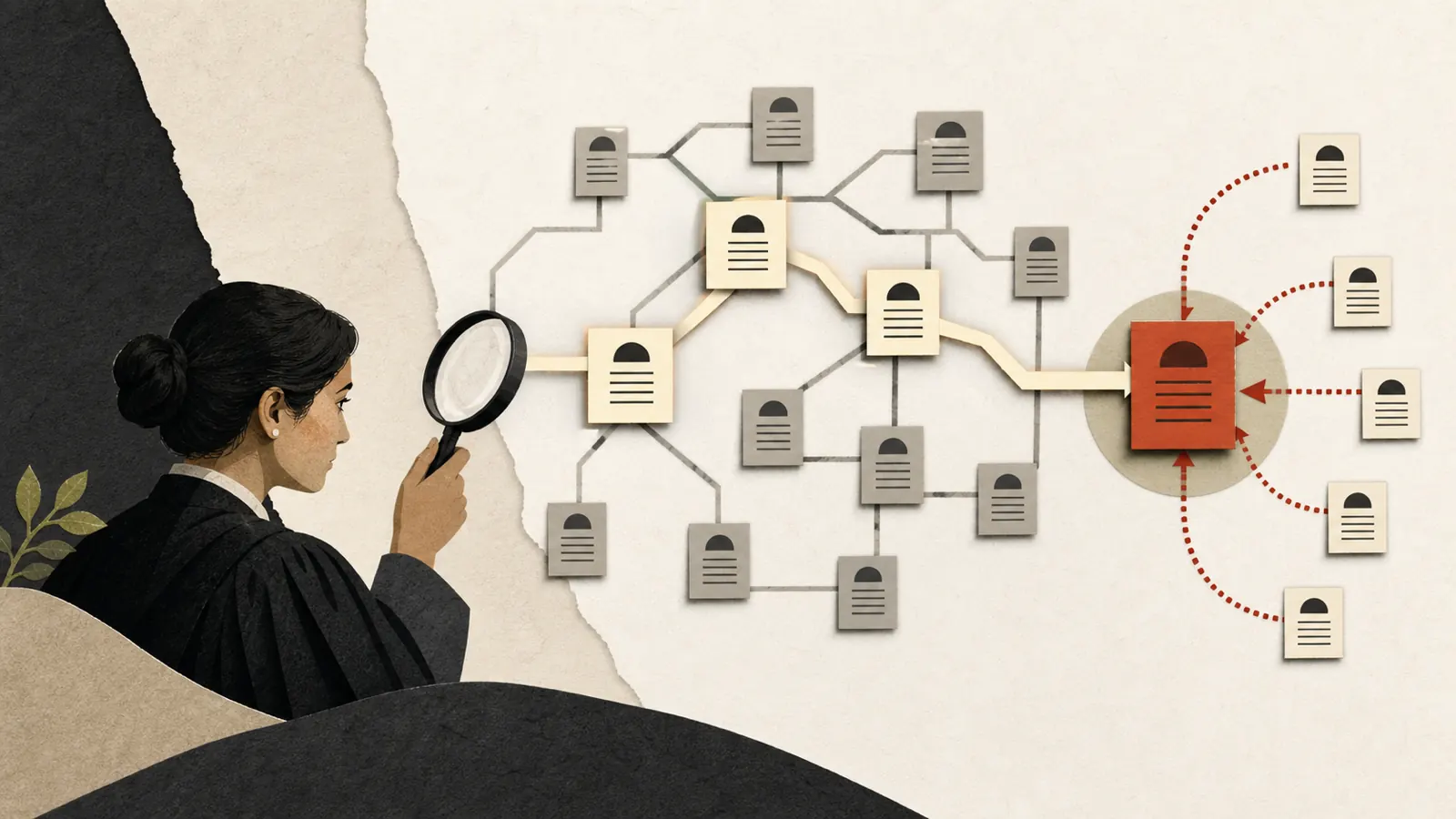
A reliable legal research workflow in India does more than locate a judgment that appears to support a proposition. It defines the question, identifies the governing legal materials, tests the status and relevance of each authority, and leaves a record that another lawyer can review. The finished product should show how the researcher moved from facts to law, including where the answer remains uncertain.
The process below is designed for litigation, advisory, transactional, and in-house research. It can be adapted to a short internal query or a substantial opinion. The discipline is the same in either case: use search tools for discovery, but treat the official text and a lawyer's analysis as the basis for the conclusion.
How should you frame the legal issue before searching?
Begin with a short factual chronology and a neutral question. A question that assumes the desired result tends to produce narrow searches and missed adverse authority. Separate established facts from client instructions, disputed assertions, and points that still need evidence.
Then break the main question into researchable sub-issues. A dispute about a contractual remedy, for example, may raise questions about the governing statute, the construction of the clause, limitation, jurisdiction, procedural relief, and later treatment of the authorities relied upon. Each sub-issue may require a different search vocabulary and source set.
Record these boundaries in a research brief:
- the forum and territorial jurisdiction;
- the relevant dates and the research cut-off date;
- the procedural stage and relief sought;
- the material facts that could change the answer;
- the proposition to be proved or disproved; and
- express exclusions, assumptions, and confidentiality limits.
Do not add client names, privileged communications, or personal data to a research system unless they are necessary and the system has been approved for that use. The security overview can inform a product assessment, but an organisation should apply its own confidentiality, access, retention, and professional-duty requirements.
Which Indian legal sources should you search first?
Start with primary law. India Code is an official repository for central legislation. Check the Act, relevant section, schedules, commencement provisions, amendments, and subordinate legislation. A bare section viewed in isolation may not disclose whether it was in force on the material date or whether a rule or notification changes its operation.
For Supreme Court authorities, the Supreme Court Reports search provides access to reportable judgments through the Court's official reporting system. The Supreme Court's Judges' Library also explains the Court's legal research and reference resources. High Court, tribunal, regulator, ministry, and Gazette websites should be used where they are the issuing authority for the material in question.
Commercial databases, commentaries, newsletters, and AI tools remain useful for discovery. They can reveal alternative terminology, connected cases, and later discussion. Follow every important proposition back to the best available primary text. Gotham's legal corpus may assist discovery and source review within a wider research process.
| Question | Preferred material | Verification point |
|---|---|---|
| What law applied on the relevant date? | Act, amendment, rule, notification, or Gazette text | Commencement, territorial scope, amendment history, and saving provisions |
| What did the court decide? | Full judgment or order from an official court source | Coram, date, case number, procedural posture, and operative order |
| Is the proposition binding? | Judgment plus later treatment | Court hierarchy, bench strength, ratio, distinguishing facts, and subsequent history |
| Does a regulator's position matter? | Official circular, direction, order, or FAQ | Statutory source, addressee, effective date, and later withdrawal or replacement |
| Is a secondary statement dependable? | Commentary traced to cited primary material | Whether the source supports the precise statement being made |
How do you turn an issue into effective searches?
Build a search map before opening dozens of results. For each sub-issue, list the statutory language, recognised doctrinal terms, factual phrases likely to appear in judgments, procedural vocabulary, and older expressions that courts may still use. Include common spelling variants and former section numbers where legislation has changed.
Search in rounds. The first round identifies the governing provision and leading vocabulary. The second looks for leading and recent authorities. The third searches for contrary treatment, jurisdictional limits, and factual distinctions. A final round uses the names and citations found in strong authorities to trace connected matters and later cases.
Keep a search log. Record the database or portal, query, filters, date searched, and result selected. This avoids repeating unproductive searches and helps a reviewer understand why an authority may have been missed. Teams can turn the sequence into reusable research workflows while retaining a matter-specific log.
An AI research tool can suggest synonyms or group candidate cases, but it should not silently collapse discovery and verification. The companion guide to AI legal research in India explains how to keep AI output subordinate to source checking.
How should each judgment be read and verified?
Open the complete judgment. Confirm the case title, court, case number, decision date, coram, and whether the document is a judgment, interim order, review order, or connected disposition. Check that the cited paragraph belongs to the court's reasoning rather than counsel's submission, a summary of facts, or a quotation from another case.
Read around the passage. State the proposition in language no broader than the authority permits. Note the material facts and procedural posture because a proposition expressed during an interim application may not answer the same question after trial. If there are separate opinions, identify which reasoning commands the relevant majority.
Authority also depends on institutional context. Compare court hierarchy and bench strength. Search for review, recall, stay, appeal, overruling, distinction, or later statutory change. Do not treat a case as good law merely because it remains searchable or is repeatedly quoted in secondary sources.
Use a proposition table rather than a stack of downloaded PDFs:
| Proposition | Authority and pinpoint | Status check | Application or limit | Reviewer |
|---|---|---|---|---|
| Exact legal statement required | Case name, citation, paragraph, and source link | Later treatment and statutory currency checked | Material facts supporting or limiting use | Name, date, and decision |
This table forces a useful distinction between finding an authority and proving that it supports the sentence you intend to write.
How do you verify legislation, rules, and notifications?
First identify the enabling Act and the precise provision. Then establish the text in force on the relevant date. Read definitions, provisos, explanations, schedules, non-obstante clauses, repeal and savings clauses, and commencement provisions that bear on the issue.
Where delegated legislation matters, confirm that the rule, regulation, circular, or notification came from the competent authority and falls within its stated power. Record the publication date and effective date, which may differ. Search for corrigenda, amendments, superseding instruments, and court decisions on validity or interpretation.
An unofficial consolidated text can be convenient, but it may merge amendments without showing temporal changes. Preserve the official source link and a copy of the version reviewed. If official repositories conflict or a document cannot be obtained, say so in the research note and qualify the conclusion. Do not fill the gap from memory.
What should a reviewable research note contain?
Write the answer only after the authority table is stable enough to support it. Lead with the short answer and its confidence limits. Follow with the material facts and assumptions, issues, governing provisions, analysis, adverse or contrary authority, unresolved questions, and recommended next step.
A practical completion checklist is:
- Each conclusion answers a framed issue rather than a broader question.
- Every material legal proposition has a primary-source citation and pinpoint where available.
- Statutory provisions were checked for commencement and amendment on the relevant date.
- Judgment passages were read in context and separated from submissions and obiter.
- Court hierarchy, bench strength, procedural posture, and later treatment were considered.
- Contrary authorities and plausible alternative interpretations are recorded fairly.
- Facts, assumptions, unresolved points, and research cut-off date are explicit.
- Confidential material is stored and shared under approved controls.
- A qualified lawyer has reviewed work used for advice, filing, or an external communication.
The note should allow another lawyer to reproduce the search and challenge the reasoning. Gotham's practice pages show how research may sit beside other legal work, and pricing can support an operational evaluation. Neither replaces source-level testing or professional review.
When is the legal research workflow actually finished?
Research is finished when the responsible lawyer has enough verified authority to answer the defined question at the required level of confidence, not when the search results become repetitive. Stop conditions should reflect the risk of the task. A filed submission demands a different depth of review from an early internal orientation note.
Before closing the file, run a final adverse search, refresh time-sensitive sources, test every citation link, and make sure the written conclusion matches the proposition table. Mark any point that depends on an assumption or unavailable document. Archive the brief, search log, source copies, authority table, research note, and reviewer record according to the matter's retention rules.
This legal research workflow for India makes speed useful without disguising uncertainty. It gives reviewers a visible chain from issue framing to verified authority. If your team wants to design that chain around its own sources, controls, and approval points, contact Gotham to discuss the workflow.