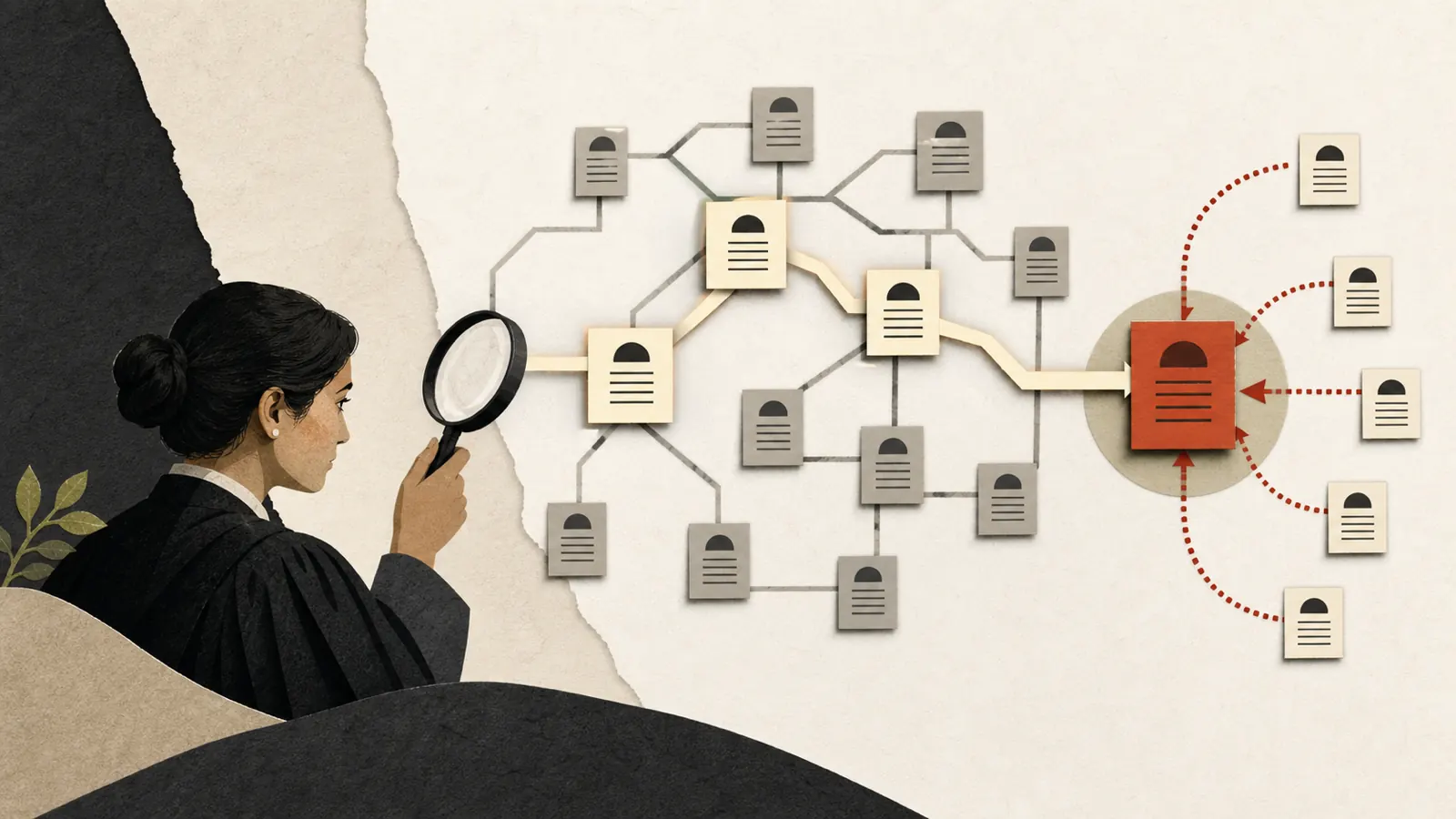
To find binding precedent in India, start with the precise legal proposition, identify the court that will decide the issue, rank authorities by court and bench strength, extract the ratio from the full judgment, and trace every promising decision forward to the research cut-off date. Finding a case that sounds right is only the beginning. The hard part is proving that its relevant proposition still governs.
This workflow is for researchers who need an auditable answer. Whether the first lead comes from a reporter, database, colleague, or AI legal research tool, the researcher remains responsible for hierarchy, context, and currency.
What does “binding precedent” mean in an Indian research task?
Article 141 provides that the law declared by the Supreme Court is binding on all courts within India. The operative phrase is “law declared.” A case citation, result, or isolated sentence is not automatically the governing rule. The researcher must identify the proposition the Court decided in the setting of the material facts and issues before it.
The Supreme Court has repeatedly cautioned that judgments must be read in context. In its 18 November 2025 judgment, the Court restated that the rule deduced from applying law to the case’s facts constitutes the ratio, and that a judgment should not be read as though it were a statute.
The practical hierarchy is more detailed than “Supreme Court beats High Court”:
| Authority | Usual precedential position | What to verify |
|---|---|---|
| Supreme Court, larger bench | Governs smaller Supreme Court benches and courts below on the decided proposition | Bench strength, ratio, later Constitution Bench or larger-bench treatment |
| Supreme Court, same-strength bench | Binding below; a coordinate bench ordinarily follows or refers disagreement | Whether apparently conflicting cases decide the same issue |
| Jurisdictional High Court | Binding on subordinate courts and tribunals within its territorial jurisdiction, subject to Supreme Court law | Full bench or division bench priority and later treatment |
| Another High Court | Persuasive, not binding merely because it is directly on point | Whether the home High Court or Supreme Court has addressed the issue |
| Tribunal or subordinate court | Generally persuasive outside applicable statutory or appellate constraints | Appellate history and any controlling superior-court authority |
Use hierarchy as a filter, not a substitute for analysis. A larger-bench decision on a neighboring question may not control your proposition.
Which court and bench should you search first?
Write down the deciding forum before entering a query. For a matter before a district court, you will usually look first for governing Supreme Court authority and the relevant High Court’s law. For a High Court question, Supreme Court authority remains controlling, while that High Court’s bench structure determines how its own cases rank.
Then capture bench strength for every serious candidate. Do not infer it from a headnote. Open the judgment and record the coram. The Supreme Court stated in its 6 December 2019 judgment that a larger-bench decision binds a smaller bench, and discussed decisions rendered without considering binding precedent or a relevant provision.
A compact authority card prevents confusion later:
| Field | Entry to record |
|---|---|
| Case | Party names and neutral or reporter citation |
| Court and date | Court, decision date, and research retrieval date |
| Coram | Names of judges and bench strength |
| Proposition | One sentence, stated narrowly |
| Pinpoint | Paragraph or page supporting that proposition |
| Material facts | Facts needed for the rule to apply |
| Treatment | Followed, explained, distinguished, doubted, referred, or overruled |
| Source | Official judgment URL plus any reporter cross-reference |
How do you search for the controlling proposition rather than a familiar case name?
Begin with a proposition sentence: “Whether X applies when Y despite Z.” Break it into the rule, statutory language, factual trigger, exception, and remedy. Search exact statutory phrases and distinctive doctrinal terms first, then widen the vocabulary.
Use more than one retrieval path:
- Search the Supreme Court’s official SCR portal and Verdict Finder for party names, citations, dates, and terms.
- Use the official eCourts Judgment Search for keywords, Acts, phrases, and court material.
- Confirm the statutory text and amendments through India Code, not a quotation reproduced in a secondary article.
- Search a reliable reporter or research database for editorial classification, cited cases, and treatment signals.
- Return to the official PDF or authenticated report before relying on the language.
Try both current and historical section numbers where legislation has changed. Search synonyms used by older judgments. If the issue turns on a proviso or explanation, search its exact words. A generic query often returns the most discussed case, not the most authoritative one.
The Gotham legal corpus can support broad discovery, while a structured research workflow helps preserve the chain from query to verified source. Neither removes the need to inspect the controlling text.
How do you identify the ratio without mistaking observations for the rule?
Read the judgment in this order: issues, material facts, parties’ competing submissions, authorities considered, the court’s reasoning, and the final disposition. Ask what proposition was necessary to move from those facts to that result.
Create a proposition table while reading:
| Passage | Role in the decision | Research action |
|---|---|---|
| Express answer to a framed issue | Possible ratio | Test against facts, reasoning, and disposition |
| Broad statement beyond the issue | Possible obiter | Do not present as the narrow holding without analysis |
| Summary of counsel’s argument | Not the court’s conclusion | Trace forward to the court’s acceptance or rejection |
| Quotation from an earlier case | Earlier authority, not necessarily adopted in full | Read the cited case and note why it was used |
| Fact-specific disposal or concession | May have limited precedential content | Avoid converting the result into a general rule |
This is where many apparently clean answers fail. A paragraph can contain the right words while addressing a different issue. In a 5 August 2025 Supreme Court judgment, the Court explained that a decision is not authority for a point that was not argued or decided. That is a useful check against treating silence as a holding.
How do you check whether a precedent has been weakened by later treatment?
Run a forward treatment search for every authority you plan to cite. Search its case name, equivalent citations, neutral citation, appeal number, and distinctive language. Do not stop at a database badge. Open the later judgment and determine which proposition it treated.
The judgment treatment research guide gives a fuller method for recording what later courts actually did with each proposition and checking the underlying text.
Classify treatment precisely:
| Later treatment | What it may mean | What you should do |
|---|---|---|
| Followed or applied | The later court used the earlier ratio | Confirm it is the same proposition and comparable facts |
| Explained | Scope was clarified | Use the clarified formulation and cite both decisions |
| Distinguished | Rule retained, but held inapplicable on different facts or law | Record the distinguishing fact or provision |
| Doubted or referred | Authority is unsettled or awaits a larger bench | Find the reference outcome and disclose uncertainty |
| Overruled | Precedential force removed for the affected proposition | Do not rely on that proposition as current law |
| Per incuriam | Decision treated as made in ignorance of binding law or provision | Verify the exact basis and which part is affected |
| Sub silentio | Point was not consciously determined | Do not claim that the case decided that point |
The Court’s 5 August 2019 judgment discusses per incuriam in the Article 141 setting, including the problem of a court acting without awareness of a binding decision. Treat that label cautiously. It is a legal conclusion grounded in hierarchy and the issue actually considered, not shorthand for disagreeing with an outcome.
Work forward until the research cut-off date. A citation chain that ends five years before your memo does not establish current law.
What research workflow reduces the chance of missing a later case?
Use a two-loop process. The discovery loop favors recall: collect plausible authorities, variant terminology, statutory hooks, and cited cases. The verification loop favors precision: rank, read, trace, and document only the authorities that can support the proposition.
Follow this sequence:
- Define the forum, issue, relevant date, and statutory version.
- Draft the proposition and list its elements, exceptions, and factual triggers.
- Find a recent high-authority “hub” judgment that surveys earlier law.
- Move backward through every authority material to the proposition.
- Compare bench strength and resolve apparent conflict by reading both judgments.
- Move forward from each key case through every available citation and treatment tool.
- Check later judgments using party names, all known citations, and characteristic phrases.
- Verify legislation on India Code and decisions against official court sources.
- Write a narrow rule with pinpoints, qualifications, contrary authority, and a research cut-off date.
- Have another researcher reproduce the chain before the work product is finalized.
For repeatable team use, Gotham practice tools can help organize legal work, and the security overview sets out considerations for handling research material. Keep confidential facts out of public search tools and follow your organization’s approved research policy.
What should the final precedent check contain?
Before calling the research complete, confirm each item:
- The deciding court and territorial jurisdiction are explicit.
- The statutory text and version are verified from an authoritative source.
- Every primary authority has a recorded coram and bench strength.
- The stated proposition is supported by a pinpoint in the full judgment.
- Material facts and exceptions are captured, not stripped away.
- Quoted text is the court’s reasoning, not counsel’s submission or a quoted headnote.
- Earlier conflicting or larger-bench authority has been investigated.
- Later treatment is checked through the stated cut-off date.
- Any pending reference, review, curative petition, or material procedural development is noted where relevant.
- Official URLs, equivalent citations, search terms, and retrieval dates are preserved.
- A second reviewer can reconstruct why each authority was included.
A defensible answer is rarely the longest one. It is the answer whose authority chain another lawyer can retrace. If your team wants a more structured path from broad discovery to proposition-level verification, contact Gotham to discuss a legal research workflow built around sources, review, and traceability.
This article is general information about research method. It does not determine which authority governs any specific dispute, and it is not a substitute for advice from a qualified legal professional who has reviewed the facts, forum, and current law.