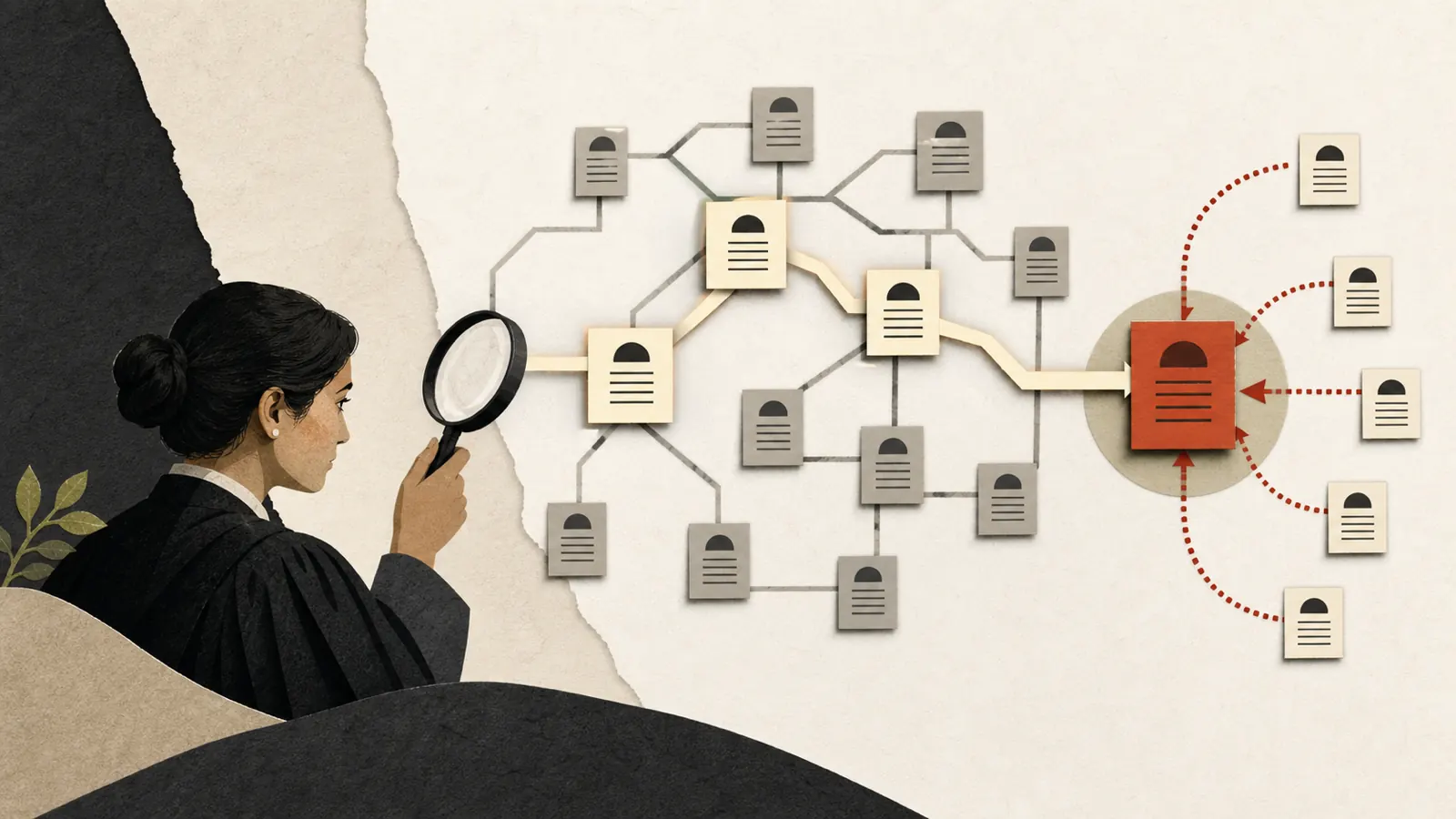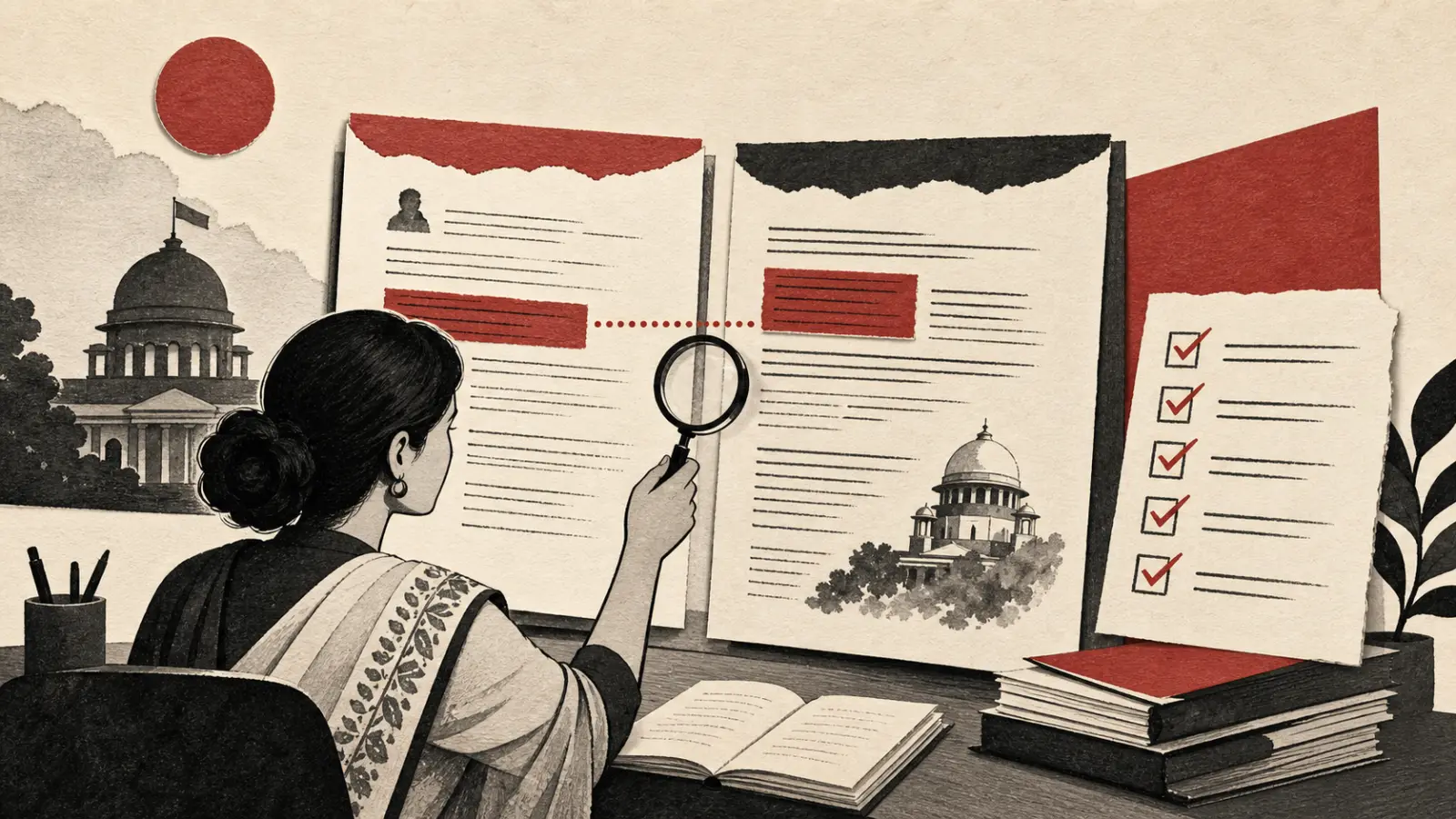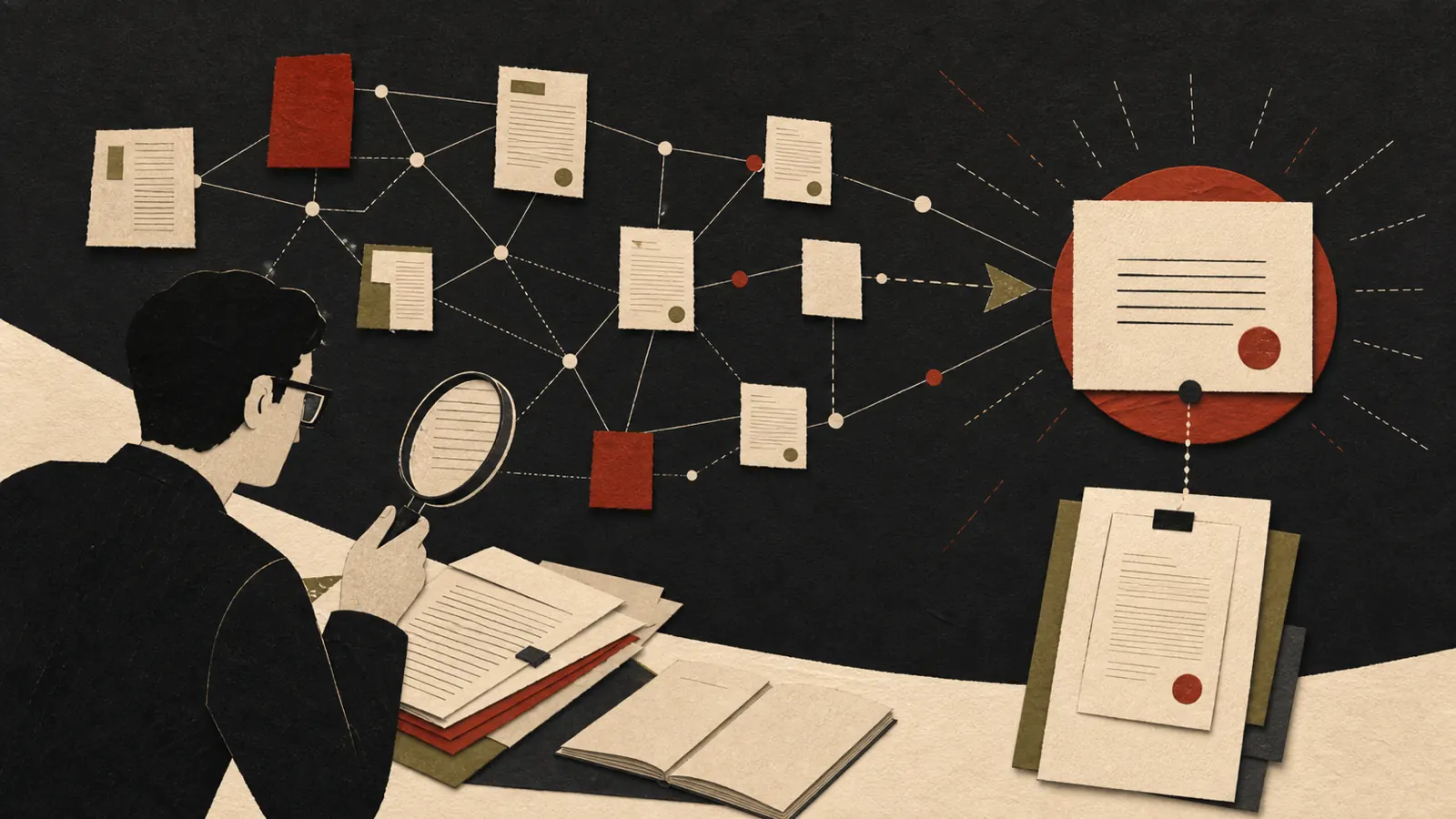
Judgment treatment research in India asks a narrower question than whether a case has been cited: what did the later court do with the earlier decision's relevant proposition? A citation may signal agreement, disagreement, factual comparison, or little more than a reference in counsel's submissions. The label becomes reliable only after someone reads both judgments and connects the same legal proposition across them.
That distinction matters when a team is preparing a pleading, opinion, or research note. A prominent decision may still be good law but inapplicable to the facts. Another may have been explained so narrowly that the original broad reading is no longer safe. The workflow below creates a trail that a second researcher can inspect. It complements the broader guide to finding binding precedent in India.
What does judicial treatment actually describe?
Treatment describes a later court's relationship to an earlier decision. It should be recorded at proposition level. A later judgment can follow one part of a case, distinguish another part, and say nothing about a third. Writing "followed" beside the case name without identifying the proposition hides that difference.
Use a practical taxonomy, but preserve the later court's own language:
| Treatment | Working meaning | Research consequence |
|---|---|---|
| Followed | The later court accepts and uses the earlier rule on a materially similar issue | Confirm the same proposition, statutory version, and relevant facts |
| Applied | The court uses the earlier rule to decide the dispute before it | Record how the rule was connected to the facts |
| Approved or affirmed | A higher court accepts the reasoning or result under review | Check the precise grounds and whether every proposition survived |
| Explained | The later court clarifies the scope or rationale of the earlier case | State the rule using the clarification and cite both judgments |
| Distinguished | The earlier rule remains intact, but a material difference makes it inapplicable | Record the exact factual, procedural, or statutory distinction |
| Doubted | The later court expresses uncertainty about correctness | Search for a reference to a larger bench and its eventual outcome |
| Referred | The issue is sent to a larger bench or another forum for resolution | Trace the reference until its present status is established |
| Overruled | A competent higher or larger bench rejects the earlier legal proposition | Identify which proposition was overruled and the controlling decision |
| Reversed or set aside | The result in the same litigation is displaced on appeal | Do not assume every statement in the earlier judgment was overruled |
| Per incuriam | The later court treats the decision as rendered without considering binding authority or a relevant provision | Verify hierarchy, bench strength, and the precise omission identified |
Database labels can help locate candidates. They are leads, not conclusions. The later judgment's reasoning controls the classification.
Why is a citation count not enough to prove treatment?
A cited-case list does not tell you where the reference appears or why it was made. The case might appear only in a party's argument. It may be quoted for an uncontroversial procedural point while the proposition you care about is untouched. A dissent may rely on it even though the majority takes another route.
Open the later decision and search every known form of the earlier citation. Read several paragraphs before and after each hit. Then identify the speaker, issue, proposition, and disposition. If the reference occurs in a summary of submissions, keep reading until the court gives its view. If it appears inside a quotation from a third case, trace that intermediate authority too.
This is also why headnotes need checking against the signed judgment. Use the official Supreme Court Reports portal for reported Supreme Court material and the Supreme Court of India's judgments resources to search by case details. The eCourts Judgment Search provides another official route for court decisions. Portal coverage and search behavior can differ, so a failed query is not proof that no treatment exists.
How should you define the proposition before searching forward?
Write the proposition in one sentence before running a treatment search. Include the legal rule, the statutory provision if relevant, and the factual trigger that matters. "Case X concerns arbitration" is too broad. "Case X holds that provision A applies when condition B exists" gives the later-treatment review something testable.
Create an authority card with these fields:
| Field | What to record |
|---|---|
| Earlier judgment | Full cause title, court, date, case number, and known citations |
| Bench | Coram and bench strength, taken from the judgment |
| Proposition | A narrow statement supported by a pinpoint paragraph or page |
| Context | Material facts, procedural posture, statutory version, and relief |
| Search forms | Party-name variants, neutral or reporter citations, case number, and distinctive phrase |
| Cut-off | Date through which later treatment was checked |
If the proposition cannot be stated without qualifiers, keep the qualifiers. They may be exactly what a later court uses to distinguish the authority. A structured legal research workflow can keep these authority cards beside the source documents and reviewer notes.
How do you run a forward-treatment search in India?
Start from the official text of the earlier judgment. Capture every citation format shown in it or in a reliable report. Search each format separately because later courts do not cite cases consistently. Party names may be shortened, spelling may vary, and corporate names may change.
Run the search in this order:
- Search the exact neutral citation, reporter citation, case number, and appeal number.
- Search both full and shortened party names, including common spelling variants.
- Search a distinctive phrase from the relevant holding in quotation marks where the portal permits it.
- Review decisions that cite the earlier case, beginning with larger benches and superior courts.
- Search for the case name beside treatment terms such as "followed," "distinguished," "doubted," "referred," and "overruled."
- Trace references, review petitions, curative proceedings, connected appeals, and subsequent orders.
- Repeat the search using the relevant statutory provision and proposition, since a later court may discuss the rule without citing the expected format.
- Recheck results through a second retrieval source and save the official PDF used for analysis.
For Supreme Court authorities, work across SCR and the Court's own case and judgment search routes. For High Court or district material, use the relevant court portal and eCourts services. A broad discovery layer such as the Gotham legal corpus can help uncover citation variants, while the official document remains the source to read and preserve.
How can you tell whether a case was distinguished rather than rejected?
Distinguishing accepts that the earlier rule exists but finds a material reason not to apply it. That reason might be a different statutory text, a missing factual condition, another procedural posture, or a remedy that was never considered in the earlier case. The later court should supply the distinction; researchers should not invent one to reconcile uncomfortable authorities.
Record the comparison in two columns: facts or law in the earlier case, then facts or law in the later case. Add the paragraph where the later court makes the distinction. Next, ask whether the difference matters to your own research problem. An authority distinguished on facts can still govern a future dispute whose facts match the earlier case.
Overruling is different. It concerns the correctness or authority of a legal proposition and must come from a court or bench capable of displacing it. Reversal also differs. An appellate court may set aside the outcome in the same litigation without rejecting every statement made below. Use the term found in the later judgment, then explain what it affected.
What should you do when later judgments seem to conflict?
Do not settle apparent conflict by date alone. Compare court hierarchy, bench strength, the exact issue decided, and the statutory text in force. Two decisions can use different language yet coexist because they address different conditions. Conversely, a later smaller bench does not silently erase a governing larger-bench decision.
Build a short conflict table with one row per proposition. Include the court, bench, pinpoint, material facts, treatment language, and disposition. Read any authorities the later case says were overlooked. If a bench refers the disagreement to a larger bench, locate the reference order and search for the final decision. Until the chain is resolved, report the uncertainty instead of choosing the most convenient result.
The Supreme Court of India website provides current access points for judgments, daily orders, and case information. Verify the relevant legislation and its effective dates through India Code, because an amendment may explain what first appears to be judicial disagreement.
What should a completed treatment record contain?
The final record should let another researcher reproduce the conclusion without guessing. Before signing off, check that:
- The earlier case is identified by full title, court, date, case number, and confirmed citations.
- The proposition is narrow, includes its qualifications, and has a pinpoint in the full judgment.
- Coram, bench strength, statutory version, and procedural posture are recorded.
- Searches covered party-name variants, citation variants, case numbers, and distinctive language.
- Every treatment label is supported by a pinpoint in the later judgment.
- Followed, applied, explained, and distinguished are not treated as interchangeable.
- Reversal of an outcome is not casually described as overruling a proposition.
- Any larger-bench reference is traced to its latest verifiable status.
- Official PDFs and retrieval dates are preserved.
- The research cut-off date appears in the note.
- A second reviewer has checked any authority central to the work product.
Update the record when the cut-off date changes. Treatment research goes stale because courts continue deciding cases and legislation changes. Teams can use Gotham practice tools to organize repeatable review steps and the security overview when assessing how confidential research material is handled.
If your team wants a clearer path from discovery to proposition-level treatment checks, contact Gotham to discuss a research workflow with source capture, review gates, and an auditable treatment log.
This article provides general legal research information. It does not determine the status or effect of any judgment in a particular dispute and is not a substitute for advice from a qualified legal professional who has reviewed the facts, forum, and current law.