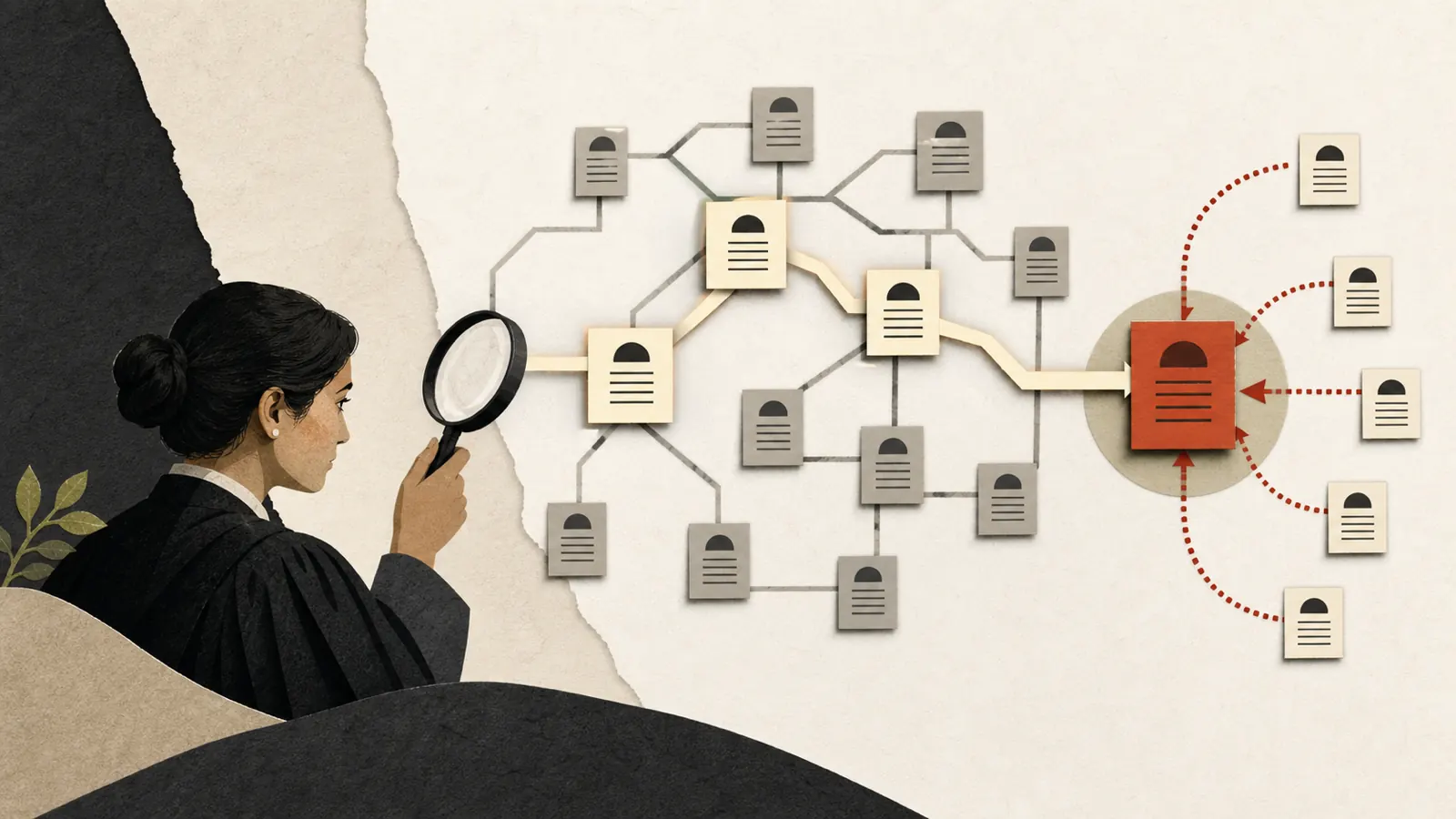
Searching by a statute and section sounds precise, but the first result is rarely the final answer. A court may quote the provision without interpreting it. An older decision may concern wording that has since changed. A useful judgment may refer to a proviso, rule, former section number, or doctrinal phrase rather than the citation a researcher typed.
A dependable method therefore moves in both directions. Start with the official legislative text, expand the search vocabulary, and then trace every promising decision back to its facts, reasoning, and later treatment. The result should be more than a list of links. It should be a reviewable account of which authority supports which proposition, and where the limits lie.
What should you confirm about the section before searching cases?
Open the Act on India Code and confirm the exact statute title, year, section number, heading, and wording. Read the entire provision, including its provisos, explanations, illustrations, and cross-references. Definitions elsewhere in the Act may control apparently ordinary words.
Next, establish the version relevant to the facts. Note commencement dates, amendments, repeal and savings provisions, and any renumbering. A dispute arising before an amendment may be governed by different language from a current dispute. Rules, regulations, schedules, and notifications can also change how the section operates in practice.
Turn this reading into a compact search sheet:
- exact Act name, common abbreviation, and any former name;
- current and former section numbers;
- distinctive phrases from the provision;
- linked definitions, provisos, rules, and schedules;
- relevant date range and territorial application; and
- the precise proposition the research needs to test.
This preparation prevents a common error: collecting cases that mention the same number under a different statute, or cases that apply a text different from the one relevant to the question.
How do you build queries for case law research by section in India?
Use a query ladder rather than one long search. Begin narrowly with the formal citation, then widen the vocabulary while preserving the legal issue.
| Search round | Example query pattern | What it is meant to find |
|---|---|---|
| Exact citation | "Section 34" "Arbitration and Conciliation Act, 1996" | Decisions expressly citing the provision |
| Provision and issue | "Section 34" limitation condonation arbitration | Decisions addressing the required proposition |
| Statutory phrase | "public policy of India" "Section 34" | Cases using the provision's own language |
| Older reference | former section or predecessor Act plus issue | Authorities decided under earlier wording |
| Adverse treatment | case name plus overruled, distinguished, review, or reconsidered | Later history and limits |
| Court-focused | provision, issue, and court name | Binding or locally persuasive authority |
Search quoted and unquoted versions, spelling variants, abbreviations, and phrases used by courts rather than only those used by the researcher. Once a strong judgment appears, harvest its vocabulary, cited cases, and statutory cross-references for the next round.
Keep the issue constant while changing one query element at a time. That makes it easier to see which term improved the results. A search log can record the portal, query, filters, search date, and useful results. Teams may encode this sequence in reusable research workflows, while preserving a matter-specific record of what was actually searched.
Which official sources should you use to locate and verify judgments?
No single portal should be treated as complete for every Indian court and period. Use multiple discovery routes, then verify important material against the best official source available.
For central legislation, begin with India Code. For Supreme Court decisions, search the official Supreme Court Reports collection. The eCourts judgments search offers another official route across participating courts. Supreme Court, High Court, tribunal, regulator, and ministry websites may provide the judgment or order issued by the relevant body.
Commercial databases, search engines, digests, and Gotham's legal corpus can help with discovery, especially where naming and citations vary. Discovery convenience does not settle authenticity, authority, or statutory currency. Preserve the official link where available and compare the text if versions differ.
When the source is a scanned document, check whether optical character recognition has misread the section number, party name, or paragraph. Search failure may reflect a poor scan rather than the absence of authority.
How can you tell whether a judgment actually interprets the section?
Open the complete judgment and identify why the section appears. It may be part of the court's reasoning, a party's submission, a quotation from an earlier case, or a passing reference in the facts. Only the first category may directly answer the research question, and even then its force depends on the issue decided.
Read enough context to answer five questions:
- What question did the court have to decide?
- Which version of the statute applied?
- What material facts and procedural posture shaped the answer?
- Which paragraph contains the court's reasoning and operative conclusion?
- Was the relevant reasoning necessary to the decision?
Write the proposition in narrower language than the judgment if necessary. A ruling about maintainability at an interim stage should not silently become a broad statement about final liability. Likewise, a court's description of an argument is not its endorsement of that argument.
Pinpoint citations matter. Record the paragraph containing the proposition, but also read the surrounding paragraphs and the operative order. If the document has no stable paragraph numbering, preserve the page reference and enough context for a reviewer to relocate the passage.
How should you assess the authority of a section-wise judgment?
A relevant case is not automatically a controlling one. Compare court hierarchy, territorial jurisdiction, bench strength, date, and the nature of the proceeding. Where separate opinions exist, determine which reasoning represents the applicable majority.
Then search forward. Look for appeals, review or recall proceedings, stays, later decisions that follow or distinguish the case, and statutory amendments that may have displaced its reasoning. A judgment can remain easy to find long after its proposition has narrowed.
Use an authority table to make these judgments visible:
| Field | What to record | Review question |
|---|---|---|
| Proposition | Exact legal statement being tested | Is it no broader than the case supports? |
| Source | Court, case, date, citation, paragraph, official link | Can another researcher retrieve it? |
| Statutory version | Wording and relevant effective date | Does it match the facts under review? |
| Authority | Hierarchy, bench strength, and procedural posture | Is it binding, persuasive, or merely informative? |
| Later treatment | Followed, distinguished, doubted, stayed, or overruled | Is the proposition still dependable? |
| Factual limit | Facts that make the holding applicable or distinguishable | What would change the analysis? |
This table also exposes conflicts. If two benches appear to state the rule differently, do not choose the more convenient quotation. Record both, investigate hierarchy and later treatment, and flag the point for qualified review.
What should your section-based research workflow look like?
A repeatable workflow keeps discovery separate from verification:
- Frame a neutral issue and note the facts that could change the answer.
- Verify the relevant statutory text, date, amendments, and connected instruments.
- Build queries from the citation, statutory phrases, doctrine, facts, and procedure.
- Search official and secondary discovery sources, logging each useful query.
- Read complete judgments and extract only propositions grounded in the court's reasoning.
- Test hierarchy, bench strength, factual fit, and later treatment.
- Run an adverse search for contrary interpretations and limiting decisions.
- Draft a short answer from the authority table, with assumptions and uncertainty stated.
- Have the work reviewed at a depth proportionate to its intended use.
This section-level process fits within the broader legal research workflow for India. If a team uses AI to propose queries or group candidate cases, retain the same verification boundary. The tool may accelerate discovery, but the researcher remains responsible for reading sources and supporting each statement.
What should you check before closing the research?
Use a completion check rather than stopping when the results begin to repeat:
- The official text and relevant historical version of the section were checked.
- Definitions, provisos, explanations, rules, and linked provisions were considered.
- Exact-citation, phrase, doctrinal, factual, and adverse queries were run.
- Important judgments were retrieved from an official source where available.
- Each quoted passage is the court's reasoning, not a submission or headnote.
- Court hierarchy, bench strength, procedural posture, and factual fit were recorded.
- Appeals, review proceedings, later treatment, and statutory change were searched.
- Contrary cases and unresolved conflicts appear in the research note.
- Pinpoints, source links, search date, and research cut-off date are reproducible.
- A qualified reviewer has checked work intended for advice, filing, or external use.
Store the search sheet, query log, source copies, authority table, and final note under the organisation's access and retention controls. The security overview can support a product evaluation, while each organisation must apply its own confidentiality and professional-duty requirements.
Section-wise research works best when it produces a transparent chain from legislative text to judicial treatment. It is slower than copying the first promising extract and much faster than repairing an unsupported conclusion later. If your team wants to organise section-based discovery and verification around its own sources and review gates, contact Gotham to discuss the workflow or explore how it fits across wider legal practice work.