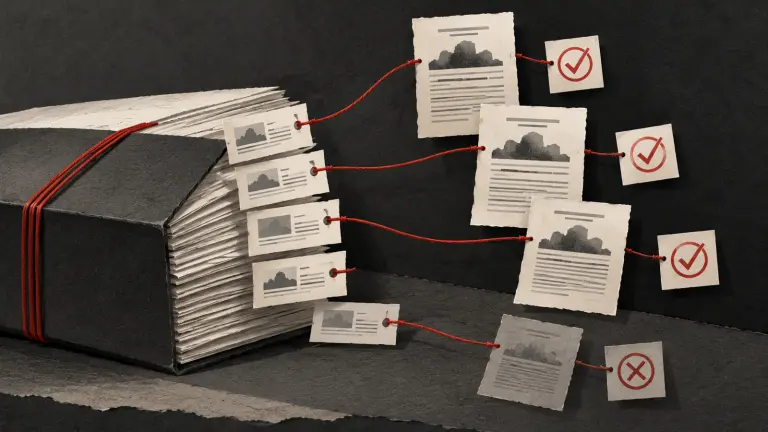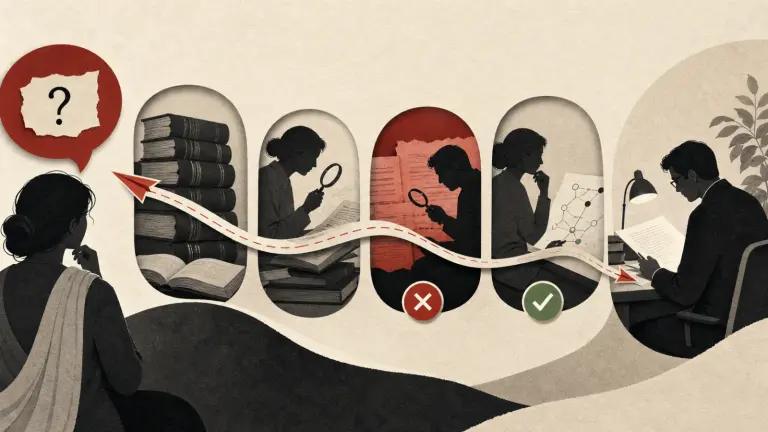
Legal research rarely turns on whether two cases share a phrase. It turns on what a court decided, which passage supports the proposition, what authority the court had, and how later decisions treated that point. A useful citator has to connect those questions while keeping the source close enough for a researcher to inspect.
Gotham’s agentic legal research helps a researcher move from an initial question to case records, retrieved passages and available court context. On a case page, the Cited by view lets the researcher inspect later judgments matched to that authority and the treatment recorded for those citations. These are complementary ways to explore legal material: the source passages remain available for review, and a lawyer decides what the authorities mean for a client or filing.
A citation can be real and still be the wrong support
A citation check begins with identity. Does the reference point to the intended judgment, or to another decision with a similar party name, date, or citation? That matters before any interpretation begins. A judgment’s neutral identifier, report citation, court, date and case number are useful clues, but the original decision remains the source to verify.
Identity is only the first question. The next is whether the cited passage actually supports the sentence attached to it. A judgment may quote a submission before rejecting it, summarize a previous rule before distinguishing it, or decide one narrow issue while discussing several others. A reference can therefore resolve correctly while the proposition remains overstated or unsupported.
The distinction is visible in Indian constitutional law. Article 141 provides that the law declared by the Supreme Court binds courts within India. It speaks to law declared, which requires attention to the decision’s issue and reasoning rather than treating every sentence as an equivalent rule. The official Constitution of India is the primary source for that text.
In M/s Bajaj Alliance General Insurance Co. Ltd. v. Rambha Devi & Ors., the Supreme Court discussed the distinction between ratio decidendi and obiter in its treatment of the per incuriam doctrine (paras. 109–111). That decision is an example of why a citation list is only a starting point: the relevant proposition and the court’s analysis must be read in the judgment itself. Its discussion is specific to the issue before that Court; it is not a shortcut for classifying every cited passage.
Our case-law citation verification checklist covers practical source checks. This article focuses on the research problem behind a citator: why the case, passage, court and later reference need to stay connected without collapsing into one yes-or-no label.
The questions behind an authority relationship
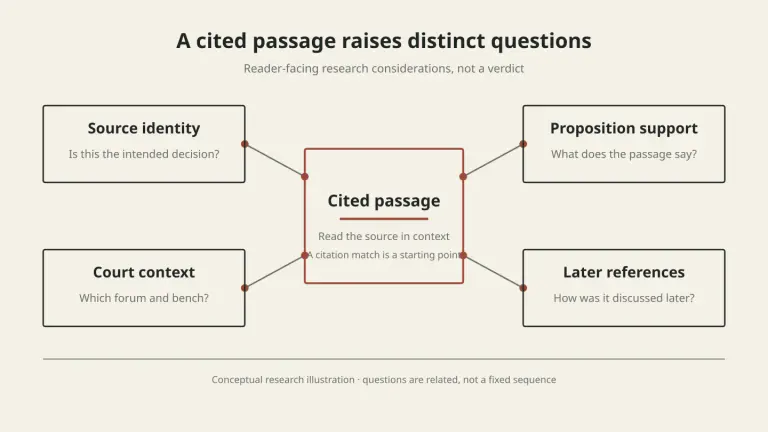
Consider a fictional research question: whether a procedural deadline can be extended after an online filing failure. A search brings back two judgments that use the phrase “sufficient cause.” One is from a court relevant to the forum and discusses the provision that governs the deadline. The other is from a different court, concerns a separate statute, and uses the phrase while recounting a party’s argument.
The phrase makes both cases candidates. It does not make them interchangeable. Before relying on either, the researcher needs to answer several distinct questions:
- Is this the intended decision? Resolve the citation against the judgment itself, not just a matching title or search result.
- What does the passage say? Read the pinpoint with enough surrounding text to identify whether it is the court’s reasoning, a quotation, or a procedural direction.
- What is the court relationship? Consider jurisdiction, hierarchy and the forum in which the proposition will be used.
- What happened later? Check whether a later decision relied on, explained, distinguished or otherwise discussed the proposition in question.
These are reader questions, not a fixed sequence in which every matter must be processed. Their order can change with the research problem. A known authority might prompt a treatment check first; an unfamiliar citation might need source resolution before anything else. The value comes from keeping the distinctions visible so the researcher can choose the next useful question.
Return to the fictional filing-deadline question. The researcher first confirms that the two results are the intended judgments, then reads the pinpoint and the paragraphs around it. That reveals that one passage states the court’s reasoning on the relevant rule while the other only recounts an argument made by counsel.
The first case is a stronger research lead, but the researcher still needs to compare the deciding court with the forum and check whether later decisions have changed how that proposition is used. The work is not complete just because the citation resolves or a phrase matches.
This is the difference between a citation network and a citator. A network can show that two documents mention one another. A citator needs to make the relationship useful to a legal question: which decision is cited, what proposition is relevant, what the later court did with it, and which source passage supports that reading. Gotham’s legal research surfaces case records and relevant passages in response to a question; the case reader’s Cited by view lets researchers inspect matched later decisions and their recorded treatment. A reader can open those decisions and assess the cited passage in context.
Court context is more than a hierarchy label
Court names provide essential orientation, but an authority question can also turn on the legal system, territorial reach and bench that decided the case. Two courts with the same name may sit in different jurisdictions. A decision can be binding in one forum and persuasive in another. Within a court, bench strength can affect how an earlier decision is treated.
The Constitution gives a concrete Indian example. Article 145(3) requires a minimum of five judges for a case involving a substantial question of constitutional interpretation or an Article 143 reference. Article 145(5) provides for decisions by majority while preserving a judge’s ability to deliver a dissenting opinion. These provisions help explain why identifying the court alone does not answer which opinion states the controlling proposition. They do not mean every five-judge decision necessarily decides a constitutional question.
For research, the useful distinction is among the court, the bench, the issue and the opinion. A reader may need to know that a judgment is from the Supreme Court, that the relevant point appears in a separate opinion, or that the case concerns a procedural issue rather than the substantive rule surfaced by a search. Each fact answers a different part of the question.
Gotham’s legal research surfaces case and court context with source material, while the case reader’s citation view brings matched later references within reach. These complementary reader paths keep the underlying decisions available for inspection. The design choice favors visible context over a single universal badge: one short label cannot carry every jurisdictional, doctrinal and procedural qualification a lawyer may need.
Later references need a proposition-level reading
When a later judgment cites an earlier case, the citation establishes that one decision referred to another. It does not, by itself, tell the researcher whether the later court adopted the earlier proposition, distinguished it, confined it, or mentioned it only in passing. Those are different legal uses, and the distinction matters most when the proposition is material to an argument.
The same later judgment can treat different propositions from an earlier decision differently. A court may follow one point, explain another, and distinguish a third because the facts or statutory setting differ. Reading a case name in a citation table without the surrounding passage can hide that granularity.
That is why a useful research view keeps the cited source and the later discussion available for inspection. A treatment relationship should help a reader find the relevant material and understand why it may matter; the underlying words and legal context remain decisive. Our guide to judgment treatment research in India explores how practitioners can review later references, while finding binding precedent addresses the forum-specific authority question.
Time adds another dimension. Suppose a fictional decision interprets a statutory provision, Parliament later amends that provision, and a more recent case cites the earlier judgment while resolving a different issue. The older decision still exists and the citation is still real, but a researcher asking about the current text cannot treat its age or citation count as an answer.
The relevant questions include which version governed the earlier dispute, what changed, and why the later court referred to the case. A case relationship helps locate evidence; chronology helps the lawyer decide whether that evidence bears on the present question.
Procedural posture can be just as important. A final judgment on a contested issue, an interim order, and a consent order may all be citable, but the route by which the court reached its words can affect what they establish. A record of later references therefore needs to lead back to the document and its setting. The researcher then checks whether the later court addressed the same issue and whether the cited passage was part of the court’s reasoning.
Why the design keeps evidence close
Three product choices shape this work.
Source traceability comes first. A research answer should lead back to the judgment and relevant passage. That gives a lawyer a concrete place to verify wording, identify surrounding reasoning, and decide whether the source addresses the issue. A summary can orient the search, but it cannot stand in for the source when legal reliance is at stake.
Different questions stay distinct. Citation identity, proposition support, court authority and later treatment are related, but one does not prove the next. Keeping those questions separate helps avoid a familiar failure mode: a valid citation being mistaken for proof that a particular sentence follows from the cited decision.
Context helps users make the next decision. A useful research result should make it easier to ask what passage to read, which court relationship matters, or which later reference needs checking. The product can organize material and explain its connections; it should not replace a lawyer’s judgment about the weight of an authority or its application to specific facts.
These choices involve a trade-off. A simple status can be quick to scan, while a legal relationship often needs more explanation to be useful. Gotham’s approach keeps the result tied to the source and makes the relevant context available to examine. That takes more attention than a bare “good law” signal, but it gives the researcher a better basis for review and for deciding what to investigate next.
The same trade-off shapes how a researcher interprets a relationship. A short label can help orient a reader, but it should not be mistaken for a complete view of a decision. The lawyer needs enough context to test a claim against the passage, the issue and the later judgment. Gotham’s case reader connects an authority to matched later references, and legal research results surface source passages for inspection. That gives the researcher material to examine rather than a label to accept on its own.
A research aid, not a substitute for legal judgment
Gotham’s agentic legal research helps a person move from a question to relevant case records, retrieved passages and available court context. In the case reader, the Cited by view helps inspect later judgments matched to that authority, including the treatment recorded for those citations. These capabilities organize research and point to material a lawyer can assess.
The legal conclusion remains with the lawyer. Whether a judgment binds a forum, supports a proposition, or applies to a client’s facts depends on the law and record in that matter. Researchers should consult the official source, check the applicable procedural and statutory context, and review subsequent authority before relying on a proposition.
For teams building a repeatable process, pair the citator with a clear citation check, a research memo, and a record of the proposition each source supports. You can read our citation verification checklist, review the legal research memo workflow, or talk with Gotham about how source-linked research can fit your team’s work.
Questions about legal citators
What is a legal citator?
A legal citator helps researchers trace references between legal sources and examine how later decisions discuss an earlier authority. A useful citator keeps the underlying judgments available so the reader can assess what the connection means in context.
Does a citation match prove that a case supports my proposition?
No. A matching citation helps identify a source. The researcher still needs to read the cited passage and its context to see whether it states the proposition, records a party’s submission, or addresses a different issue.
What does later treatment tell me about a judgment?
Later treatment can show how another decision refers to an earlier one, but the reference must be read in context. The relevant question is how the later court handled the proposition you care about, not simply whether the case name appears.
How does Gotham’s agentic citator support legal research?
Gotham’s agentic legal research helps connect a question to case records, retrieved passages and available court context. On a case page, the Cited by view lists matched later judgments with treatment labels, so a researcher can inspect the related decisions. A qualified lawyer assesses how the authorities apply to a matter.
Can a citator decide whether a judgment is binding?
A citator can help organize the authority question by bringing relevant court, bench, issue and opinion context alongside source material. Whether a judgment binds a particular forum and supports a proposition depends on law and facts that a lawyer must assess.
This article describes legal research design, not legal advice. A qualified lawyer must assess the authorities and propositions relevant to a matter.
How Gotham researches and reviews field guides