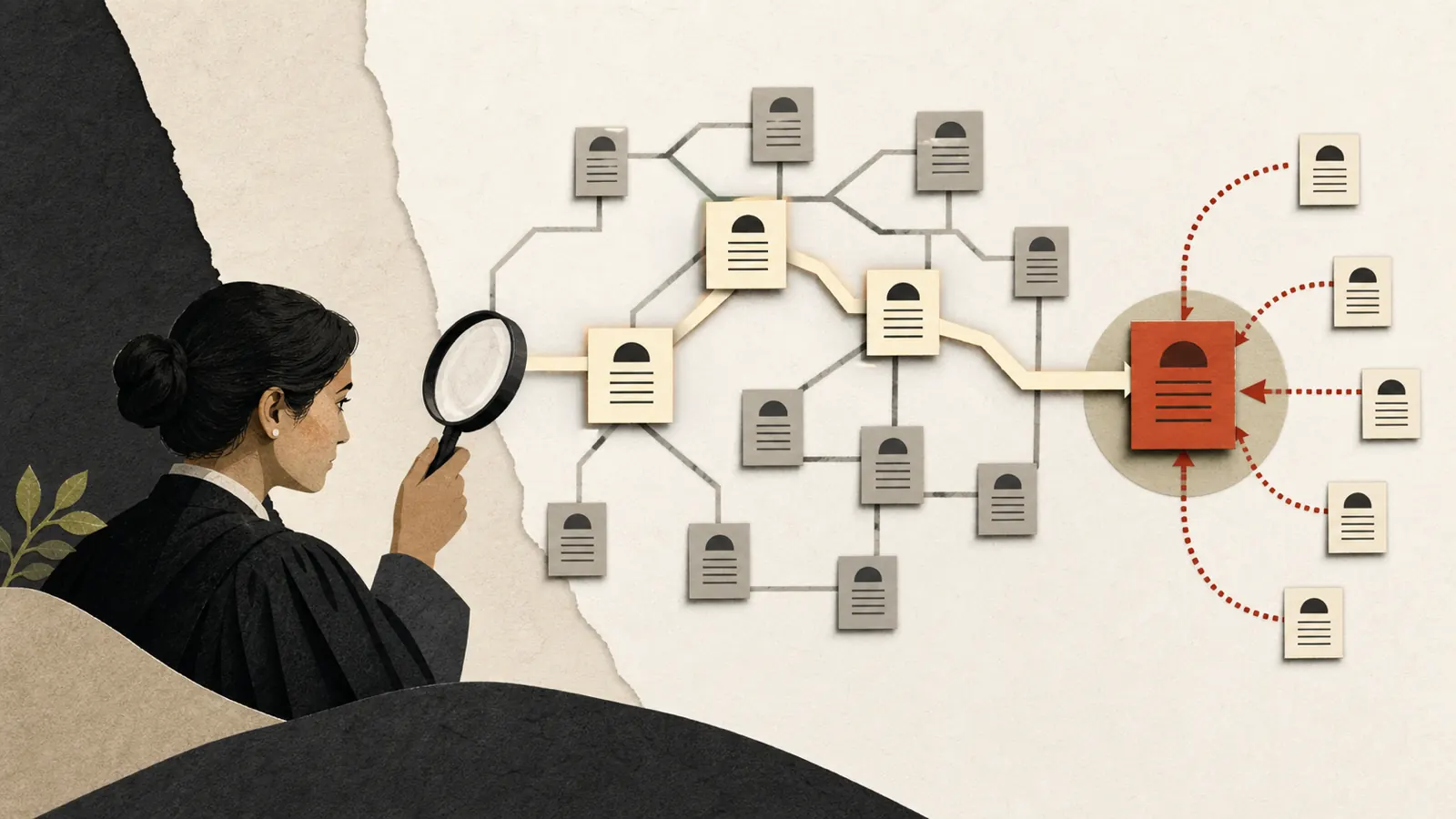
A legal research memo workflow in India should make the researcher's reasoning reviewable. The reader needs to see the question asked, facts assumed, law checked, authority weighed, contrary material considered, and date on which the search stopped. A polished answer without that chain may be quick to read, but it is difficult to trust or update.
This workflow is designed for internal legal research, not for giving legal advice through a template. Use official sources where available, including India Code, the Supreme Court of India, the eCourts Services portal, and the eGazette of India. A qualified lawyer should review any memo used for advice, filing, or an external communication.
How should the research request be framed?
Start with a written research brief, even if it is only half a page. A request such as “find cases on termination” is not ready for research. Identify the legal question, material facts, relevant dates, forum, jurisdiction, procedural posture, intended reader, deadline, and required depth.
Separate facts into four groups:
| Group | Meaning | Treatment in the memo |
|---|---|---|
| Confirmed | Supported by reviewed instructions or records | State with source reference where useful |
| Assumed | Used to complete the research within scope | Label expressly |
| Disputed | Contested or inconsistent across sources | Present without resolving unless asked |
| Missing | Could materially change the analysis | Turn into a follow-up question |
Reframe the request neutrally. “Why can the client terminate?” invites confirmation. “On the stated facts, what termination rights and limits may apply?” leaves room for contrary results. Break the main question into sub-issues such as governing provision, temporal application, jurisdiction, procedure, remedies, and later treatment.
Record the permitted sources and confidentiality boundary. Do not paste sensitive matter facts into an unapproved search or AI service. Gotham's security overview can support a product assessment, but the organisation must apply its own professional, contractual, privacy, and access requirements.
Which official sources should be checked first?
Begin with the text that creates or records the law. India Code provides central legislation, but a researcher still needs to check the Act, sections, definitions, schedules, amendments, commencement, and connected subordinate legislation. The relevant law may differ on the date that matters to the client.
For Supreme Court material, use the Court's official site and its linked judgment resources. For case status, orders, and district or High Court services, eCourts can help locate matter details, while the relevant court remains the source to verify the document. eGazette provides official Gazette publications that may matter for notifications, appointments, commencements, rules, and amendments.
Use a source plan:
| Research need | Starting source | Verification task |
|---|---|---|
| Central Act or section | India Code | Text, commencement, amendments, definitions, savings |
| Rule or notification | eGazette and issuing authority | Gazette number, publication and effective dates, later changes |
| Supreme Court proposition | Official judgment or Supreme Court report | Coram, case number, paragraph, order, later treatment |
| Procedural history | Court record and eCourts where relevant | Match parties, case number, dates, and document type |
| Secondary explanation | Treatise, database, article, or AI output | Trace each material statement to primary authority |
Commercial databases and Gotham's legal corpus can support discovery. They do not remove the need to open the best available primary source, read the relevant passage in context, and preserve its link.
How should the search strategy be documented?
Create a search map for each sub-issue. Include exact statutory wording, doctrinal terms, factual phrases, procedural terms, former section numbers, alternative spellings, and citations found in leading authorities. Search broad enough to find the vocabulary, then narrow enough to test the actual proposition.
Use at least three rounds. The first identifies the governing law and leading cases. The second looks for current, jurisdiction-specific, and factually close authorities. The third actively seeks adverse treatment, distinctions, overruling, statutory change, and competing lines of authority.
Maintain a search log:
| Date and researcher | Portal or database | Query and filters | Result used | Follow-up |
|---|---|---|---|---|
| Timestamp | Named source | Exact query | Citation or “none selected” | Later-treatment search |
A “none selected” entry is useful. It shows that a route was tried without forcing the next researcher to repeat it. It also prevents the final memo from presenting the selected cases as though no contrary search occurred.
Teams that repeat similar work can configure research workflows, but the log should remain specific to the matter and the question.
How should judgments be read and tested?
Read the full document, not a search snippet or headnote alone. Confirm title, court, case number, date, coram, procedural posture, and whether the source is a judgment, interim order, review order, or another disposition. Identify whether the relevant words are the court's reasoning, a party's submission, a quoted authority, or a factual recital.
Capture propositions in a table before drafting prose:
| Proposed sentence | Authority and pinpoint | Why it supports the sentence | Limits or contrary material | Status checked |
|---|---|---|---|---|
| Narrow legal proposition | Case, citation, paragraph, source | Ratio and relevant facts | Forum, bench, posture, distinction | Date and method |
State no proposition more broadly than the authority supports. Check court hierarchy, bench strength, material facts, separate opinions, later decisions, review or appeal history, and intervening legislation. Search by citation and party name because later courts may refer to the same authority differently.
If an official copy is unavailable, say which source was used and what was done to verify it. Do not silently improve a missing paragraph or citation from memory. The guide to finding binding precedent in India offers a connected review framework.
How should statutes, rules, and notifications be verified?
Identify the version in force on the material date, not merely today's consolidated text. Read the long title, extent, commencement, definitions, provisos, explanations, schedules, non-obstante clauses, repeal and savings provisions, and delegated legislation relevant to the issue.
For each instrument, record:
- issuing authority and enabling provision;
- official title, number, and source link;
- Gazette publication date and effective date;
- relevant territorial or subject scope;
- amendments, corrigenda, supersession, or withdrawal;
- version used and date accessed; and
- any unresolved conflict between official repositories.
An amendment date and an effective date may differ. A notification may apply only to a class of persons, territory, or provision. If temporal application matters, construct a short legislative timeline and attach the official instruments used. The legislative history research guide can help organise that work.
What structure should the legal research memo use?
Lead with the short answer, but do not strip away the conditions that make it accurate. The reader should understand the likely answer, confidence level, and decisive uncertainty without reading the entire file first.
A reviewable memo structure is:
- Question presented: one neutral, scoped question.
- Short answer: concise result with qualifications.
- Facts and assumptions: only those material to analysis.
- Research scope: jurisdictions, sources, exclusions, and cut-off date.
- Governing law: statutes, rules, notifications, and authority framework.
- Analysis: issue-by-issue application with pinpoint citations.
- Contrary authority and uncertainty: fair account of competing material.
- Conclusion and next steps: answer, missing facts, and verification needed.
- Authority table or annexure: source links, status checks, and extracts where permitted.
Distinguish law from application. Use a separate paragraph to explain the rule, then apply it to the stated facts. Avoid presenting a search platform's relevance score as the strength of an authority. Where the result depends on an assumption, repeat the assumption at the point of analysis.
How should review and citation checking be performed?
Give the reviewer the brief, memo, search log, authority table, and source set. A review assignment should state whether the reviewer is testing the research coverage, legal analysis, citation accuracy, writing, or all four. Quietly asking someone to “take a look” produces uneven review.
Run two passes. In the authority pass, open every material source and compare the memo's sentence with the cited passage. In the analysis pass, test whether the conclusion follows from the authorities and stated facts, including adverse material. Resolve comments in the document system and record the reviewer and date.
Final checks include:
- Every issue in the brief is answered or marked unresolved.
- Each material proposition has a primary-source citation where available.
- Pinpoints lead to the relevant court reasoning, not submissions.
- Statutory currency and effective dates were checked.
- Contrary authorities and material distinctions are fairly stated.
- Quotations match the source and are no longer than necessary.
- Facts, assumptions, and legal conclusions are visibly separate.
- Links, case numbers, dates, and party names were checked.
- Research cut-off date and reviewer are recorded.
When is the memo complete, and how should it be updated?
Completion depends on the use and risk of the research. A preliminary internal orientation and a memo supporting a filing do not need identical depth. The responsible lawyer should set the stopping rule before research expands indefinitely.
Archive the brief, log, source copies or stable links, proposition table, memo, and review record under the matter's retention policy. Set a refresh trigger when the answer depends on a pending judgment, expected notification, approaching hearing, or law likely to change. On update, preserve the earlier memo and record what changed instead of rewriting history.
This legal research memo workflow makes uncertainty visible and updates manageable. It turns a conclusion into a chain that another lawyer can inspect. To discuss how the process could fit your team's sources and review controls, contact Gotham or explore Gotham's practice pages.