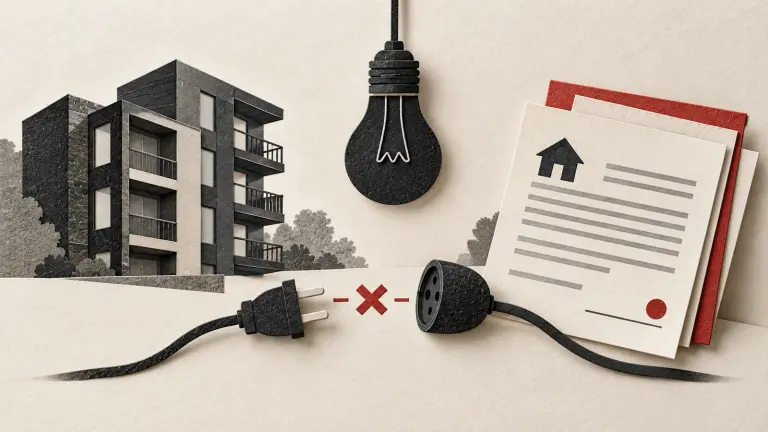
A tenant who pays electricity through a landlord may receive a separate amount instead of a bill addressed to them. The first question is what the amount represents: a reading from a sub-meter, a share of a master meter, a fixed charge, or a mix of these. A CESC bill and a landlord's calculation are related records, but they are not the same account.
This guide is a record-checking process for a tenant in India, with a Kolkata example. It cannot determine whether a particular charge is due, whether a meter serves one flat or several, or whether a landlord must provide access to a utility account. Those questions depend on the agreement, meter setup, local law and evidence. For a supplier's own unexpectedly high bill, see the separate guide to checking an electricity bill in India. If the issue is that power was cut off, use the separate guide to a landlord cutting electricity; a charge dispute and a service interruption raise different questions.
Identify whose meter and bill are involved
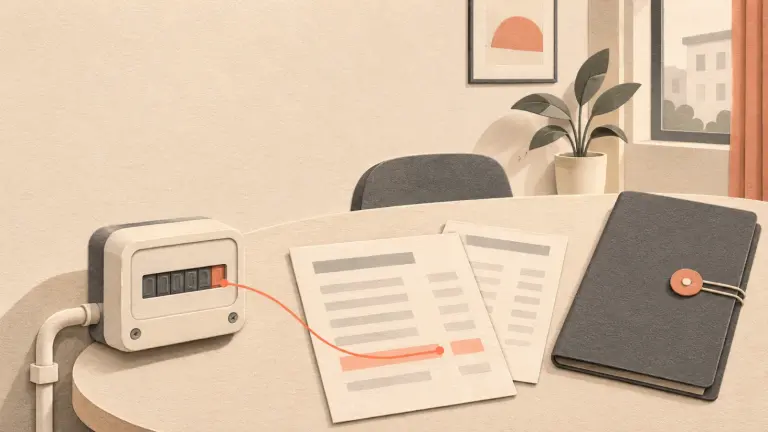
Write down who is named on the CESC account, which meter serves the property, and whether your room or flat has a separate sub-meter. Ask who reads it, when readings are taken, and whether the amount includes common areas or other units. Do not enter a locked meter room or touch wiring or sealed equipment. If it is safe and you are permitted to do so, note or photograph a visible meter reading with the date.
Ask the landlord or account holder to identify the period and the calculation in writing. A useful request can ask for:
- the rental agreement or house-rule term said to cover electricity and any rate or allocation method;
- the sub-meter number or other identifier, with opening and closing readings and reading dates;
- the unit rate and arithmetic used, plus any fixed charge, common-area share or adjustment;
- the corresponding master-bill period and a copy of the relevant bill or a redacted extract; and
- receipts or ledger entries showing how earlier payments were applied.
The purpose is to see whether the figures can be followed from the meter reading to the amount demanded. A calculation that adds a shared charge may need a different explanation from one that simply multiplies a sub-meter unit difference by a stated rate. Neither example establishes which method the agreement or law permits.
Separate a CESC billing issue from a landlord allocation
If the master bill itself has an unexpected reading, meter number or charge, the named CESC consumer can ask CESC to explain that bill or raise a meter complaint. CESC's FAQ describes copy-bill access through the Customer Zone for registered consumers; its complaints page lists customer and complaint details. Ask the named consumer to obtain the needed record and share a redacted copy. Do not request their login credentials or assume that being an occupant alone gives access to another person's account history.
The Electricity Act, 2003 addresses the relationship between a distribution licensee and electricity consumers. Sections 42(5)–(7) provide for a licensee grievance forum and Ombudsman; section 43 concerns supply on an application; section 45 addresses charges for electricity supplied by the licensee; sections 50 and 55 address supply-code regulation and metering; and section 56 addresses licensee disconnection for non-payment. These provisions do not, by themselves, set a universal formula for a private landlord's sub-meter charge or decide who must share another consumer's CESC records. Review the official Electricity Act text on India Code for the provisions that apply to the utility account.
For an issue about CESC's own meter, bill or supply, the eligible consumer can check CESC's published grievance redressal and Ombudsman process. That process is for the utility relationship. It should not be presented as a forum that automatically decides a separate amount a landlord passes through to a tenant. The Consumer Grievance Redressal Forum and Ombudsman guide may help organize a consumer complaint record, but verify that the forum and process fit the actual dispute.
Keep the tenancy and payment record together
Save the agreement, addenda, house rules, messages about the rate or meter, dated readings, bills provided, calculations, receipts and any written response. If an earlier reading or rate was agreed in a message, preserve that exact exchange. Keep an itemized schedule showing the period, reading difference, rate, other components and amount paid or disputed. Record each reading with its date and meter identifier; this keeps the sub-meter period easy to compare with the CESC bill period. This creates a clearer record without proving that a particular term is enforceable.
If the written terms do not explain the charge, ask neutrally which term applies and how the amount was calculated. Do not make an accusation based only on a mismatch or refuse other rent on the assumption that a bill complaint pauses payment. The tenant rental-deposit guide explains how to preserve evidence when the tenancy terms are incomplete; it does not determine an electricity allocation dispute. If you receive a formal demand or notice, the India guide to organizing a reply to a legal notice can help you prepare the documents for a local lawyer.
A short written request
You can ask for the records without claiming a right that has not been established:
Please share the electricity calculation for [period], including the meter identifier, opening and closing readings, dates, unit rate, any fixed or shared-area component, and the agreement term used. If the amount is based on the main CESC account, please provide the relevant bill or a redacted copy from the account holder. I will compare the records and reply in writing.
Keep the message, reply and any bill in the same dated folder. Redact customer IDs, service addresses, QR codes and unrelated account information before sharing copies. If the landlord says access to the main meter is not possible, ask what reading or statement they can provide instead. Do not enter a restricted area, interfere with a meter or use another person's online account.
When to get local advice
The result may depend on the lease wording, whether the agreement is written or oral, who is the CESC consumer, how the sub-meter is installed, whether the bill includes shared loads, and how the parties have calculated charges before. The West Bengal Electricity Regulatory Commission's regulations index lists the 2013 Electricity Supply Code as the principal regulation and separately identifies a 2026 first-amendment draft. The official PDF text was not extractable in this review, so this guide does not quote a supply-code clause about a landlord's private allocation. A draft amendment is not an in-force rule.
If the dispute is about the private calculation rather than CESC's bill, gather the agreement, readings, calculation and payment history and ask a lawyer practising in West Bengal which tenancy or contract rules apply. If the supplier's own bill is disputed, the named consumer should use CESC's current complaint steps and verify eligibility and escalation deadlines. A complaint route, a bill copy or a sub-meter calculation does not decide the legal amount owed.
Official sources
- Electricity Act, 2003, India Code, including sections 42–45, 50, 55 and 56.
- CESC FAQ, including registered-consumer copy-bill information.
- CESC complaints and CESC grievance redressal / Ombudsman.
- West Bengal Electricity Regulatory Commission regulations index, identifying the 2013 Supply Code and separate 2026 draft amendment. The 2013 PDF was opened, but its text was not extractable for clause-level reliance in this review.
This is general information, not legal advice. The source materials do not answer whether a particular private charge is due, whether a landlord must share a bill, or which tenancy remedy applies to a specific property.
Questions about landlord electricity charges
Can a landlord charge a tenant for electricity without showing the CESC bill?
The answer depends on the tenancy terms, meter arrangement and records. The Electricity Act's licensee-tariff rules do not, by themselves, set a universal private landlord allocation formula or decide whether a specific demand is due. Ask for the relevant agreement term, sub-meter readings, billing period and calculation; obtain local advice if the amount remains disputed.
Can a tenant log in to the landlord's CESC account to see past bills?
CESC describes copy-bill access through its Customer Zone for registered consumers. The official information reviewed does not establish that every occupant may access another person's account. Ask the named consumer to retrieve and share the relevant bill with unrelated account details redacted; do not ask for or use their password.
Does CESC's complaint process decide a landlord's sub-meter charge?
CESC's complaint and grievance routes concern a CESC supply, bill or meter issue for an eligible consumer or intending consumer. A landlord's allocation to a tenant is a separate private account or contract question; the CESC route does not automatically decide it.
How should I check a sub-meter electricity calculation?
Ask for the sub-meter identity and dated opening and closing readings, the period covered, the stated unit rate, and any fixed or shared-area component. Compare the result with the master utility bill if the account holder can provide it. This is a way to test the arithmetic and records, not a legally prescribed tariff formula.
Should I stop paying rent or electricity charges while I dispute a bill?
Do not assume a billing complaint pauses a tenancy payment or service deadline. Keep the disputed amount and other payments clearly documented, review the agreement and get advice from a lawyer familiar with the property's location before withholding payment.
General information, not legal advice. A landlord's electricity charge depends on the tenancy terms, meter arrangement, records and facts. Utility consumer rights and complaint channels generally concern the distribution licensee's account; they do not decide every private tenant-landlord allocation dispute.
How Gotham researches and reviews field guides