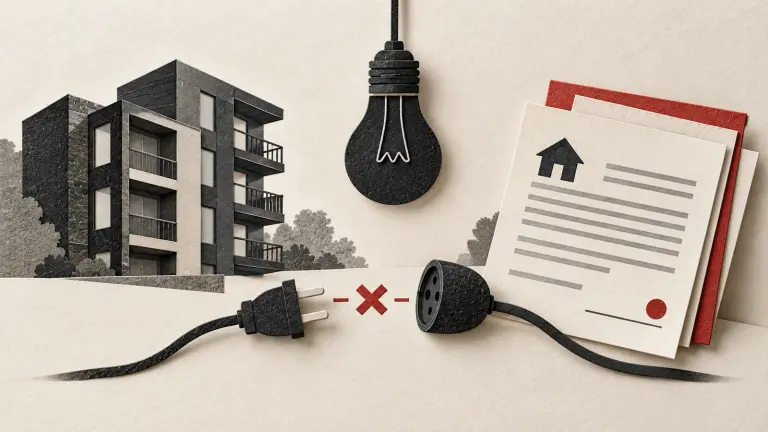
If the power goes off in a rented home, first work out whether the interruption is inside the building or on the electricity supplier’s network. A landlord, caretaker or building manager may have switched off a private breaker or interfered with wiring; the distribution company (DISCOM) may instead have disconnected a meter, or there may be an outage. The right person and process depend on which happened.
Keep yourself safe, record what you can without touching electrical equipment, and report a suspected supplier issue through the DISCOM’s official complaint channel. If a landlord appears to have deliberately cut a service, preserve the tenancy and communication records and check the law that applies to the property’s State, city, premises and tenancy. India does not have one uniform landlord-electricity remedy or one forum for every tenant.
This is general information, not a finding that a landlord acted unlawfully or that a particular tenant qualifies for relief. Local counsel should confirm the current law, forum and procedure for the address before you file or take a formal step.
First: deal with immediate danger
If you see sparks, smoke, a burning smell, exposed or fallen wires, a hot meter, or water near electrical equipment, stay away. Do not touch the meter, fuse, wiring, distribution board or a fallen cable. Keep other people away and contact the DISCOM’s emergency fault service. For an immediate threat to life, fire or personal safety, move to a safe place and call the appropriate local emergency service; India’s single emergency number is 112. Do not try to restore supply yourself or ask an unqualified person to work on the installation.
If there is no immediate danger, use a torch or phone light instead of a candle near electrical equipment. Never run a fuel-powered generator indoors, in a garage, or in another enclosed space: exhaust can cause fatal carbon-monoxide poisoning. Keep it outdoors at least 20 feet (about 6 metres) from doors, windows and vents, and follow the manufacturer’s instructions. Never plug a generator into a wall outlet or connect it to building wiring yourself; that can send electricity back onto lines and endanger others. If fixed wiring is involved, ask a qualified electrician about properly installed transfer equipment and check applicable local requirements. These are general safety precautions, not a statement of Indian installation law. CEA publishes Indian electrical-safety guidance; the generator placement and carbon-monoxide guidance cited here is from the US CDC, and the backfeed warning is from the US CPSC.
Identify where the interruption is happening
Without opening or operating electrical equipment, ask a neighbour whether their power is also off and check the DISCOM’s official outage or complaint channel. Note whether the outage affects the whole building, common areas, or only your unit. If safe, take a photo of the display or switch position from a distance; do not enter a locked meter room or handle a meter.
| What you can observe | Who to contact first | What to ask |
|---|---|---|
| Neighbouring homes or the whole street also have no supply | DISCOM, using the number or channel on the bill or its official website | Is there a fault, planned outage or supplier-side disconnection for this address? Record the complaint number and expected next step. |
| Other units have power, but your unit does not; the meter is dark, sealed, or shows a disconnection message | DISCOM, then the account holder or landlord as appropriate | Was the service disconnected by the licensee? Why, on what date, and what written notice or account record applies? Do not break a seal or reconnect it. |
| Your unit alone is off, and the meter appears normal; a private switch, fuse or internal wiring may be involved | Landlord or building manager in writing; a qualified electrician arranged by the responsible person | Ask them to inspect the private installation safely and confirm what was switched off or failed. Do not access or operate a shared board yourself. |
| The outage follows a storm, damaged cable, transformer fault, or building-wide electrical issue | DISCOM for network faults; building manager for common-area equipment | Ask each to confirm which part of the system is affected. A building fault and a DISCOM outage can look similar from inside a flat. |
These are clues, not proof. The DISCOM can confirm whether it acted on its connection; a qualified electrician may need to identify a fault inside the premises. If the account is in another person’s name, ask the account holder to make or join the supplier complaint. You can still preserve your own records and explain that you occupy the premises.
Preserve a clear record
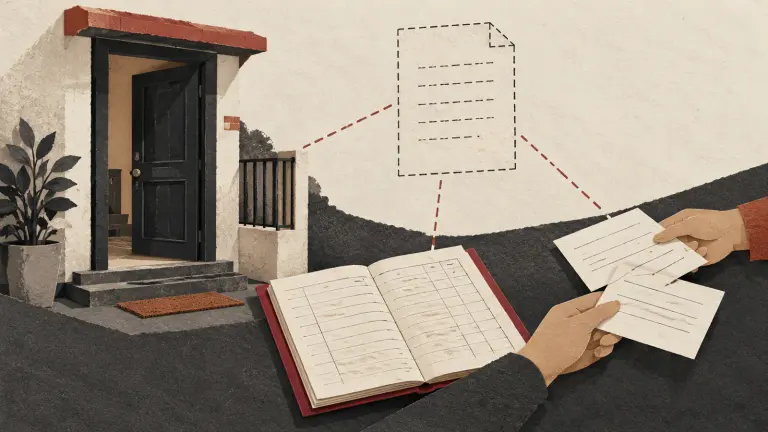
Write down the date and time the power stopped, when it returned (if it does), the areas affected, and any safety issue. Keep copies of:
- your signed rental or leave-and-licence agreement, renewals, inventory and any written terms about electricity, meter access, common facilities, charges and payments;
- recent electricity bills, receipts, payment confirmations and the meter or consumer number if available;
- messages, emails, notices and call logs with the landlord, manager, account holder or DISCOM, including the date and complaint number;
- photographs or short videos taken safely from a place you may access, and the names of people who saw what happened; and
- any written response from the DISCOM or a qualified electrician identifying whether the interruption was supplier-side or within the property.
Keep originals, make a dated copy of digital messages, and avoid editing records. Do not trespass into an electrical room, interfere with a meter or seal, reconnect supply, damage equipment, threaten anyone, or stop paying rent or agreed charges based only on this guide. Those actions can create safety and legal problems and may harm your position.
If a landlord or building manager appears to have cut the supply
Send a short, factual message through a channel you can preserve. State when the supply stopped, what you observed, whether the DISCOM has confirmed an outage or disconnection, and the practical impact. Ask whether the landlord or their agent switched off or altered any equipment, what reason they rely on, and when safe restoration will be arranged. Ask for a written response. Do not accuse someone of a crime unless you have advice and evidence supporting that claim.
The Electricity Act, 2003 gives an owner or occupier a route to apply to the distribution licensee for supply at the premises. Section 43 says the licensee must give supply within one month after receiving an application, subject to the Act. The application must be complete in the licensee’s required form and include required charges and other compliance documents. The section provides different timing where mains must be extended or a substation commissioned, and section 44 excepts cases where events beyond the licensee’s control prevent supply. This is a right to apply, not a promise that every application will be granted immediately or that supply can be connected without technical, safety, identity or local supply-code requirements. Section 42 provides for consumer grievance forums and Ombudsman arrangements concerning the licensee’s services. Section 56 addresses a licensee’s disconnection for non-payment and requires at least fifteen clear days’ written notice, subject to its terms. These provisions do not by themselves decide whether a private landlord may interrupt a tenant’s existing service, establish who operated the switch, or guarantee a particular remedy. A private landlord is not the DISCOM simply because the landlord controls access to a meter or building switch.
Some State tenancy statutes separately address essential services. Their coverage, forum, proof and relief differ. Two examples illustrate why the address and tenancy must be checked:
- Maharashtra: Section 29 of the Maharashtra Rent Control Act, 1999 says a landlord must not, without just or sufficient cause, cut off or withhold an essential supply or service enjoyed by a tenant. Its explanation includes electricity and certain acts or omissions by the landlord that cause a competent authority to cut the service. A tenant in occupation may apply to the court for a restoration direction, and the court may grant interim relief in the circumstances set out in the section. Separately, section 29(7) says a tenant who has been enjoying an essential service that the landlord has withheld, or who seeks another essential service at the tenant’s cost for the premises in their occupation, may apply to the municipal authority or another authority authorised for that purpose. That authority may permit or provide the service without insisting on the landlord’s “No Objection Certificate.” This does not guarantee that a connection is technically or otherwise available: confirm that the Act applies to the premises, which authority is authorised, and the current application and connection requirements. The Act is not a nationwide rule.
- Delhi: Section 45 of the Delhi Rent Control Act, 1958 addresses cutting off or withholding essential services, including electricity, and allows a tenant to apply to the Rent Controller. An interim restoration order is available under section 45(3) where the Controller is satisfied that the service was cut off to compel the tenant to leave or pay higher rent; a final restoration order under section 45(4) depends on a finding that it was withheld without just and sufficient cause. Whether the Act applies must be checked under its own scope and exclusions: section 1 extends it to the New Delhi Municipal Committee and Delhi Cantonment Board areas and specified urban areas within the Municipal Corporation of Delhi, with provision for later notifications; section 3 excludes certain premises, including government premises (subject to its provisos), premises with monthly rent above ₹3,500, and certain premises constructed after the 1988 amendment for ten years from completion. A Delhi address alone does not establish that section 45 governs the tenancy. The historic-area and residential-use wording appears in section 47, not section 45; do not apply that section 47 wording as a limit on section 45. Confirm current text, notifications and coverage with local counsel.
These examples do not decide whether a particular cut was justified, who caused it, what evidence is sufficient, or whether a court will order restoration or compensation. Other States and local laws may use different rules or forums. Get advice from a lawyer practising where the property is located before relying on a section, sending a legal notice, or filing an application. Ask the lawyer to check the current statute and amendments, the premises’ statutory coverage, who the relevant parties are, the correct forum and procedure, and whether any deadline or parallel proceeding affects your case.
If the DISCOM disconnected the meter or supply
Ask the DISCOM to confirm the registered consumer, meter number, disconnection date and reason in writing. If the matter concerns non-payment, ask for the bill, account ledger, notice and payment status. Section 56 of the Electricity Act sets rules for a distribution licensee disconnecting for non-payment, including written notice of not less than fifteen clear days, subject to the statutory wording and circumstances. Whether that provision applies to the event depends on what the licensee actually did. Do not assume that a landlord’s private switch-off is a DISCOM disconnection or that a supplier’s action was unlawful simply because you did not receive a message.
Use the DISCOM’s complaint process for a supplier-side dispute, such as an unexplained disconnection, disputed account or non-supply complaint. Keep the acknowledgement and ask for the next escalation step. Under section 42(5) and (6) of the Electricity Act, State Electricity Regulatory Commissions provide for a Consumer Grievance Redressal Forum (CGRF) and an Electricity Ombudsman for eligible grievances against the licensee. The detailed process, filing requirements and time limits come from the applicable State Commission regulations; check the bill and the regulator’s current site.
For example, in Delhi the DERC’s 2024 forum and Ombudsman regulations cover distribution licensees in their respective Delhi supply areas and include non-supply, interruption and disconnection among electricity-service grievances. DERC issued corrigenda on 19 July and 3 September 2024. They correct cross-references and wording in specified regulations; read both with the 2024 regulations, especially before relying on a particular filing step or deadline. In Maharashtra, first use the supplier’s internal complaint route or CGRF for a complaint about the licensee. A consumer aggrieved by non-redressal through the CGRF may make a representation to the Electricity Ombudsman under MERC’s regulations, subject to eligibility and timing rules. MERC’s 27 March 2026 notification replaced its 31 October 2025 territorial arrangement and maps districts between the Mumbai and Nagpur Ombudsman offices; confirm the office and current filing instructions for your district rather than relying on an old address list. Those electricity consumer processes address a licensee’s service and do not replace a separate tenancy remedy against a private landlord.
If the interruption was a general outage or a building installation failure, a CGRF may not be the right route against a landlord. Report the outage to the DISCOM or the private installation issue to the building manager, and ask the DISCOM to confirm the network status. If a complaint route rejects the issue as outside its jurisdiction, keep that response and obtain local advice about the tenancy or other applicable route.
A focused first message
The electricity supply to [unit/address] stopped at about [date and time]. The affected area is [unit/building/other]. The DISCOM complaint number is [number, if any]; its response so far is [brief fact]. Please confirm whether you, your agent or the building manager operated or changed any switch, fuse or connection affecting the unit, the reason, and the safe steps and time for restoring service. Please respond in writing. I am keeping a record of the outage and will use the applicable supplier or local tenancy process after confirming which applies.
Adapt this to the facts. Avoid sending account passwords, identity documents or unrelated personal information. If you fear retaliation or violence, prioritise safety and seek help from a trusted person, local support service or lawyer before contacting the landlord directly.
Working checklist
- Move away from any electrical hazard; call emergency help if someone is in immediate danger.
- Check, without touching equipment, whether neighbours or other units are also affected.
- Ask the DISCOM to confirm an outage or licensee disconnection; save its complaint number and response.
- Notify the landlord or building manager in writing if the interruption appears internal or privately operated.
- Preserve the agreement, bills, payment records, communications and safe observations with dates.
- Identify the property’s State, premises type, tenancy form and the account holder; have local counsel confirm which tenancy law, if any, applies.
- Use the DISCOM’s CGRF/Ombudsman route only for an eligible licensee grievance, following the current State procedure.
- Do not tamper with wiring or meters, reconnect supply yourself, withhold rent on assumption, or treat this guide as a court order.
Related situations
Electricity disputes may occur alongside other tenancy disagreements, but each needs its own facts and legal route. See the tenant nonpayment guide for rent-arrears and possession issues, and the rental deposit guide for documenting a disputed deposit. If you receive a legal notice, the guide to replying without a lawyer explains how to organize a response. The consumer complaint guide covers a separate complaint process; check whether it is suitable before using it for an electricity dispute.
Official sources
These official materials provide starting points for checking the law and current process. Their application depends on the address, tenancy, supplier and facts. Confirm current text and local procedure before taking a formal step.
- Electricity Act, 2003, India Code, including sections 42–44 and 56.
- Maharashtra Rent Control Act, 1999, Maharashtra Government, section 29.
- Delhi Rent Control Act, 1958, India Code, including sections 1, 3, 45 and 47.
- Delhi Electricity Regulatory Commission, Consumer Grievance Redressal Forum and Ombudsman regulations, 19 July 2024 corrigendum, and 3 September 2024 corrigendum.
- Maharashtra Electricity Regulatory Commission, current CGRF and Ombudsman regulations, 2020 English regulations, 2024 first-amendment Gazette, and 27 March 2026 territorial notification.
- Maharashtra State Electricity Distribution Company, Consumer Grievances Redressal Forum.
- Central Electricity Authority, Electrical Safety Handbook page and 2026 amendment to the electrical safety regulations. For general generator and carbon-monoxide precautions, see the US CDC's power-outage guidance and the US CPSC's generator backfeed warning; these are general safety references, not Indian law.
- Government of India, Emergency Response Support System 112.
This is general information, not legal advice or a finding that a landlord acted unlawfully or that a tenant qualifies for relief. Indian tenancy rules and electricity procedures vary by State, premises and facts. Ask a lawyer practising where the property is located to confirm current law, forum and procedure before taking a formal step.
How Gotham researches and reviews field guides