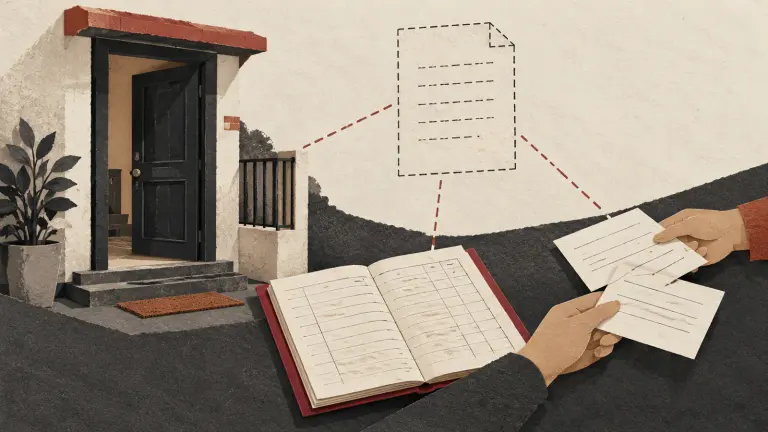
A tenant's missed rent payment calls for a careful account check, not an assumption that the amount is settled or that possession can be taken back. Reconcile each rent period against the agreement and original payment records, then get advice on the law and process that apply where the property is located. Rent recovery and possession are related but distinct questions.
“Three months unpaid” is a search phrase, not a legal test that decides what happens next. Compare the agreement and payment history before treating an amount as arrears. List each rent period, the amount due, payments received and how each payment was allocated. Keep disputed repairs, utilities, deposit deductions, rent changes and roommate payments in separate rows. Check for a transfer sent to a different account, a delayed credit, an agreed adjustment or a disagreement about the amount.
Keep the original agreement and extensions, receipts and bank records, messages, and a dated log of attempts to contact the tenant. Do not alter source records; label any working copy or calculation. If another person manages the property or collected rent, preserve their account records too.
Make the account easy to check
Use one row for each rental period, then show the agreement amount, any change to the amount, payments received, credits, disputed items and the balance you calculate. Record the source for each entry, such as a bank statement, receipt or dated message. If you use a spreadsheet, preserve original records separately and note who prepared the working calculation and when it changed.
| Record | What to compare | Why it matters |
|---|---|---|
| Tenancy terms | Rent amount, due date, payment channel, deposit and later changes | Establishes which terms are documented and which are disputed |
| Payment history | Amount, date, sender, recipient and reference | Helps identify a missing or misallocated credit |
| Other charges | Utility, repair or other amount and its stated basis | Keeps a disputed charge from being silently folded into rent |
| Communications | Date, channel, sender, recipient and delivery evidence | Preserves what was asked, answered or left unanswered |
| Possession record | Keys, inspection, access and any handover communication | Keeps the possession timeline distinct from the rent calculation |
Do not backfill missing entries from memory without labelling them as recollection. If the tenant or property manager supplies another ledger, retain it alongside your own and identify where the figures differ. A neutral reconciliation can then focus on a particular period or transaction instead of an unsupported total.
Keep rent recovery and possession as separate questions
A rent ledger can help explain a payment dispute. It does not itself decide that the tenancy has ended or that possession can be taken back. The legal route depends on the property’s State or Union Territory, the premises and parties, the agreement, and the laws and notifications that apply to those facts. Even a central statute is not a complete answer for every tenancy. In Meghmala v. G. Narasimha Reddy, a land and title dispute, the Supreme Court said that even a trespasser cannot be evicted forcibly and must be evicted following the procedure prescribed by law (paras 34–36). That decision does not identify the forum, notice or process for a particular tenancy; those still require local legal review.
Before sending a formal demand, ending a tenancy, filing a case or taking any step toward possession, ask a lawyer practising where the property is located to identify the current governing law and required process. Ask specifically which forum has jurisdiction, what notices or service rules apply, whether any local rent authority or tribunal is involved, and whether rent must be paid or deposited while a case is pending. Do not infer a deadline from the number of missed payments or from a rule described for another State.
Do not use force, change access, remove belongings, enter without lawful authority, or interrupt essential services to pressure a tenant. A demand or unanswered message is not permission to do those things. If there is an immediate safety concern, contact appropriate local emergency services and obtain local legal advice.
A careful first communication
If the records show a possible shortfall, a neutral reconciliation request can state the periods and amounts in your ledger, identify any credits you have included, and ask the tenant to point out a payment or calculation you may have missed. Keep the communication factual and retain a copy and delivery record. Check the agreement and obtain local advice before treating an informal message as a statutory notice or relying on any particular delivery method, wording or response period.
If the tenant responds, compare the explanation against the original records and correct errors before escalating. If there is no response, keep the unanswered communication in the file and get advice on the applicable next step. Silence alone does not establish the amount owed, end a tenancy or select the forum.
What to take to a local lawyer
Bring the property address and State, the complete agreement and amendments, rent ledger with source records, deposit and utility terms, payment proofs, communications with dates, any property-manager records, and any notices or court papers already received. Explain whether the premises are residential or commercial, who signed, whether the premises or parties may fall within an exemption, and whether the tenant disputes the amount. Ask for the applicable law as currently in force, including any commencement notification or amendments relevant to the property.
Common mistakes to avoid
- Treating a search result, a model law or another State’s rent statute as the rule for this property.
- Adding disputed charges to rent without showing their source and contractual basis.
- Assuming a particular number of missed months automatically ends a tenancy.
- Treating a demand letter as a possession order, or a possession dispute as merely a debt collection issue.
- Relying on an internet notice template without checking current local requirements and service rules.
- Using pressure, lock changes, removal of property or service interruption instead of a legally reviewed process.
Working checklist
- Identify the property location, premises type, parties and all signed tenancy documents.
- Reconcile each rent period against original payment records and separate disputed items.
- Preserve communications and property-manager records without editing originals.
- Ask the tenant to identify any missing credit or calculation issue in a factual, documented way.
- Before formal notice, proceedings or possession action, have local counsel identify the current State-specific law, forum, notices, service and any ongoing payment obligations.
- Keep money recovery and possession decisions distinct; do not act on a presumed deadline or take possession by pressure.
Related resources
For a separate tenant-side issue, see the guide to rental deposit recovery without a written agreement. Legal teams can use Gotham's practice workspace to organize matter records, consider a repeatable workflow, or contact Gotham about legal operations.
Sources and scope
The Supreme Court's decision in Meghmala v. G. Narasimha Reddy, paragraphs 34–36, arose from a land and title dispute. It supports the limited point that possession cannot be recovered by force and that the procedure prescribed by law must be followed. It does not determine which forum, notice, service method or process applies to a particular tenancy.
The Transfer of Property Act, 1882 (India Code) is one central statute that may be relevant to leases. This article does not determine its application to a specific property or how it interacts with local tenancy legislation, the agreement or facts.
This guide does not identify the governing rent law for a specific property. State and Union Territory rules, commencement notifications, exemptions, premises type, the parties and agreement can change the analysis. Have a lawyer practising where the property is located review the current local law and process before taking formal steps.
This article provides general information, not legal advice. Tenancy, notice, rent recovery and possession rules depend on the property, state or Union Territory, agreement, parties and current law. Obtain advice from a lawyer practising where the property is located before taking formal steps.
How Gotham researches and reviews field guides