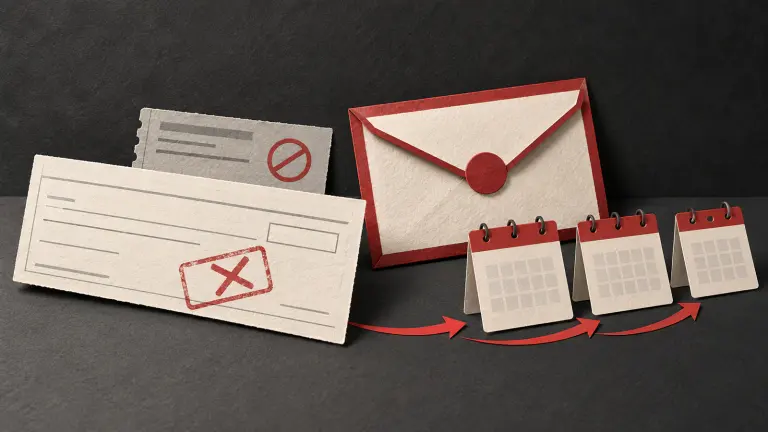
Short answer: Under the proviso to section 138 of the Negotiable Instruments Act, 1881, the payee or holder in due course must make a written demand within 30 days after receiving information from the bank that the cheque was returned unpaid. The drawer then has 15 days from receipt of that notice to pay. If payment is not made, the cause of action arises after that period. Section 142(1)(b) generally requires a written complaint within one month from that date. The complaint period is one month, not 30 days; a court may condone delay for sufficient cause.
These are separate statutory steps. A wrong trigger date or uncertain service record can matter, so calculate from documents and seek prompt advice.
What starts the 30-day notice period?
The 30 days run from the payee’s receipt of information from the bank about the return unpaid. Information may come by return memo, bank message, account statement, email or another communication. It is not automatically the cheque date or deposit date.
Section 138’s proviso controls. Keep the original return memo and record when the bank information reached you. If that date is unclear, ask the bank for written transaction history and counsel to confirm the last day.
The official Negotiable Instruments Act contains sections 138 and 142. Gotham’s legal deadline workflow can help teams record triggers and owners; a tool cannot decide a disputed date.
What should the demand notice say and how should it be sent?
Section 138 requires a written demand for payment of the cheque amount. Identify the cheque and dishonour, make a clear demand, and send it in a way that allows proof of dispatch and service. Have an advocate review the notice where there are multiple cheques, drawers, a company or disputed addresses.
Preserve the cheque or reliable copy, cheque number and amount, return memo, date bank information was received, final notice exactly as sent, enclosures, dispatch receipts, tracking, returned envelope or delivery record, address source, and any reply or payment offer. Keep a calculation of the 30-day period.
The statutory notice is more than a routine collection letter. A general demand may include several sums, but the section 138 demand must meet the law and relate to the cheque. Discuss interest, costs and multiple instruments with counsel rather than assuming they can be merged.
Gotham’s legal notice management guide and urgent notice workflow explain recordkeeping. The Act controls legal sufficiency.
How long does the drawer have to pay?
The drawer has 15 days after receiving the notice to pay the cheque amount. Receipt and posting are different. Keep proof of service and calculate from receipt, subject to applicable rules and any dispute about deemed service.
If full payment is made within that period, the cause of action based on nonpayment does not arise as described in section 138(c). If only part is paid or payment is offered without completion, preserve the offer and obtain advice on its effect.
Is the complaint deadline 30 days?
No. Section 142(1)(b) says the written complaint must be made within one month of the date the cause of action arises under section 138(c). That date follows failure to pay within the 15-day period. Do not silently convert a month into 30 days.
The proviso allows cognizance after expiry if the complainant satisfies the court that sufficient cause prevented timely filing. This is a possible condonation route, not a filing plan. File on time and retain evidence explaining any delay.
Section 142(2) governs territorial jurisdiction, generally by the branch where the payee maintains an account when the cheque is deposited for collection, with a separate rule for direct presentment. Confirm the court and local practice with counsel.
Worked example: keep the clocks separate
A bank informs Nikhil on 4 March that a cheque was returned unpaid. He calculates the 30-day demand period from receipt of that bank information. Suppose the notice reaches the drawer on 20 March. The drawer’s 15-day payment period is calculated from receipt. If no payment follows, Nikhil identifies the cause-of-action date and then calculates the section 142 complaint period of one month from it.
This is an illustration, not a calendar calculation for a live file. It does not resolve holidays, deemed service, disputed bank-information timing or other counting rules. Nikhil should record the source for each date and have counsel verify the last day. These three periods are distinct.
| Stage | Event | Record |
|---|---|---|
| 1 | Bank information received | Memo, email/message, account record and date |
| 2 | Written demand within 30 days | Final notice, dispatch receipt and copy |
| 3 | Drawer receives notice | Tracking, acknowledgment or returned cover |
| 4 | 15 days expire without payment | Receipt calculation and payment reconciliation |
| 5 | Cause of action arises | Calculation under section 138(c) |
| 6 | Complaint within one month | Filing receipt and any condonation evidence |
What if the notice is returned?
A returned envelope does not automatically decide whether service was valid. Record the address used, why it was chosen, dispatch method, tracking, postal endorsement and other communication. Service turns on law and facts; General Clauses Act section 27 and case law may matter.
If the address is outdated, check whether the drawer supplied another one or whether you had a reliable current address. Ask counsel whether a further notice is appropriate and whether time remains. Do not let a service question consume the original 30-day period.
The official General Clauses Act, 1897 contains section 27 on service by post. Its application to a particular notice, the address and the facts should be assessed with the NI Act and relevant decisions; a returned envelope does not answer the legal question by itself.
What if a company issued the cheque?
NI Act section 141 addresses company offences and responsibility of persons in charge of and responsible for the company’s business, subject to statutory conditions and defenses. Identify the drawer, company, signatory and roles before drafting. Naming every director does not establish liability; the complaint must meet the statute.
Check whether the cheque came from a personal or company account, where each proposed accused can be served, and how liability arose. Align the notice and service record with the correct party and address.
Can there also be a civil recovery claim?
A section 138 complaint is a statutory dishonour process; it does not automatically recover money or resolve every civil remedy. Civil recovery, arbitration or another remedy may be available depending on the transaction. Calculate limitation separately. A demand notice alone does not generally restart civil limitation.
Limitation Act rules for written acknowledgment before expiry and qualifying part-payment have conditions. A WhatsApp acknowledgment can require analysis of attribution, timing and signature. See the WhatsApp evidence guide and ask counsel before relying on it.
Read the official Limitation Act, 1963 for the separate acknowledgment and part-payment rules. The cause of action and period for a civil claim must be determined independently of the section 138 sequence.
How should a legal team review dates?
Keep a written calculation with a named owner and independent reviewer. Store bank information and proof of service beside each date. Set reminders before the last day; escalate uncertain service immediately. Maintain a separate timeline for each cheque unless counsel confirms otherwise.
Record the trigger, source, receipt time, rule, due date, reviewer, action and proof. Gotham’s litigation chronology guide explains related records. For research context, see India legal research, contact Gotham, or visit the home page. Reminders support an advocate’s calculation; they do not replace it.
Frequently asked questions
Is the 30 days counted from the cheque date?
No. Section 138 measures it from receipt of bank information that the cheque was returned unpaid. Preserve evidence of when that information reached you and confirm the final day with counsel.
Does the drawer get 15 days from posting?
The statute gives 15 days from receipt of notice. Posting and receipt are different. Keep dispatch and delivery evidence and get advice if service is disputed or the envelope returns.
Is the complaint due 30 days after the payment period?
Section 142(1)(b) says one month from the cause-of-action date under section 138(c). Do not restate it as a fixed 30 days. Condonation for sufficient cause is possible, not automatic.
What if I missed the one-month complaint period?
The court may take cognizance after expiry if sufficient cause is shown under the proviso to section 142(1)(b). Counsel can assess the delay, evidence and filing procedure.
Can I send another notice if the first was returned?
It depends on timing, address, service evidence and law. A second notice does not necessarily cure a defect or restart time. Seek prompt advice and retain the original notice and envelope.
Does this notice extend limitation for the civil debt?
Do not assume so. NI Act deadlines and civil limitation are distinct. A demand alone ordinarily does not reset the civil clock; acknowledgment and part-payment rules have separate conditions.
Deadline sequence
Record the bank-information date, make the section 138 demand within 30 days, prove receipt, allow 15 days to pay, then calculate the complaint period as one month from the resulting cause of action. Have counsel verify dates, service, jurisdiction and parties before filing.
This article provides general legal information, not legal advice. Cheque-dishonour deadlines depend on the statute, bank records, service facts and applicable procedure. Obtain prompt advice from qualified counsel.
How Gotham researches and reviews field guides