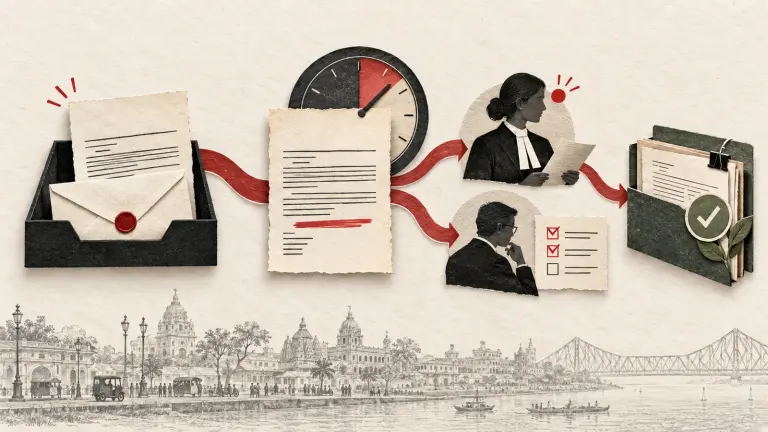
Ignoring a legal notice does not automatically mean you admit every allegation or lose a case. But ignoring the wrong document can cause serious procedural problems. A private lawyer's demand is different from a statutory notice, court summons, interim order or government communication. If you have not responded, first identify what you received, preserve proof of when it arrived, and check whether a legal deadline has passed. Then get advice on the claim, limitation and next step.
Identify the document before predicting consequences
People use “legal notice” for many types of letters. Look at the sender, named client, title, statutory section, court or authority, case number, method of service, demanded action and deadline. Is it a lawyer's private demand? A notice under a statute? A summons issued by a court? A police or regulator notice? An order directing you to do or stop something?
A private advocate's notice usually states one party's position and asks for action. It is not itself a decree or injunction. The sender may later file a case, but must still establish the legal requirements. Silence by itself does not automatically make the allegations true.
A court summons or order is different. It comes from a court or tribunal and can require an appearance, response, compliance or other action under procedural rules. Missing that deadline may expose you to consequences such as an ex parte proceeding, procedural orders or enforcement steps, depending on the forum and case. Contact counsel immediately rather than sending only a general letter to the opposing lawyer.
Some statutory notices have their own timing and consequences. Under section 138 of the Negotiable Instruments Act, a cheque-dishonour demand notice is part of a specific statutory process, with a 15-day payment period after receipt for the drawer and other timelines for the payee. The official Act should be read with the bank memo and service record. A seven-day deadline in an ordinary contract letter does not automatically have the same legal status.
What can follow an unanswered private notice?
The sender may send a reminder, negotiate, discontinue the demand, begin mediation if required, file a civil or commercial suit, pursue arbitration under an agreement, or take another legally available step. Which route is possible depends on the claim, contract, forum, limitation and evidence. The sender may also do nothing. No universal sequence applies.
An unanswered letter can become part of the evidence showing that a demand was made and no response arrived. A court may consider correspondence in context, but silence does not automatically prove liability or convert a disputed claim into a judgment. You may still have defences, set-offs, limitation arguments or evidence that the sender's account is incomplete.
The sender's response deadline is often a requested deadline rather than a court-mandated period. It should not be ignored casually, but it is not automatically an enforceable order. Check whether the deadline comes from a statute, contract, court rule or only the sender's demand. If you need more time, counsel may be able to seek an extension or send a measured acknowledgment without admitting the claim.
Deadlines to check carefully
| Document or issue | What to verify | Immediate action |
|---|---|---|
| Court summons or order | Court, case number, service date, appearance or filing date | Contact an advocate and calendar the court deadline |
| Cheque dishonour under NI Act §138 | Receipt date, cheque, bank memo, amount and statutory steps | Get urgent advice on the 15-day payment period and related procedure |
| Government/public officer claim | Whether CPC §80 applies and any urgent-relief exception | Check the two-month notice rule and counsel's route |
| Commercial dispute | Commercial nature, specified value, urgent interim relief | Check pre-institution mediation under Commercial Courts Act §12A |
| Contract or debt demand | Cause-of-action date, contract, payments and acknowledgments | Check limitation independently; do not rely on the notice date |
| Private letter deadline | Whether contract or statute makes it binding | Respond strategically; do not confuse request with court order |
Section 80 of the Code of Civil Procedure generally requires two months' prior notice before instituting a suit against Government or a public officer for an act purportedly done in official capacity. Section 80(2) permits a suit seeking urgent or immediate relief with the court's leave, subject to its terms. This is a specific rule, not a universal requirement for suing every person. See the official Code of Civil Procedure.
Section 12A of the Commercial Courts Act requires pre-institution mediation for a commercial dispute of specified value where the suit does not contemplate urgent interim relief. Whether it applies depends on the dispute and procedural law. Read the official Commercial Courts Act, and do not treat every business payment demand as automatically subject to the same process.
Limitation does not normally restart because a notice was sent
A common mistake is to assume the sender can keep a claim alive by sending reminders. Limitation is governed by statute and the type of remedy. The Limitation Act, 1963 includes section 18, which can start a fresh period where a written acknowledgment of liability is signed by the liable party before the existing period expires, and section 19, which deals with qualifying payment on account of a debt or interest before expiry. Each has statutory requirements.
A creditor's unilateral notice is not ordinarily the debtor's signed acknowledgment. A recipient's silence also does not automatically become one. But a reply admitting a debt, a signed balance confirmation, or a qualifying payment may affect limitation depending on the language, date and circumstances. Do not send an acknowledgment or part payment without understanding the effect. Review the official Limitation Act with counsel.
What to do if you already missed the stated date
- Do not destroy the notice. Preserve the envelope, courier tracking, email headers and all attachments.
- Check whether a court or authority is involved. Look for a case number, seal, e-filing reference, official service method or order.
- Calculate dates from service. Some deadlines run from receipt or service, not the document's date. Record both.
- Contact counsel quickly. Share the full notice and contract, not just a summary. Ask whether an application, appearance, payment or reply is now urgent.
- Preserve your evidence. Collect agreements, invoices, payment proof, messages, delivery records and witnesses.
- Avoid spontaneous admissions. A late response can still help, but do not make a promise or concession to “fix” the missed deadline without advice.
- Keep communication professional. A short request for time may be appropriate, but it does not extend a court deadline unless the court or law provides for it.
If the document is plainly a private notice and no statutory or court deadline appears, you may still decide to respond, negotiate or wait for the sender's next step after legal review. The point is to make that choice deliberately. A vague threat to sue is not the same as a filed case, but it may be a signal to prepare.
Worked example: ignored invoice demand, then received summons
Ravi receives a demand from a supplier's lawyer for an alleged balance of ₹2 lakh. He believes he paid it and ignores the letter. Six weeks later, a process server delivers papers bearing a civil court name and case number.
The first letter was a private demand. Ravi's silence did not automatically establish the balance. The second delivery is court process. He should immediately photograph the documents, note how and when they were served, contact an advocate and check the appearance/filing date. He should gather the contract, invoices, bank statement, payment confirmation and ledger. He should not assume that emailing the supplier's lawyer now replaces the court response.
If Ravi's bank record shows the payment, counsel can assess whether the amount is credited, whether the supplier's suit is correctly framed, and what response is required. If the case is a qualifying commercial dispute, counsel can assess the applicable procedure and any mediation requirement. If the limitation period is relevant, the earlier demand date does not automatically restart it. The correct step depends on the filed claim and service date, not on a generic internet deadline.
Does ignoring a notice create a defamation claim?
No. The sender's allegations, your silence and a possible later dispute do not automatically create a defamation claim for either party. Defamation requires analysis of the actual words, publication, audience, applicable law and defences. Do not threaten a counterclaim merely to pressure the other side. If the sender publishes the allegations or contacts third parties, preserve evidence and ask counsel to assess the specific conduct.
FAQs
If I ignored a lawyer's notice, have I admitted the claim?
No automatic admission follows from silence alone. A court may consider the correspondence in context, but the claimant still has to establish its case. Other statutes or procedural rules can create separate consequences, so classify the document first.
Can the other side sue immediately after the deadline in its letter?
It may be able to file if legal requirements are met, but a sender's deadline is not always a statutory waiting period. Some matters require a prior notice or mediation; others do not. The claim, contract and forum determine the route.
Is a court summons just another legal notice?
No. A summons is court process. It can require a procedural response or appearance, and missing the date can have serious consequences. Get advice immediately and follow court directions.
Does a notice extend the limitation period?
Generally, a unilateral notice does not restart limitation. The Limitation Act has specific rules for signed acknowledgment and qualifying payments. A reply or payment may matter, so get advice before acknowledging a disputed debt.
What if the notice is from the Government?
Identify the authority, statute, service method and response date. Government notices may arise under specific procedures and should not be handled like ordinary private demands. Section 80 CPC concerns notice before certain suits against Government/public officers; it is not a blanket rule for every government communication.
Can I still reply after the stated date has passed?
Possibly, but first determine whether the date was statutory, contractual, set by a court, or only requested by the sender. A late reply cannot automatically cure a missed court deadline. Counsel can advise whether a response, application or settlement step is appropriate.
Checklist for today
- Sort private demand from statute, summons, order or official notice.
- Preserve service evidence and calculate actual deadlines.
- Contact counsel at once if a court, NI Act matter, Government or regulator is involved.
- Gather the contract and factual evidence behind the demand.
- Check limitation separately; do not infer it from the letter date.
- Avoid admissions, retaliatory publication or unsupported counter-threats.
- Record every next date and retain proof of any reply or filing.
Read legal notice management workflow, urgent legal notice email workflow, and litigation status reporting for related process guidance. Explore India legal research workflows, contract review workflows, or contact Gotham. This article is general information, not legal advice. Have a qualified Indian lawyer assess the notice, forum, limitation period and required next step.
This article provides general legal information, not legal advice. Notice requirements and deadlines depend on the claim, statute, forum, facts and jurisdiction. Obtain advice from qualified counsel before acting.
How Gotham researches and reviews field guides