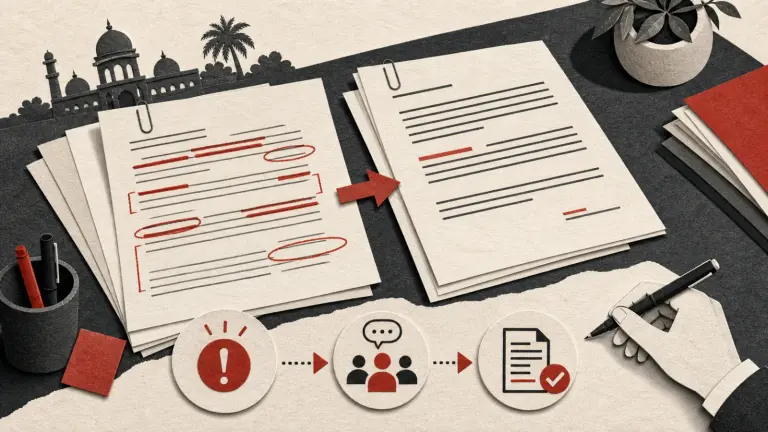
A home purchase contract may give you a right to end the deal if financing is denied, but you should not assume that a general 30-day clause will do so. Before signing, ask for the contract to say what happens if the lender refuses the loan, how long the condition lasts, who must return each payment and when. Whether any amount is refundable depends on the complete agreement, the parties and the facts.
This matters whether the purchase is associated with Minha Casa, Minha Vida (MCMV) or another financing route. The program name does not replace the private purchase contract or decide what happens to every deposit, installment or brokerage fee. A home purchase can involve separate agreements with a seller or developer, a broker and a bank. Check each document and the person or company that receives each payment.
Separate a short review window from a financing condition
A contract might let either side cancel within 30 days if a property or document problem prevents the sale. That is not necessarily the same as a financing condition that lasts until the lender finishes reviewing your application. Ask a lawyer to read the exact wording with the rest of the agreement, including any paragraph about deadlines, deposits, brokerage, penalties and extensions.
A recent Superior Court of Justice (STJ) decision illustrates why the written terms matter. In AgInt no AREsp 2,155,010/RJ, published on 14 May 2026, the lower court's decision relied on an express clause addressing the non-approval of financing, among other contract and evidence details. The state court ordered a return of 80% of the amounts at issue. The STJ declined to re-examine the contract and evidence in that appeal. This decision does not create a universal refund rule, decide an MCMV purchase, or guarantee that a similar clause will produce the same outcome.
The Brazilian Civil Code, Law 10,406/2002, treats a condition as a future, uncertain event that can affect a transaction's legal effects. It also recognises contractual freedom within legal limits and allows parties to set objective rules for how clauses operate and which party bears a risk. That gives the parties a framework for negotiating a financing condition; it does not require a seller to accept a buyer's proposed wording.
Ask the contract to answer five practical questions
| Point to clarify | Questions to put in writing |
|---|---|
| What counts as a financing failure? | Does the term cover a written denial, approval for less than the amount needed, or an appraisal or property-document issue? Does it apply if the bank's review remains pending? |
| When does the condition end? | Does it end a fixed number of days after signing, or after a defined lender decision? What happens if the lender asks for more documents or is still reviewing the file? |
| What must each party do? | Which application steps and documents must the buyer provide, by what dates, and how will a bank decision be evidenced? Are extensions documented in writing? |
| Which payments are covered? | Does the term address the deposit, installments, an option amount, brokerage or other sums? Who received each payment, and which party is responsible for returning it? |
| How and when is a return made? | What notice is required, how is the agreement ended, what is the return deadline, and are any deductions permitted? Identify who has authority to sign the distrato. |
Terms such as “not caused by the buyer,” “financing not approved,” “all amounts,” or “within 30 days” may leave important questions open. If the parties use one of these phrases, ask what it means in this transaction. For example, an application may be denied because a buyer missed a document deadline, because the bank's property appraisal differs from the price, or because the property documentation needs correction. The agreement should make clear which events count and what the buyer must do to invoke the condition.
Do not assume a brokerage fee will be returned just because a seller refunds a deposit. Identify the recipient and read the separate brokerage agreement. In the STJ case above, the dispute involved an express refund provision and evidence about the transaction; the lower court's order was for 80%, not a blanket return of every payment. The case is a reason to name the payment, recipient and responsible party clearly, not a model clause to copy.
Check which kind of property transaction you have
A purchase from a private seller, a purchase of a new unit from an incorporator and a signed real-estate loan may engage different rules and parties. For contracts involving units in a real-estate incorporation, Brazil's Law 4,591/1964 contains specific contract-summary and cancellation provisions, including rules about what the summary should disclose. Those provisions should not be assumed to answer every question about a lender's decision before closing. The contract's structure and the stage of the transaction matter.
Also separate a financing application for a planned purchase from a dispute after a loan has been signed. A denial before closing is not the same event as a borrower falling behind on an existing mortgage or a lender enforcing a registered fiduciary-transfer guarantee. Do not use a general refund clause to infer what happens under a separate bank contract.
If you have not signed yet
Before paying a deposit or signing, ask for the financing condition to appear in the final contract and any related receipt or brokerage document that controls your payment. Read the clause with the rest of the agreement. Check that any conflicting deadline, forfeiture or deduction provision is reconciled in writing. If a change is accepted, make sure every relevant party signs the same final version and keep a complete copy.
You can propose terms that address the lender's decision, but there is no universal rule from the materials reviewed here that makes this exact clause standard in Brazilian home purchases. The parties can negotiate, and a seller can decline. A local real-estate lawyer can explain the legal and commercial effect of the proposed wording before you commit money.
If you already signed
Save the complete signed contract and every addendum, payment receipt, advertisement, brokerage agreement, lender message and application-status record. Keep a dated note of calls and ask for important updates in writing. Identify which party received each amount and which clause governs a cancellation or refund. Give a qualified Brazilian real-estate lawyer the full set of documents; a short excerpt may omit a definition, deadline or exception that changes the analysis. If the agreement was signed electronically, our Brazil e-signature evidence guide covers records that may help check identity, authority and the signed version.
Do not sign a distrato, waiver or settlement, or accept a deduction, based only on a message that financing “did not work out.” Ask the other party to identify the clause and calculation it relies on. Whether you have a claim, must pay a penalty or can recover a payment depends on the exact transaction and evidence. This guide cannot determine that outcome. When checking the agreement, also compare its definitions, exceptions and cross-references; our contract consistency guide explains that review task.
For a negotiated contract revision, our contract redlining workflow describes how a legal team can record the original wording, proposed change and approval. A broader contract review playbook covers how teams organize review and approval. These are operational guides, not a substitute for a lawyer's advice on a Brazilian property transaction.
Before you send the contract for review
- Identify each buyer, seller, developer, broker and lender, and the role each plays.
- Mark the financing amount and dates the transaction depends on.
- Find every reference to financing, appraisal, bank approval, deposit, brokerage, cancellation, penalty, refund and deadline.
- List each payment already made, the recipient and the document that records it.
- Ask what written event starts and ends the financing condition.
- Confirm which parties must sign a change or refund agreement.
- Keep personal, banking and property identifiers private when sharing copies.
An article cannot tell you whether a contract protects a specific payment. Have the complete documents reviewed by a qualified Brazilian lawyer before you sign, cancel or agree to a refund calculation.
Questions about financing conditions in a Brazil home purchase contract
Does an MCMV buyer automatically get a full refund if financing is denied?
Do not assume that. A refund depends on the signed documents, who received each payment, the transaction structure and applicable law. Minha Casa, Minha Vida does not by itself establish the result of every private purchase contract.
Can I ask the seller to add a financing-denial clause?
You can propose a written term before signing, but the seller may accept, reject or negotiate it. A proposed clause has no effect unless the parties adopt it in the executed agreement.
Is a 30-day document-review clause the same as a financing contingency?
Not necessarily. Read the actual trigger and end date. A clause about property or document irregularities within 30 days may not clearly cover a lender's later decision on the buyer's financing.
Will a financing-denial clause return brokerage fees too?
Not automatically. Check who received the fee, what the brokerage agreement says and whether the proposed clause names that payment and the responsible party. A court decision about another contract cannot decide your own fee.
What should I do if I already signed and the bank has not approved the loan?
Read the signed contract, amendments, receipts and brokerage agreement; save the lender's written status and all payment records; and get advice from a qualified Brazilian real-estate lawyer before signing a distrato or accepting a deduction.
General information about Brazilian contract issues, not legal advice. The result depends on the signed documents, transaction structure, parties, payment records and applicable law. Ask a qualified Brazilian real-estate lawyer to review the complete contract before signing, cancelling or agreeing to deductions.
How Gotham researches and reviews field guides