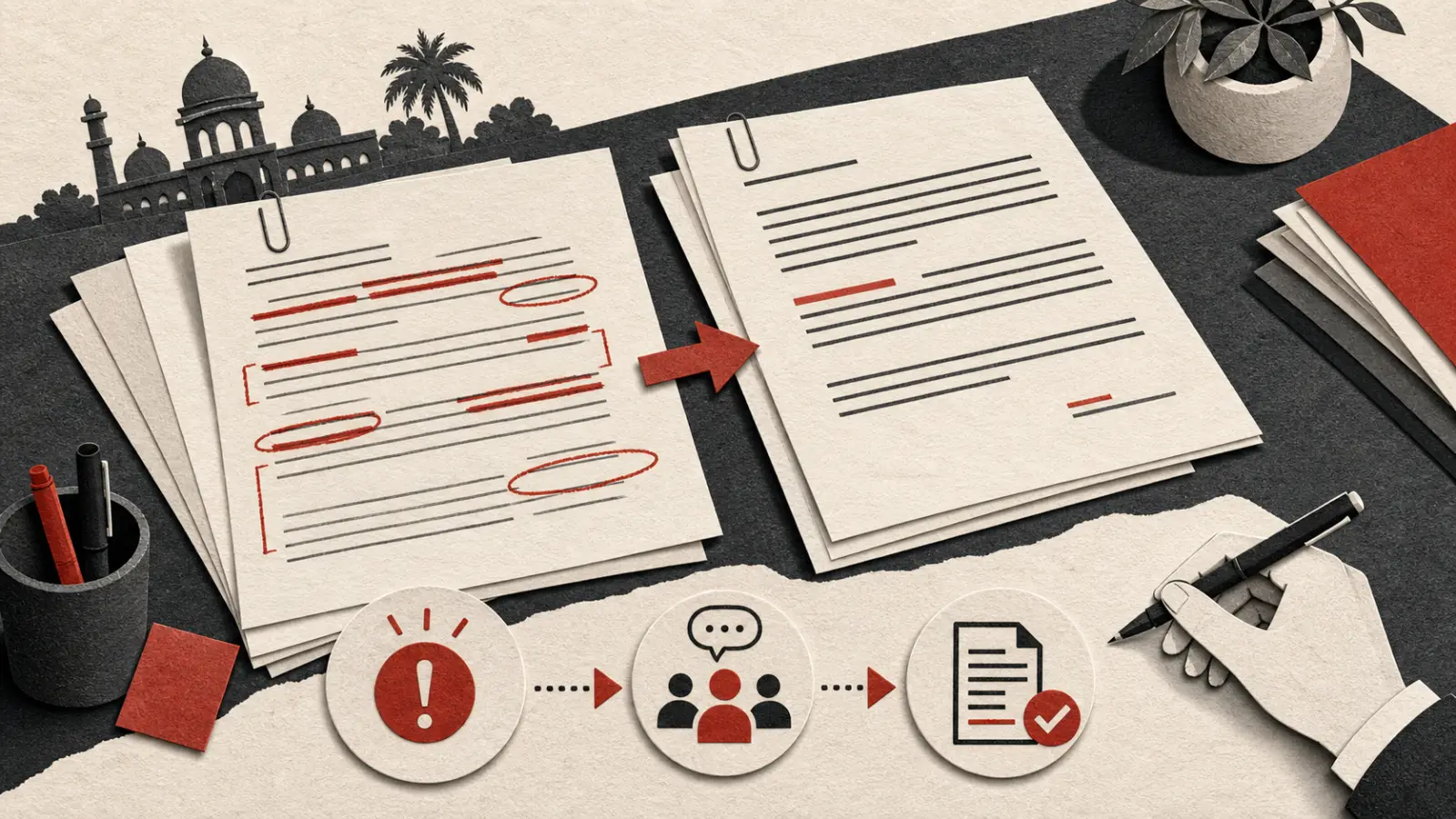
A contract redlining workflow is the controlled path from a counterparty draft to an approved signing copy. It is not simply turning on Track Changes. A dependable process preserves what was received, makes each proposed change intelligible, routes genuine exceptions to the right person, and leaves an audit trail that another lawyer can reconstruct.
The best workflow feels light because its controls sit at natural decision points. This guide sets out a practical model for legal teams that want faster negotiation without sacrificing context or judgment.
What should happen before anyone starts redlining a contract?
Begin with a clean intake. Save the source file exactly as received and record its sender, date, agreement type, parties, business owner, expected value category, governing jurisdiction, target signature date, and related documents. Do not overwrite that source. If the contract refers to schedules, policies, statements of work, or online terms, collect them before review.
Confirm which side's paper is being used and whether an approved template exists. Ask the business owner for the commercial bargain in plain language. A lawyer cannot sensibly revise a renewal clause, service level, or liability allocation without knowing what the deal is meant to achieve.
| Intake item | Why it matters | Evidence to retain |
|---|---|---|
| Original draft | Establishes the negotiation baseline | Read-only source copy and receipt details |
| Parties and entities | Prevents contracting with the wrong entity | Entity names and authorised contacts |
| Deal summary | Connects drafting to commercial intent | Requester's concise written summary |
| Referenced documents | Reveals obligations outside the main file | Schedules, policies, URLs, prior amendments |
| Deadline and owner | Makes routing and escalation possible | Named business and legal owners |
| Applicable playbook | Sets the approved review position | Playbook name and version |
The Indian Contract Act, 1872 is an important official source for Indian contract law, but it is not a redlining playbook. Transaction-specific laws, facts, authority, and current advice may all matter. The workflow should prompt a reviewer to identify those questions rather than claim to answer them automatically.
How should a reviewer create the first legal redline?
Work in a new review copy with a predictable filename and a single designated editor. First read the agreement as a whole. Definitions, order-of-precedence clauses, schedules, and incorporated policies can change the effect of apparently ordinary language. Then make a structured pass by issue rather than editing isolated sentences on sight.
For each material change, decide whether the goal is to correct an error, align language with the commercial deal, apply a standard position, address a legal requirement, or escalate a non-standard risk. Use comments for short explanations and questions. Avoid commentary that is argumentative, vague, or written for an internal audience when the file will go outside the organisation.
A useful first-pass sequence is:
- Confirm parties, dates, scope, price mechanics, and document hierarchy.
- Check operational duties, acceptance, dependencies, and service commitments.
- Review confidentiality, data, intellectual property, compliance, and audit rights.
- Review warranties, indemnities, liability, insurance, remedies, and termination.
- Check notices, assignment, dispute provisions, governing law, execution, and schedules.
- Run a cross-reference and defined-term check after edits are complete.
Keep formatting changes separate where possible. A redline full of font and spacing noise hides the negotiation. Gotham's legal practice workspace can keep the document, matter context, and review activity together, while workflow tools can support repeatable intake and approval stages.
What is contract negotiation automation, and how do playbooks guide redlines?
Contract negotiation automation helps a team collect the right deal facts, compare a draft with approved positions, prepare proposed edits, and route exceptions. The playbook supplies the conditions and decision owner; it does not make the final legal or commercial judgment. A reviewer should be able to trace each suggestion to the received document, the applicable playbook version, and the fact that triggered it.
For example, suppose a counterparty draft permits disclosure to all affiliates, while the team's playbook allows affiliate access only when the business owner confirms a need and the recipient is bound by suitable confidentiality duties. The first pass should flag the clause and ask which affiliates need access. It should not silently delete the permission or approve it merely because similar wording appeared in an earlier deal. If the facts support a permitted fallback, the lawyer can propose a tracked change; otherwise the issue goes to the named approver.
| Decision-log field | Illustrative entry |
|---|---|
| Source and location | Counterparty draft v1, permitted-recipient clause |
| Playbook rule | Affiliate access requires confirmed need and appropriate duties; record playbook version |
| Missing fact | Which affiliates need the information, and for what purpose? |
| Proposed action | Hold the redline until the business owner answers; then use the approved position or escalate |
| Owner and outcome | Named reviewer, approver if needed, decision date, and linked approval |
| Final evidence | Tracked version, clean copy, and comparison against the approved decision |
This example is a workflow illustration, not a suggested clause or a statement about Gotham's automated output. The contract review playbook guide explains how to define the underlying positions and escalation rules.
How do clause playbooks improve a contract redlining process?
A clause playbook gives the reviewer a preferred position, permitted fallbacks, context questions, and an escalation owner. It should not reduce every clause to red, amber, or green. A limitation clause, for example, may depend on contract role, deal structure, data access, available remedies, insurance, and linked indemnities.
Use a compact decision record:
| Playbook field | Reviewer action |
|---|---|
| Preferred position | Apply when the stated conditions are met |
| Fallback | Confirm its preconditions before selecting it |
| Context questions | Obtain missing facts from the appropriate owner |
| Linked clauses | Review definitions, exclusions, schedules, and remedies together |
| Escalation trigger | Quote the deviation and explain why approval is needed |
| Decision owner | Route to the role with actual authority |
| Rationale | Record the reason for the final position |
The UNCITRAL Model Law on Electronic Commerce describes principles including functional equivalence, technology neutrality, and non-discrimination against electronic form. It is a model law, not a universal rulebook for a particular contract. Its careful distinction between function and medium is still a useful design lesson: a digital workflow should preserve the functions served by an original, signature, record, and evidence trail.
When should a redline be escalated for approval?
Escalate when a proposed position falls outside delegated authority, not whenever a clause looks unfamiliar. The request should be decision-ready. Include the relevant language, the standard position, the proposed deviation, commercial context, connected terms, plausible consequence, available options, and the reviewer's recommendation.
Route by subject and authority. Privacy, security, tax, finance, insurance, product, and executive approvals should go to named roles with deputies. A shared mailbox with no accountable owner is not a control.
Use this approval checklist:
- The exact deviation is quoted or linked.
- The business reason for requesting it is recorded.
- Relevant definitions and connected clauses were checked.
- The recommendation distinguishes legal and commercial considerations.
- Conditions attached to approval are explicit.
- The approver's identity, decision, and date are retained.
- The final draft reflects the decision without unintended changes.
Approval in chat or email may be operationally convenient, but the outcome should return to the matter record. The contract review software guide explains how to evaluate traceability and lawyer-led validation when selecting supporting technology.
How do you exchange versions without losing the negotiation history?
Choose one exchange protocol and state it at the outset. Keep a clean working copy and a comparison copy where useful. Accept or reject changes deliberately before the next round, and never assume that a filename containing “final” is the agreed signing version.
A simple naming convention can combine agreement, party, date, round, and status. The label matters less than consistency. Restrict editing rights, use version history, and identify who is responsible for producing each comparison. Before sending, compare against the last received version rather than relying on visual memory.
ISO guidance on documented information notes that organisations have flexibility in how they document information within a quality system. That is a useful operational principle here. Keep the records needed to operate and evidence the process, but avoid collecting fields that nobody uses.
What quality checks belong before signature?
The final quality pass should use both a clean copy and a comparison. Confirm that all comments are resolved, tracked changes are intentionally accepted, blanks are completed, defined terms are used consistently, cross-references work, schedules are attached, signature blocks match the parties, and the document hierarchy is coherent.
Also reconcile the contract with approvals. If an approver authorised a specific fallback subject to a condition, verify both the wording and the condition. Check that last-minute business edits did not bypass review.
| Final check | Question to answer |
|---|---|
| Text integrity | Does the clean copy match the approved redline? |
| Completeness | Are every schedule, exhibit, and incorporated item present? |
| Internal logic | Do definitions, references, dates, and precedence provisions align? |
| Authority | Were required exceptions approved by authorised roles? |
| Execution | Are names, entities, signature method, and counterparts addressed? |
| Retention | Can the signed copy and decision history be retrieved later? |
How can a legal team improve the workflow over time?
Review a sample of completed negotiations at regular intervals. Look for repeated exceptions, missing intake facts, avoidable formatting noise, slow approval points, and clauses that produce inconsistent decisions. Discuss why those patterns occur before rewriting the playbook.
Measure process quality rather than raw editing volume. Useful questions include whether escalation packets were complete, whether the final copy matched approvals, whether reviewers could find the right guidance, and whether the signed contract was stored with its related record. Do not reward fewer redlines without considering deal quality, and do not treat every exception as failure.
A good contract redlining workflow gives lawyers room to reason while making routine handoffs dependable. Start with one agreement type, test the process on representative files, and revise it from observed work. To discuss a traceable review workflow for your team, contact Gotham, review the security approach, or explore Gotham pricing.