A contract review playbook should make a busy lawyer's next decision easier. Too many playbooks do the opposite. They become long policy documents, detached from the document on screen and difficult to apply under deadline pressure.
The useful version is a decision system. It connects each clause to a preferred position, acceptable fallbacks, contextual questions, approval authority, and a record of what happened. This guide explains how to build that system without flattening legal judgment into a collection of traffic lights.
What problem should a contract review playbook solve?
Start with the work, not the template. Interview the people who request, review, negotiate, and approve one recurring agreement type. Ask where reviews stall, which issues recur, and which exceptions arrive too late. Pull a small, permitted sample of completed matters and compare the actual redlines with the reasons recorded for them.
That exercise usually exposes several different needs:
- new reviewers need to know the organisation's baseline position;
- experienced lawyers need quick access to fallback language and escalation rules;
- business owners need clear questions they can answer;
- approvers need the clause, risk, commercial context, and recommendation in one place; and
- legal operations teams need consistent records that can improve the process.
Define a narrow first release around one agreement type, one review side, and one operating context. A customer-side software agreement playbook should not quietly double as a vendor-side services playbook. The parties, leverage, data flows, regulatory context, and economics may call for different positions.
The playbook is operational guidance, not a statement that one clause is universally correct. For Indian agreements, teams may consult the official text of the Indian Contract Act, 1872 alongside transaction-specific legislation and current advice. The Act is a legal source, not a substitute for deciding the organisation's commercial stance.
What belongs in a usable clause position schema?
A clause entry should answer the questions that arise while the reviewer is looking at the language. Keep legal reasoning visible, but separate it from the short instruction needed during a live review.
| Field | What to capture | Practical example |
|---|---|---|
| Clause and purpose | Standard name plus the business or legal function | Limitation of liability; allocates exposure if obligations fail |
| Preferred position | Drafting the team ordinarily proposes | Mutual cap tied to an agreed commercial reference point |
| Acceptable fallbacks | Pre-approved alternatives in order | Different cap structure if specified conditions are met |
| Unacceptable or escalate | Language requiring another decision | Uncapped exposure outside approved categories |
| Context questions | Facts that can change the position | Deal role, data access, insurance, value, term, criticality |
| Dependencies | Other provisions that affect the analysis | Indemnity, exclusions, remedies, security, termination |
| Rationale | Concise reason behind the position | Keeps exposure aligned with the agreed allocation of risk |
| Drafting options | Approved text with usage notes | Preferred and fallback wording, with defined-term checks |
| Decision owner | Role authorised to approve an exception | Legal lead, security owner, finance owner, business sponsor |
| Evidence and record | What the reviewer must retain | Source text, selected position, rationale, approver, date |
Avoid absolute labels unless the policy truly is absolute. A “red” clause may be acceptable after a fact changes or an authorised person approves it. A “green” clause can still be problematic when a definition, schedule, or related provision changes its effect.
Drafting options also need boundaries. Record when the language applies, what defined terms must be adjusted, and which connected clauses must be checked. Copy-ready text without those notes invites mechanical redlining.
The contract redlining workflow shows how to carry a playbook position into a tracked change, escalation decision, and verified signing copy.
How should escalation work when a clause falls outside the playbook?
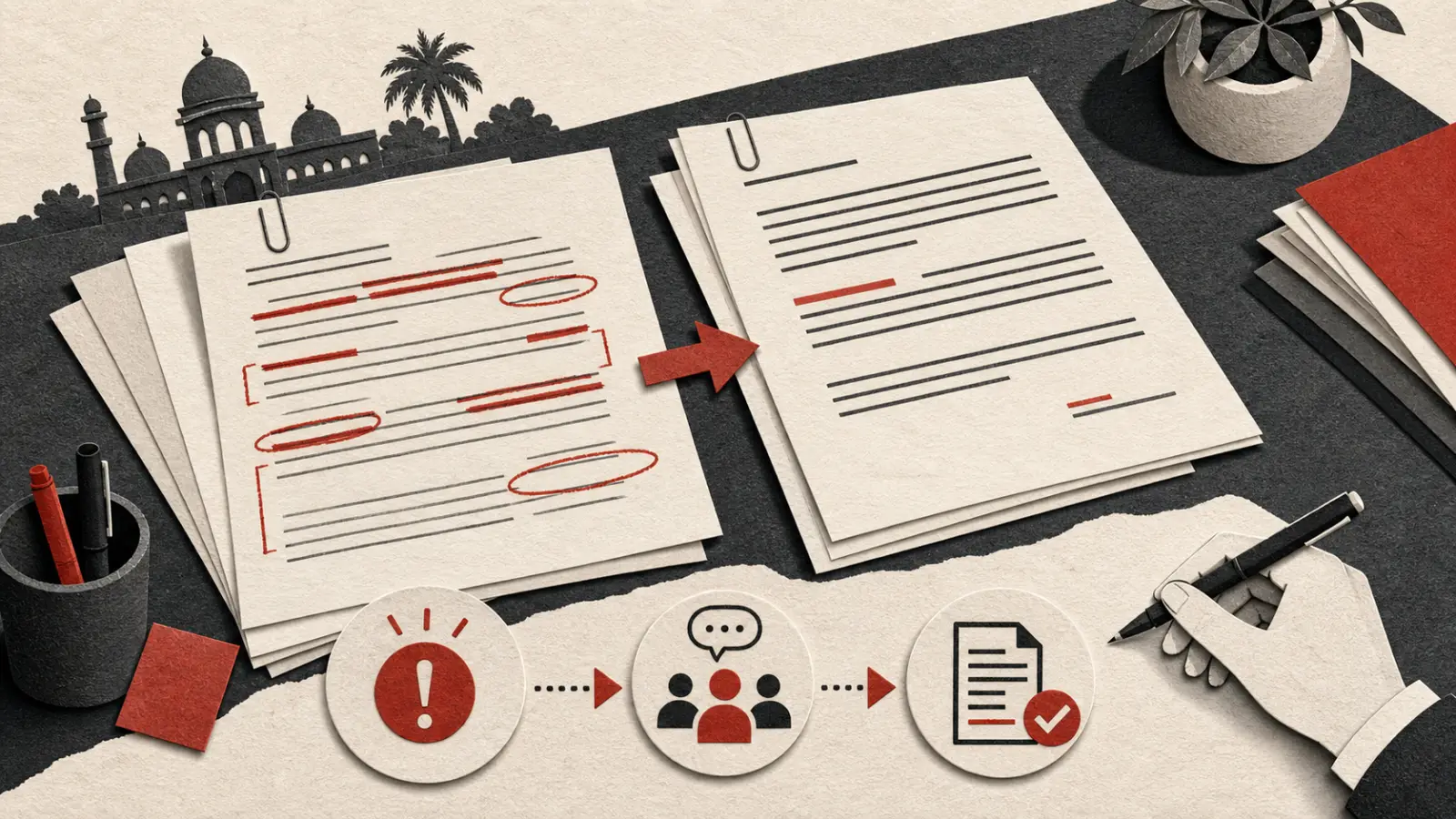
An escalation path should be specific enough to run without a meeting about the process. Design it as a short workflow:
- Identify the deviation. The reviewer quotes or links to the operative language and selects the playbook position it departs from.
- Collect decision facts. A structured form asks only the questions relevant to that issue, such as contract role, service criticality, data involved, term, and available insurance.
- Assess connected terms. The reviewer checks definitions, carve-outs, remedies, indemnities, termination rights, schedules, and amendments that could alter the result.
- Recommend an action. The reviewer proposes accept, reject, redline, or accept with a mitigation. The recommendation includes a short rationale.
- Route by authority. Legal issues go to the named legal role. Security, privacy, finance, or commercial issues go to their designated owners. Cross-functional decisions can require more than one approval.
- Record the outcome. Preserve the source language, decision, approver, rationale, conditions, and approved drafting with the matter.
- Close the loop. Repeated exceptions enter a governance queue. They do not silently rewrite the standard.
Set service expectations and deputies for each approval role. Otherwise, the neatest escalation matrix will stop when its only approver is unavailable. Gotham's workflow automation tools are designed around repeatable review, routing, and approval processes, while its legal practice workspace keeps the surrounding matter context accessible.
How do you keep legal judgment instead of encoding false certainty?
Rules work best for repeatable observations and routing. Judgment remains necessary where meaning depends on drafting interactions, facts, law, or negotiation context. Write the playbook so a reviewer can tell which kind of task they are performing.
For each clause, distinguish among:
- presence checks, such as whether a confidentiality survival period appears;
- text comparisons, such as whether wording matches an approved option;
- fact-dependent decisions, such as whether a service is operationally critical; and
- legal assessments, where qualified counsel must interpret the agreement in context.
Electronic contracting provides a useful example. The UNCITRAL Model Law on Electronic Commerce offers a legal framework built around functional equivalence for electronic communications. It does not tell a company which execution process, evidence package, or contract position fits every jurisdiction and transaction. A playbook should point reviewers to the issue and the current applicable source, then route the decision appropriately.
Software can assist with extraction, comparison, and issue spotting, but its output should lead back to the contract text. The companion guide on contract review software in India explains how to assess traceability, deployment, and lawyer-led validation before putting a playbook into a tool.
How do you test a playbook before asking lawyers to trust it?
Use completed agreements that the organisation is permitted to reuse. Include clean templates, negotiated drafts, amendments, non-standard headings, missing schedules, tables, and poor scans. Ask lawyers with relevant experience to apply the proposed playbook independently, then compare their decisions and friction points.
Test for workflow quality, not just whether the playbook contains many clauses:
- Can a reviewer find the applicable position quickly?
- Are contextual questions answerable by the person receiving them?
- Do escalation packets contain enough information for a decision?
- Are fallback choices genuinely pre-approved?
- Do linked clauses appear together at the right moment?
- Can another reviewer understand why an exception was accepted?
- Does the playbook catch known recurring issues without producing distracting noise?
Pilot it on a contained stream of live work with a clear fallback to the existing process. Observe where lawyers leave the workflow, search elsewhere, or write free-form notes. Those behaviours often reveal missing context or overly rigid fields. Do not treat workarounds as user resistance by default. They are product feedback.
If AI-assisted review is involved, test clause identification and suggested actions separately. A correct extraction can still be paired with an unsuitable recommendation, and a polished summary can still omit a material exception. The Gotham security overview can help frame diligence questions about access and deployment before sensitive agreements enter a review system.
What governance keeps a contract review playbook reliable?
A playbook changes as templates, risk appetite, products, laws, and negotiation patterns change. Give it an owner and a controlled release process from the first version. ISO's overview of ISO 31000 risk management emphasises integrating risk management with governance, strategy, planning, and organisational processes. A contract playbook can support that approach, but it should reflect the organisation's own risk framework rather than borrow labels without context.
Use this governance checklist:
- A named owner is accountable for each agreement playbook.
- Each clause position has a reviewer and approval authority.
- Versions show what changed, why, who approved it, and when it takes effect.
- Legal and business stakeholders review changes that affect their decisions.
- Approved templates, drafting options, and playbook rules stay aligned.
- Access rights limit who can publish or approve changes.
- Exceptions are analysed for patterns without becoming automatic precedent.
- Users can report unclear guidance and receive a tracked response.
- Periodic tests use representative documents and record findings.
- Retired guidance remains identifiable in historical review records.
- References to legislation, policies, and external standards are checked for currency.
- Training and release notes explain material changes to reviewers.
Set review triggers in addition to a calendar. A new template, product, jurisdiction, regulator requirement, repeated escalation, or major incident may justify an earlier review. Keep prior versions attached to prior decisions so historical work does not appear to have followed rules that did not yet exist.
How do you make lawyers choose the playbook over a private checklist?
Reduce the distance between guidance and action. Surface the relevant clause position beside the contract, prefill matter facts that are already known, and make escalation possible without copying text into email. Let reviewers add nuance, cite source language, and see who owns the next decision.
Training should use realistic documents rather than a tour of every feature. Show how a common deviation is identified, routed, decided, redlined, and recorded. Explain what the playbook does not decide. That boundary earns more trust than pretending the system is comprehensive.
Finally, measure adoption through the quality of work, not simple logins. Look for fewer incomplete escalation requests, clearer rationales, more consistent use of approved fallbacks, and easier handoffs. Review those signals carefully, without turning individual lawyer behaviour into surveillance.
A durable contract review playbook is small enough to use, specific enough to guide a decision, and governed well enough to remain credible. Start with a real agreement flow, make exceptions easy to route, and improve the playbook from observed work. To explore how Gotham can support playbook-led document review, contact the Gotham team.