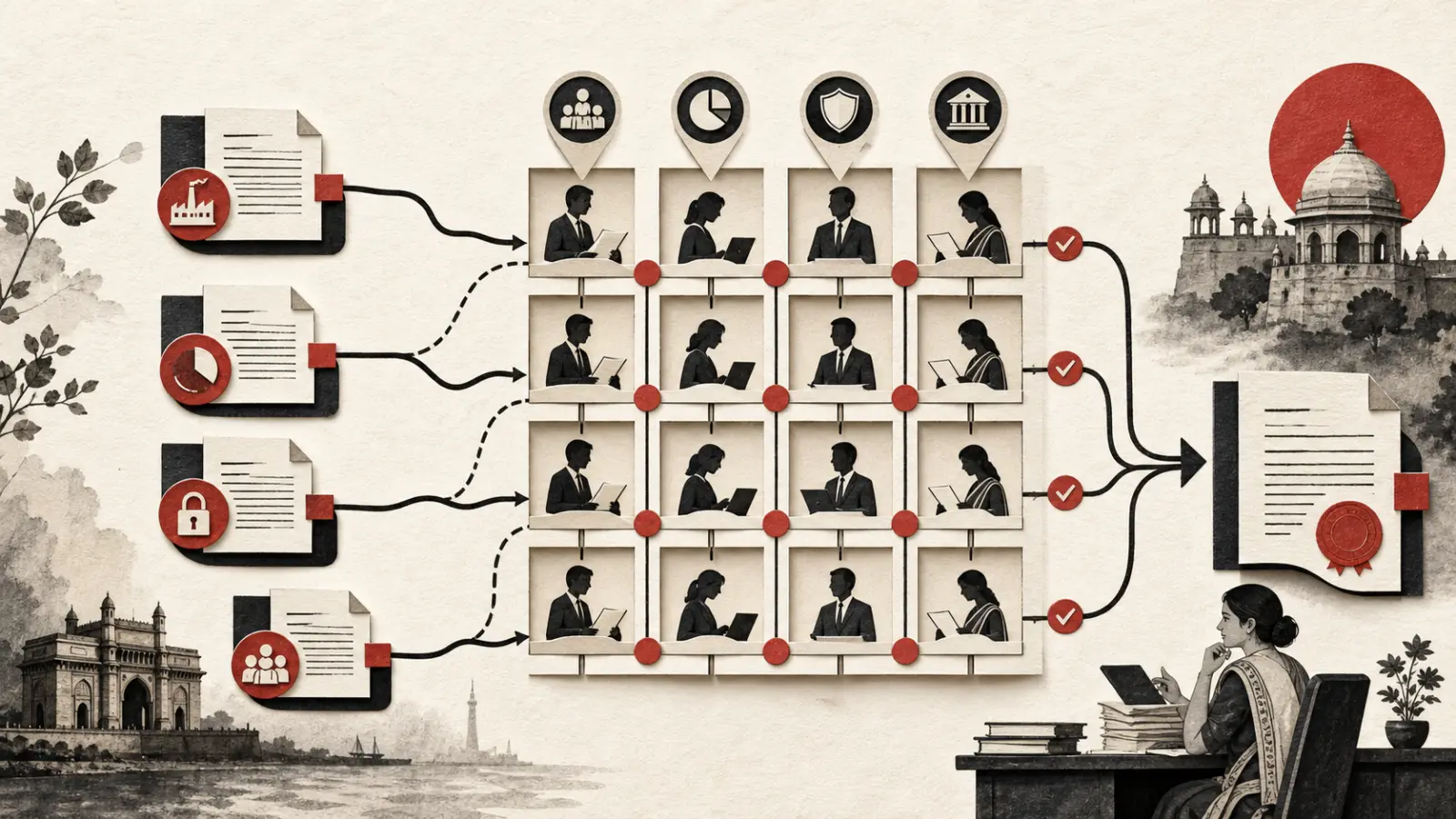
Contract review software helps legal and business teams turn a document into a structured review: identify clauses, locate missing protections, compare language, record decisions, and prepare a response. For an Indian organisation, the best choice is the tool that fits the organisation's contracts, approval rules, deployment requirements, and lawyer-led quality controls. The length of its feature list says little about that fit.
The practical buying question is whether the software can help your team review the agreements it actually receives while keeping legal judgment, evidence, and accountability visible. Vendor benchmarks and promises are a poor substitute for testing the work your team actually does.
What should contract review software actually do?
At minimum, useful review software should make a contract easier to understand and act on. Depending on the product and configuration, that can include extracting key terms, classifying clauses, comparing wording against a playbook, identifying possible gaps, answering questions about the document, and exporting findings for further work.
These functions belong inside a wider review process. A clause alert is not a legal conclusion. A summary is not a substitute for reading the operative language. The system should help the reviewer get to the right text, explain why an item was surfaced, and preserve a path from the finding back to its source.
A legal team may also need broader capabilities around the review itself:
- secure document intake and matter organisation;
- configurable playbooks for different agreement types;
- comments, assignments, approvals, and escalation;
- version comparison and a record of changes;
- integration with document and productivity systems;
- exportable reports or structured fields; and
- controls for access, retention, and deployment.
Gotham's workflow automation overview shows how document analysis can sit alongside repeatable legal processes rather than remain an isolated chat interaction.
Which Indian legal and operational requirements matter?
There is no single feature called “India compliance” that resolves every issue. The relevant requirements depend on the agreement, parties, sector, data, and deployment. Buyers should map the tool to their own legal and information-governance obligations with qualified counsel.
For contract substance, reviewers may need to consider the Indian Contract Act, 1872 and other laws specific to the transaction. For electronic records and signatures, the Information Technology Act, 2000 may be relevant. If uploaded documents contain personal data, teams should assess their responsibilities under applicable data-protection law, including the Digital Personal Data Protection Act, 2023, as brought into force and applied to their circumstances.
Those legal questions translate into concrete procurement questions:
| Area | Question for the vendor | Evidence to request |
|---|---|---|
| Data access | Who can access uploaded documents and outputs? | Role model, support-access procedure, audit events |
| Storage | Where are documents, metadata, and backups stored? | Architecture and deployment documentation |
| Model use | Are customer documents used to train shared models? | Contract terms and technical controls |
| Retention | Can the organisation define deletion and retention rules? | Product configuration and deletion workflow |
| Security | How are data protected in transit and at rest? | Security documentation and control descriptions |
| Portability | Can findings and source documents be exported? | Supported formats and a product demonstration |
| Accountability | Can a reviewer trace a finding to contract text? | Citations, clause locations, and review history |
Read the vendor's security, privacy, and contractual materials together. Marketing copy alone is not enough for a risk assessment.
How do you turn a legal playbook into software rules?
A playbook connects general AI capability to the organisation's preferred legal position. It tells the review system and the human reviewer what to look for, what is acceptable, and what requires escalation.
Start with one agreement type and a real decision path. For each clause, define:
- the business purpose of the clause;
- preferred and acceptable fallback language;
- positions the organisation will not accept without approval;
- facts that change the position, such as deal type or data access;
- the owner authorised to approve an exception; and
- the output expected from the reviewer.
Avoid turning nuanced guidance into a simplistic red-or-green label. A limitation-of-liability clause, for example, cannot be assessed from its heading alone. The reviewer may need to consider carve-outs, mutuality, the type of loss, related indemnities, insurance, and the commercial context. Software should collect those connected issues, not conceal them behind a single score.
Test the playbook against examples that legal has already reviewed. Include clean drafts, heavily negotiated versions, unusual formatting, scanned documents, amendments, and agreements with missing schedules. Where the system gets an item wrong, determine whether the cause is document quality, rule design, retrieval, model behaviour, or reviewer expectations. That diagnosis is more useful than merely noting that the result was imperfect.
What does a reliable contract-review workflow look like?
A defensible workflow keeps human responsibility clear from intake through final approval.
Intake and classification
Capture the agreement type, parties, governing context, business owner, deadline, and related documents. Confirm that schedules, amendments, and referenced policies are present. A review cannot reliably assess material that was never uploaded.
Automated first pass
Run extraction, clause identification, playbook comparison, and document questions. Treat the result as an issue list for validation. The system should point the reviewer to the supporting provision rather than offer unsupported conclusions.
Lawyer validation
Read each surfaced provision in context. Check definitions, cross-references, exceptions, and interactions with other clauses. Look independently for issues the system did not flag. Record whether the reviewer accepts, rejects, or modifies each suggested finding.
Business input and escalation
Route commercial questions to the appropriate owner and legal exceptions to the authorised approver. Keep the decision, rationale, and source language together. This prevents a later reviewer from having to reconstruct why a position was accepted.
Redline and approval
Prepare changes in the team's normal document workflow, verify that the redline reflects approved positions, and complete required sign-off. Preserve the final agreement and relevant review record according to organisational policy.
Learning loop
Periodically review overrides, recurring negotiation points, false alerts, and missed issues. Update the playbook deliberately, with an owner and version history. Do not allow one exceptional deal to silently become the default position.
How should you evaluate accuracy without trusting a demo?
Build a representative evaluation set from agreements your organisation is permitted to use. Remove or protect sensitive information as required. Have experienced reviewers create a reference set of expected clauses, issues, and answers, including reasonable differences of legal judgment.
Then evaluate tasks separately. Clause extraction, question answering, missing-clause detection, playbook comparison, and summary writing are different capabilities. A system that performs well on one may still need controls around another.
For each result, check:
- Did the system identify the correct source text?
- Did it preserve qualifications and exceptions?
- Did it distinguish an absent clause from an extraction failure?
- Did it state uncertainty where the document was ambiguous?
- Could the reviewer reproduce the result from the cited language?
- Did the output give the reviewer a useful next action instead of merely sounding fluent?
Include adversarial cases: conflicting clauses, defined terms that change meaning, a later amendment, tables, handwritten edits, broken OCR, and instructions embedded inside a document. Measure review effort as well as output quality. A long list of noisy alerts can create more work even when individual alerts sound plausible.
Which deployment and integration questions should buyers ask?
Legal review touches confidential material, so architecture is part of product fit. Determine whether the available deployment model matches the organisation's risk assessment and operating environment. Ask how identity, access groups, encryption, logs, backups, model providers, and administrative support work in that model.
Integration should follow the work rather than force users into a parallel repository. Map where requests begin, where documents live, how reviewers edit them, and where signed agreements are retained. Test actual file formats and version behaviour. An integration label does not show whether permissions, comments, metadata, and updated documents move in the way your team expects.
The organisation should also plan for service interruption and export. Can reviewers continue through an alternative process? Can administrators retrieve documents and structured review results in usable formats? Who owns the playbook configuration? These questions matter throughout the product lifecycle, including a future migration.
What should be on a contract-review software shortlist?
Use a scorecard grounded in evidence from your own pilot:
- Use-case fit: supports your agreement types, languages, formats, and review depth.
- Traceability: connects findings and answers to the relevant contract language.
- Playbook control: lets authorised users create, test, version, and govern rules.
- Review workflow: supports assignment, escalation, approval, and export.
- Security fit: aligns with your access, storage, retention, and deployment requirements.
- Integration fit: works with the systems where requests and documents already live.
- Administration: provides understandable controls, logs, and user management.
- Vendor evidence: answers diligence questions with documentation and demonstrations.
- Adoption: gives lawyers and business users an interface they can use consistently.
- Exit readiness: supports retrieval of the organisation's documents and work product.
Weight the criteria before vendor demonstrations. Otherwise, an impressive feature that is peripheral to your process can distort the decision.
If the shortlist mixes specialist review tools with lifecycle platforms, use the AI contract review versus CLM decision guide to separate the immediate review problem from the wider system-of-record decision. The legal AI software guide for India provides a broader evidence-led category comparison.
How can a team run a useful pilot?
Choose a contained, recurring agreement type with a known owner and a defined review process. Document the current workflow first. Establish what the pilot must prove, which risks need controls, who can use the system, and how reviewers will record problems.
During the pilot, compare outputs against experienced review, observe where users leave the system, and collect concrete examples of helpful and unhelpful behaviour. Review security and legal terms in parallel rather than waiting until the end. A successful pilot should produce an informed operating decision: proceed, revise the configuration, narrow the use case, or stop.
If NDAs are a suitable starting point, the companion guide to NDA review automation provides a clause-by-clause workflow. To discuss how Gotham could support your document and approval process, contact the Gotham team.