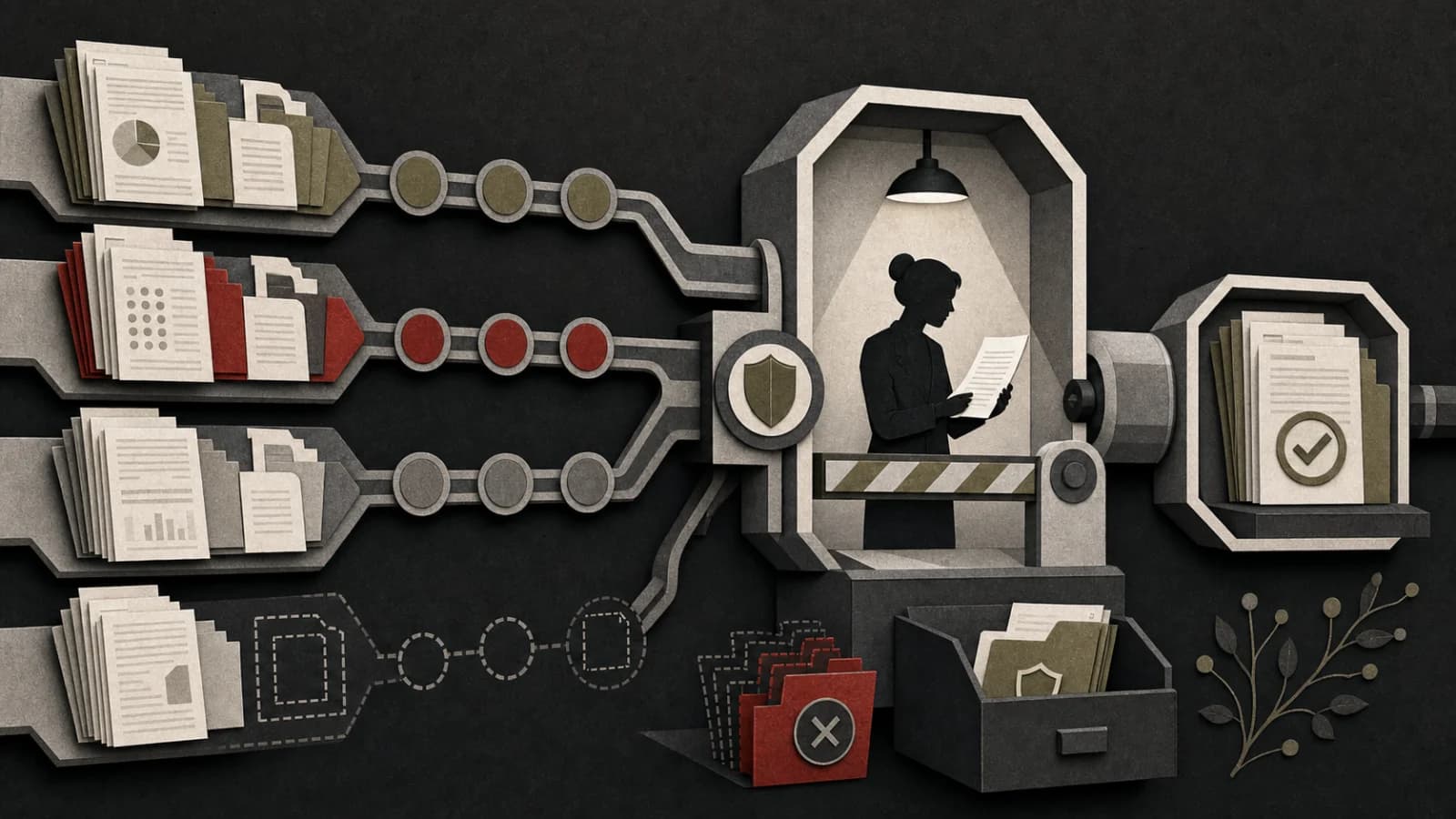
Bulk contract review for due diligence is the controlled examination of a defined contract population against transaction-specific questions. The objective is not to summarise every page. It is to give the deal team traceable findings about rights, obligations, dependencies, and exceptions that could affect its decisions.
Good review begins before extraction. The team must define scope, reconcile the document set, establish what counts as evidence, and decide how uncertainty will be reported. Software can accelerate classification and issue spotting, but accountable reviewers must validate material findings against the operative documents.
What should bulk contract review due diligence answer?
Translate the transaction thesis into a short list of review questions. A buyer concerned about post-closing continuity may focus on change-of-control provisions, assignment, termination, renewal, pricing, exclusivity, service dependencies, and consent mechanics. Another transaction may call for a different set entirely.
Before extraction begins, reconcile the review population against the deal-team version-control checklist. A clause answer is not reliable if the source set omits an amendment, includes a superseded draft, or changes after the reporting cut-off.
Create a question register before opening the data room:
| Question | Why it matters | Documents needed | Output |
|---|---|---|---|
| Can the contract move or continue as planned? | Identifies consent or structure issues | Main agreement, amendments, notices | Clause, trigger, required action |
| Can the counterparty exit? | Tests continuity assumptions | Termination and renewal terms | Right, notice, timing, consequence |
| What material obligations survive? | Supports integration planning | Agreement, schedules, side letters | Owner, action, deadline |
| Are economics fixed or adjustable? | Tests commercial assumptions | Order forms, pricing schedules | Mechanism and conditions |
| Do restrictions limit planned operations? | Surfaces exclusivity or use constraints | Operative clauses and definitions | Scope, territory, term, exception |
| Is key information missing? | Prevents false confidence | Inventory and request list | Gap, impact, request owner |
The official Ministry of Corporate Affairs portal and the Companies Act, 2013 on India Code are useful primary-source starting points for company-law context. They do not determine the diligence scope or answer transaction-specific questions. Counsel should identify the relevant law, filings, approvals, and records.
How do you establish a reliable contract population?
A data-room folder is not automatically a complete inventory. Build a contract register that assigns one stable record to each relationship and links its document family. The family may include the original agreement, amendments, renewals, order forms, statements of work, guarantees, notices, waivers, and termination correspondence.
Capture source location, filename, parties, apparent agreement type, date, document status, parent record, and review state. Preserve duplicates until they are compared. Two files with similar names may contain different signatures or schedules.
Use these reconciliation checks:
- Compare the register with finance, procurement, sales, entity, and operations records where authorised.
- Identify missing signatures, schedules, annexures, and incorporated policies.
- Link amendments and orders to the governing agreement.
- Distinguish drafts, executed copies, expired terms, and superseded documents.
- Record unreadable scans, corrupt files, and unsupported formats.
- Keep the original source and a controlled working copy.
- Assign every gap to a request owner and status.
Completeness should be reported as evidence, not a blanket statement. Explain which sources were reconciled, what date range was covered, and which gaps remain.
How should the review protocol be designed?
Turn each diligence question into a review instruction with definitions, inclusion rules, exclusions, examples, and escalation triggers. “Find all change-of-control clauses” is too loose if reviewers do not know whether to include indirect ownership changes, asset transfers, reorganisations, affiliate assignments, or related termination rights.
Use the change-of-control clause diligence guide to turn that question into a clause-level review and consent record for the deal.
For every field, specify:
- the question the field answers;
- where reviewers should look;
- the exact text or citation to retain;
- permitted values and an “unclear” option;
- connected provisions to inspect;
- when to escalate; and
- how a second reviewer resolves disagreement.
The Indian Contract Act, 1872 is an official source for general contract principles. Reviewers should not infer the effect of a clause from a label alone. Definitions, amendments, schedules, facts, and other applicable law may change the analysis.
Pilot the protocol on a varied sample. Include long-form agreements, short orders, scans, amendments, and documents with non-standard headings. Revise confusing fields before scaling the review team.
Where can automation help without weakening evidence?
Automation can classify documents, group likely families, extract candidate fields, locate clauses, and flag language for review. It is particularly useful for navigating repetitive populations. It should not turn a probable match into a final legal conclusion.
Design the workflow so each material finding retains:
- the document and stable identifier;
- the page, section, or clause location;
- the relevant source text;
- the extracted value;
- the reviewer decision and note;
- the validation status; and
- any linked amendment or definition.
Test extraction by issue and document type. A tool may perform well on clean service agreements but poorly on scanned schedules or tables. Record failure modes and route low-confidence or incomplete documents to manual review.
The guide to contract review software in India covers traceability, deployment, and lawyer-led validation. Gotham's security overview can also frame questions about sensitive data-room material before files enter any platform.
How should findings be quality controlled?
Quality control should target the conclusions that matter to the transaction. Use a combination of second review, sample testing, automated consistency checks, and exception review. Do not rely only on a single aggregate accuracy figure.
Create explicit gates:
| Gate | Reviewer checks | Failure response |
|---|---|---|
| Document family | Operative agreement and amendments are linked | Hold conclusion and request missing material |
| Extraction | Value matches cited text | Correct value and record failure type |
| Interpretation | Connected definitions and triggers were considered | Escalate to senior legal reviewer |
| Consistency | Similar language receives compatible treatment | Review protocol and affected records |
| Materiality | Finding is reported at the agreed level | Reclassify with rationale |
| Closure | Open question has an owner and status | Keep it visible in the issues log |
Use blind second review for a risk-based subset and for new extraction rules. Measure false negatives as well as false positives. Missing a material right can matter more than creating an extra review item.
What should a decision-ready diligence report contain?
Leaders need synthesis with a path back to evidence. Start with scope, sources, dates, assumptions, exclusions, and limitations. Then organise material findings by decision, not by the order in which files were reviewed.
A useful report pack includes:
- a contract population summary and reconciliation method;
- a material issues register with owners and status;
- consent, notice, termination, renewal, and obligation schedules where relevant;
- missing-document and unresolved-question lists;
- review protocol and quality-control description;
- source citations for each material finding; and
- a controlled export for integration planning.
Distinguish observation from legal assessment and transaction recommendation. “Clause requires notice on an identified event” is different from “the planned structure triggers notice,” and both differ from “the deal team should take a particular action.” Preserve those layers.
Gotham's practice workspace is designed to keep documents, research, and workflows near the matter context. If a diligence team needs a tailored intake, review, and exception process, contact Gotham.
How do you hand diligence findings into integration?
Diligence value disappears when findings remain in a static report. Before closing, assign each open consent, notice, renewal, security commitment, reporting duty, and commercial milestone to an accountable role. Record the trigger, due date logic, source clause, dependency, and evidence of completion.
Keep unresolved gaps visible. Do not silently convert an assumption into a confirmed fact. Transfer the final contract families, issue log, and obligation records under agreed access and retention controls. The result should be a review trail another authorised person can understand without recreating the entire project.
Bulk contract review succeeds when scope, population, evidence, and decisions remain connected. A faster search is helpful; a defensible handoff is better.