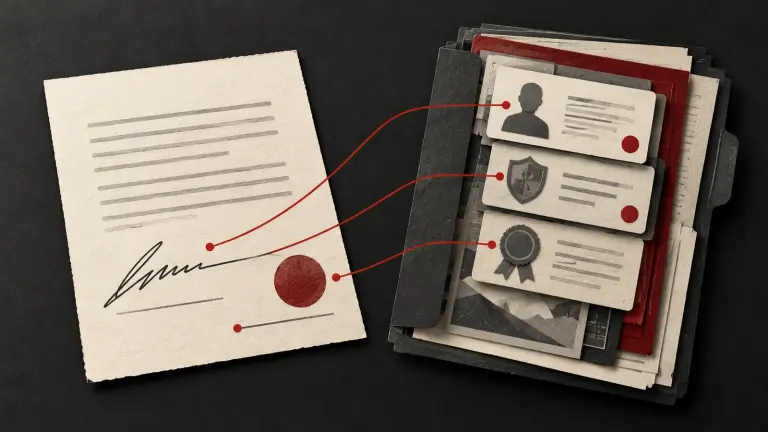
When a Brazilian agreement is signed electronically, ask four distinct questions: did the parties intend to agree; can the signer be identified; did that person have authority to bind the relevant company; and can the document’s content and integrity be shown later? A typed name, a company identifier, a drawn signature or a platform certificate may be part of the evidence, but none should be evaluated in isolation. Contract validity, evidentiary strength and whether the document qualifies as an enforceable extrajudicial title are related but separate issues.
Start with the original signed file and the complete transaction record. Preserve the version presented, the version accepted, the audit report or event log, authentication method, timestamps, email or phone validation, signer role, company authority evidence, and any later changes. If a dispute is expected, do not rely only on a screenshot of the signature box.
The legal sources have different scopes
Brazil’s Medida Provisória 2.200-2/2001 establishes the ICP-Brasil public-key infrastructure. Article 10 §1 recognizes documents produced using ICP-Brasil certification as presumed authentic in relation to signers, subject to the statute. Article 10 §2 also says that other means of proving authorship and integrity of electronic documents may be used when accepted by the parties or by the person against whom the document is produced. The analysis is therefore not limited to one commercial signing platform or a single kind of certificate.
Lei 14.063/2020 classifies simple, advanced and qualified electronic signatures in art. 4 for its covered purposes. Its art. 2 limits the relevant chapter’s scope and expressly excludes private-to-private interactions from that chapter. Do not cite the public-sector classification as a universal rule that every private Brazilian contract must use a particular signature level. Other statutes, transaction-specific rules, parties’ agreement and evidence law may apply.
For enforcement as an extrajudicial instrument, the Code of Civil Procedure, art. 784, must be considered. Paragraph 4 addresses electronic signatures in enforceable electronic titles and dispenses with witnesses when the integrity is conferred by a signature provider, under the statutory text. This does not mean every electronically signed document is automatically an enforceable title. The document must still fit a statutory category and satisfy the applicable requirements. A claim on an ordinary contract may instead require a merits proceeding.
Inspect the evidence package, not just the visual mark
Treat signature evidence as a package. Ask the sender or platform for the native completed document and any available completion certificate or audit file. Check whether the evidence identifies the person who signed, how the person authenticated, what email or phone was used, when the document was sent and completed, whether the content changed, and whether the audit record corresponds to the same file you received.
Next, connect the natural person to the contracting party. A CNPJ identifies a Brazilian legal entity; it is not, by itself, a natural person’s signature or proof of authority. Confirm the company name, registration status, role of the signer and whether the person had authority under the company’s governing documents, delegation or applicable corporate rules. A person may sign for a company, but the record should show the representative and capacity, not only the entity’s identifier.
Then confirm assent and scope. Did the signer receive the same version being enforced? Were price, annexes, schedules and terms attached? Were material terms incorporated by a link that can still be recovered? Did the other side respond, begin performance, issue invoices or make payments consistent with the contract? These surrounding records may matter if signature attribution or the agreement’s contents are challenged.
| Review area | Questions | Evidence to preserve |
|---|---|---|
| Identity | Which human account or person completed the act? | Authentication log, email/phone validation, account and event data |
| Authority | In what capacity did the person act for the company? | Corporate record, power, delegation or written confirmation |
| Assent | Did the party accept this precise version and its attachments? | Native final file, transmission record, acceptance events and annexes |
| Integrity | Can you detect whether the content changed after signing? | Hash/checksum if available, provider certificate, original files and event log |
| Enforceability | Does the document fit the statutory category being claimed? | Contract, applicable statute, witness/signature and provider evidence |
| Custody | Who downloaded, stored, moved or re-exported the record? | Collection note, storage location, timestamps and access history |
If the signature is only a typed name or company label
Do not start from the visual appearance. A cursive font can look like handwriting while proving very little about who typed it; a simple typed name can be accompanied by stronger identity, authentication and integrity evidence. Likewise, a document that displays only a CNPJ may identify a company but leave open who assented for it. Ask for the underlying audit evidence and the authority record.
If the other party disputes the signature, preserve the file and transaction context and avoid altering the original. Counsel can assess whether the available material is sufficient, what objections may be raised, whether additional authentication or proof is available, and whether the claim depends on an enforceable title or a judgment. Do not ask an employee to recreate an audit trail or backdate a resolution.
Hypothetical: the company number appears, but the signer is unclear
Assume a Brazilian supplier receives a PDF with a typed representative name and its own CNPJ in a footer. The customer later says it never accepted the quoted price. The supplier has a platform completion report, an email inviting the customer’s procurement manager to sign, a login code sent to a corporate email, and a reply from that manager confirming the scope. The PDF does not show who had authority to execute contracts.
The supplier should preserve the original PDF and completion report, confirm the exact version and attachments, retain the email thread, and obtain company-authority evidence through an appropriate source. It should not say that the CNPJ alone proves the representative signed. Counsel can assess whether the combined records establish assent and authority and which procedural route fits the relief sought. The example does not predict a court’s conclusion.
Decision table: choosing the next review step
| What you find | Next step | Do not assume |
|---|---|---|
| ICP-Brasil certificate and matching final file | Validate certificate and file integrity; keep the original validation report | That a valid certificate proves representative authority or every contract term |
| Advanced or platform-based signature with audit trail | Review identity proof, consent, integrity and the parties’ accepted method | That platform branding alone establishes legal validity |
| Typed name with no audit record | Preserve surrounding emails, delivery and performance evidence; ask for completion data | That a cursive font equals a verified signature |
| CNPJ appears but no human signer is named | Identify the representative and capacity, then verify authority | That the company number itself is a human act of assent |
| Other side disputes the document | Stop editing, preserve originals and seek advice on proof and forum | That every e-signed document can be executed directly |
| A claim is being filed as an extrajudicial title | Test each requirement under CPC art. 784 and applicable law | That art. 784 §4 turns any e-contract into an executable title |
Common errors in e-signature disputes
- Treating “digital signature” and “electronic signature” as interchangeable labels without examining the method and governing rule.
- Treating Lei 14.063’s public-sector categories as mandatory levels for all private transactions.
- Treating a CNPJ as proof of the identity and authority of a natural-person representative.
- Saving only the rendered PDF while discarding the audit certificate, original file or attachments.
- Assuming a provider’s audit log proves that its customer had legal authority to bind a company.
- Confusing a contract that can be used as evidence with an instrument that qualifies for direct execution.
- Treating electronic execution as a substitute for separate registration, notarization, witnessing, stamp or formality rules that may apply to a specific transaction.
For adjacent workflows, see the Brazil freelancer evidence guide, Brazil software IP contract guide, and the document version-control workflow. Use the official Brazilian sources above for signature and enforcement rules.
E-signature review checklist
- Preserve the exact final native file and every annex or incorporated term.
- Obtain the signature provider’s completion record and event log.
- Identify the human signer, authentication method and timestamp.
- Confirm the signer’s role and authority for the named company.
- Check whether the parties agreed to this signing method.
- Review file integrity and any validation or hash evidence.
- Preserve the invitation, acceptance, negotiation and performance records.
- Separate contract validity, evidentiary proof and enforceability as a title.
- Check transaction-specific formalities and the current statute.
- Ask Brazilian counsel to assess disputed identity, authority or enforcement.
Frequently asked questions
Is a typed name a valid electronic signature in Brazil?
It may be evidence of assent depending on the context, method, parties’ agreement and applicable legal rules. A typed name alone may leave identity, intent, integrity or authority questions unanswered. Review the complete transaction record rather than the visual mark.
Does every Brazilian private contract need an ICP-Brasil certificate?
No universal conclusion follows from the cited framework. MP 2.200-2/2001 recognizes ICP-Brasil certificates and also addresses other means of proving authorship and integrity accepted by the parties or the person against whom the document is produced. A transaction-specific rule may impose additional requirements.
Does Lei 14.063/2020 govern private company-to-company signatures?
Its chapter on signature levels is scoped by art. 2 and excludes interactions between private persons or companies. It should not be treated as the only or universal private-contract rule. Check MP 2.200-2, the Civil Procedure Code and any special statute applicable to the transaction.
Does a CNPJ prove who signed for a company?
No. It identifies a legal entity. A complete review should identify the human signatory and their capacity and verify authority using appropriate corporate or delegation records.
Is a platform completion certificate conclusive?
It can be useful evidence, but assess what it records, what method was used, whether it corresponds to the contract version, how the signer was authenticated and whether the person had authority. The certificate does not answer every legal issue automatically.
Can I enforce every e-signed agreement without a trial?
No. Direct execution depends on the document fitting a category in CPC art. 784 and satisfying its requirements. Paragraph 4 concerns qualifying electronic signatures and integrity; it does not convert every agreement into an enforceable title.
Should I use a screenshot of the signing page in court?
A screenshot can illustrate the process but should not replace the original document and underlying audit evidence. Preserve the native file, completion certificate, emails, attachments and performance records.
What if the other side denies that the employee had authority?
Preserve the correspondence and identify the employee’s position, delegation, corporate records and conduct of the company after signing. Authority and ratification questions are fact-specific; seek Brazilian counsel before making a conclusion.
Does e-signing remove notarization or registration requirements?
Not necessarily. Electronic execution and transaction-specific legal formalities are separate. Check the legislation and registry rules governing the document, asset or filing involved.
To organize signed documents and version evidence, see Gotham’s legal workflows or contact the team. This workflow does not authenticate a signature or replace a legal opinion.
General information, not legal advice. Brazilian e-signature and enforcement questions depend on the transaction, evidence, parties and applicable rules.
How Gotham researches and reviews field guides