
Legal research often begins with a phrase: find cases on this issue. But similarity is only the start. Two judgments can use the same words while addressing different questions, courts, statutory versions, procedural stages, or types of opinion. One may state a legal rule; another may quote a party, distinguish that rule, or apply it to a narrow set of facts.
That is why Gotham built an agentic ontology of law. By ontology, we mean a structured account of legal things and the relationships that make them meaningful: courts and their authority, decisions and their parts, propositions and the sources that support or qualify them, statutes and their versions, and the dates and procedural context around each record. By agentic, we mean that research can involve goal-directed assistance that helps people move across those relationships, while keeping the evidence open to inspection.
The ontology is built to help researchers ask better questions of a body of law, trace answers to primary material, and see where the available record does not support a confident conclusion. It does not compress complex legal judgment into a single confidence badge.
Similarity finds candidates, not legal relationships
Semantic search is useful because lawyers do not always know the exact phrase a court used. It can bring a researcher to an unfamiliar case or a passage that keyword search misses. Yet similarity does not tell us whether one court must follow another, whether two benches are coordinate, whether a later judgment adopted or distinguished an earlier proposition, or whether the matching words were part of the court’s reasoning.
The distinction matters in India. Article 141 of the Constitution says that the law declared by the Supreme Court binds courts within India. That is a statement about law declared, not a rule that every sentence in every Supreme Court document carries the same precedential force.
The Supreme Court’s decision in Central Board of Dawoodi Bohra Community v. State of Maharashtra explains how bench strength affects judicial discipline: a smaller bench cannot disagree with a larger bench, and a coordinate bench that doubts another coordinate bench may seek consideration by a larger bench. The Court also described exceptions and the Chief Justice’s roster authority, which is one reason a simple “higher score means stronger precedent” model would mislead.
In practice, a researcher may need to distinguish at least three questions. Is this source from a court whose decisions bind the forum I care about? Does the relevant proposition come from the controlling opinion and the issue decided? Has a later court followed, explained, distinguished, doubted, or overruled that proposition? Those questions overlap, but they are not interchangeable. Our existing guides on finding binding precedent in India and researching judgment treatment describe the practitioner’s checks in more detail.
A proposition needs its legal setting
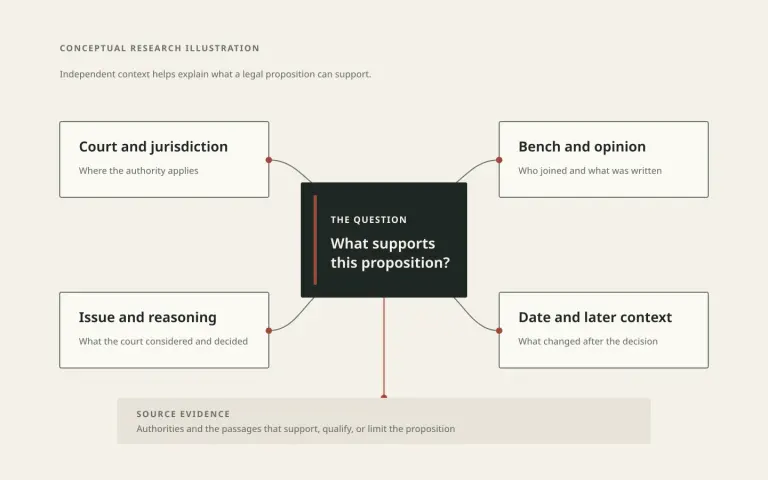
A proposition is more useful than a bare case-to-case edge because legal authorities rarely have one uniform meaning. A single decision may contain several opinions, resolve multiple issues, recount submissions, discuss earlier decisions, and issue directions whose reach depends on the case’s posture. A later judgment may rely on one proposition while rejecting another argument from the same source.
Consider a deliberately fictional example. A researcher asks whether a deadline may be extended after a filing error. Search returns two decisions containing the phrase “sufficient cause.” The first comes from the relevant appellate court and concerns a procedural rule with a discretion to extend time. The second comes from a different forum, considers a different statute, and quotes a lawyer using the same phrase before rejecting the argument.
A list ranked only by textual similarity could make the second decision appear central. These differences help a researcher assess what the result contributes: forum, legal issue, statutory setting, decision stage, who is speaking in a passage, and what the court actually decided. Gotham’s ontology connects those legal materials so similarity can be considered with context.
This is not a claim that every judgment can be reduced to a neat proposition label. In Gotham, the ontology connects a proposition to its source while preserving context a human can use to test that connection. For a researcher, the important outcome is not a tidy graph. It is a shorter path from an initial question to the relevant passage, surrounding reasoning, procedural result, and source document.
Authority depends on more than court names
Court hierarchy is important, but it is not a complete answer by itself. A useful authority analysis has to account for the relationship between the court that issued a decision and the court considering it, the territory and legal system involved, and the bench that decided the matter.
Within the Supreme Court, bench strength can be decisive: the Dawoodi Bohra judgment summarizes the rule that a larger bench binds a smaller or coordinate bench, while a lesser bench cannot set aside the law declared by a larger bench. It also describes the route for a coordinate bench that doubts an earlier coordinate decision.
Article 145(3) requires a minimum of five judges to decide a case involving a substantial constitutional-interpretation question or an Article 143 reference. The Constitution also provides for majority decisions while preserving a judge’s ability to deliver a dissenting opinion under Article 145(5).
Bench strength should not be flattened into a universal number ranking. A five-judge bench is not automatically deciding a constitutional question. Bench size is relevant, but it does not alone identify the issue decided, the ratio, or how a proposition applies in a different matter.
Article 145(5) also makes opinion identity relevant: the researcher must know which opinion supports the proposition and whether it represents the Court’s decision.
The same care applies to High Courts and tribunals. A judgment from one High Court may be persuasive in another forum without binding it. A tribunal record may not say which bench or location decided it, even where that information matters to the authority question.
If the source record does not establish the relationship, the responsible result is to make the uncertainty visible and let the researcher examine it. The product principle is straightforward: missing context should narrow what the system claims, not invite it to fill a gap with a guess.
Time and procedural posture change what a decision means
Law is not static. Statutory text changes, provisions commence on different dates, a judgment may be appealed or reviewed, and later decisions may explain or limit an earlier proposition. A question about conduct in 2019 may need a different statutory version from a question about conduct today. A later citation can matter greatly, or it can be a passing reference that does not adopt the proposition at issue.
Procedural posture matters too. A final judgment, an interim direction, an order recording consent, and a listing order are not equivalent research objects. In Roger Shashoua v. Mukesh Sharma, the Supreme Court considered the distinction between tentative reasoning in a non-final interim order and a principle later accepted by Indian decisions in the context of that case.
The point for research design is not that interim orders never matter. It is that the legal effect of a passage cannot be read from its wording alone; the decision’s context and the court’s treatment of it must be checked.
Gotham’s ontology connects time and posture to legal sources rather than treating them as decorative metadata. Researchers can examine the date, document type, issue, and later references that may bear on a question. As with legal research more broadly, researchers should verify the applicable statutory version and check later amendments, appeals, and citations against current authoritative sources.
Design decisions for useful legal assistance
These principles shape Gotham’s legal research.
Start with sources a researcher can inspect. A useful answer should point back to primary material and give a person a way to inspect the passage and its surrounding context. For Indian constitutional and statutory propositions, that means linking to official government or court sources where available. A summary or generated explanation can guide a search, but it should not conceal the authority beneath it.
Keep identity, proposition, and treatment separate. Confirming that a citation points to a real decision does not confirm that the cited passage supports the sentence. Confirming the passage does not establish the later treatment of that proposition. This separation is central to the citation verification checklist and to our research design.
Explain why a source appears relevant. A researcher should be able to understand whether a result is close because it concerns the same issue, comes from a potentially relevant court, contains a supporting passage, or was later followed. These reasons can point in different directions. Showing that distinction supports review better than compressing it into an unqualified label.
Make evidence actionable. When authority depends on forum or a proposition depends on context, show the source and make the next research question clear: check the court relationship, read the surrounding reasoning, or trace later treatment. That turns a result into a useful next step and keeps conclusions tied to what the evidence supports.
Keep the lawyer in control. Agentic research can help gather and relate material across a question. It should not silently approve an authority, decide what to file, or replace the lawyer’s analysis of doctrine and facts. The human reviewer remains responsible for deciding how a proposition applies to a matter. Teams evaluating systems can use our legal AI accuracy guide to ask what the system actually verified and what remains for review.
These choices shape the research experience. Context can take longer to explain than a single badge, and some decisions resist a neat summary because opinions are divided or procedural effect is narrow. Showing the relevant source, the distinction that matters, and a clear next question helps researchers test a result against the record and apply their own legal judgment.
How an agentic ontology supports legal research
The phrase agentic ontology can sound abstract, so the practical test is whether it helps with ordinary research questions. A lawyer might ask: Which decisions could bind this forum on the point? What is the exact proposition in the cited passage? Is the passage from the majority or a dissent? Did a later larger bench consider the same issue? Which version of the statute applied on the relevant date? Is an apparent conflict real, or are the decisions addressing different questions?
These are questions for the researcher, not a prescribed sequence of internal system operations. They require connections among sources and the ability to inspect the evidence for each connection. Gotham’s built legal ontology gives research a more contextual structure: people can move from an issue to related authority and back to the underlying source. That context helps researchers assess why an authority may matter while keeping conclusions tied to the available evidence.
The work is part of a broader effort to make legal research more connected to the documents, matters, and teams that act on it. If you are reviewing a legal research workflow and want to discuss where source traceability or authority context could help, contact Gotham. Bring a representative workflow question, and keep confidential matter material out of an initial conversation.
The standard is demanding: help people find useful authorities, understand why those sources may matter, inspect the legal material for themselves, and see where uncertainty remains. A better map of law does not remove legal judgment. It gives that judgment more context to work with.
Questions about legal ontologies
What is an ontology of law?
It is a structured way to describe legal concepts and the relationships among them, such as which court issued a decision, what proposition a passage addresses, and how another decision treats that proposition. It helps organize context; it does not decide what a lawyer should argue.
How is a legal ontology different from a case-law database?
A database can store and retrieve decisions. An ontology adds explicit meaning to connections among courts, decisions, legal propositions, statutes, and time, so a researcher can inspect why a source may matter and where the relationship is uncertain.
Does a Supreme Court citation make every sentence in a judgment binding?
No. Article 141 concerns the law declared by the Supreme Court. Identifying that law requires reading the decision as a whole and considering the issue, reasoning, bench, and procedural context. A citation match alone cannot establish the proposition.
Can an AI system decide whether a judgment is binding?
Gotham’s legal ontology helps researchers inspect source relationships and relevant context. Whether a particular judgment binds or supports an argument depends on jurisdiction, the issue, the decision’s reasoning and procedural context, and the available record. A qualified lawyer must assess the authority before relying on it.
How does Gotham’s legal ontology support legal research?
Gotham has built a legal ontology that connects legal materials through research context, including court and jurisdiction, bench and opinion, issue and reasoning, and time and procedural posture. Researchers can use those connections to examine why a source may matter and inspect the underlying material. The ontology supports research; a lawyer decides how a proposition applies to a matter.
This article describes legal research design, not legal advice. A lawyer must assess the authorities and propositions relevant to a matter.
How Gotham researches and reviews field guides