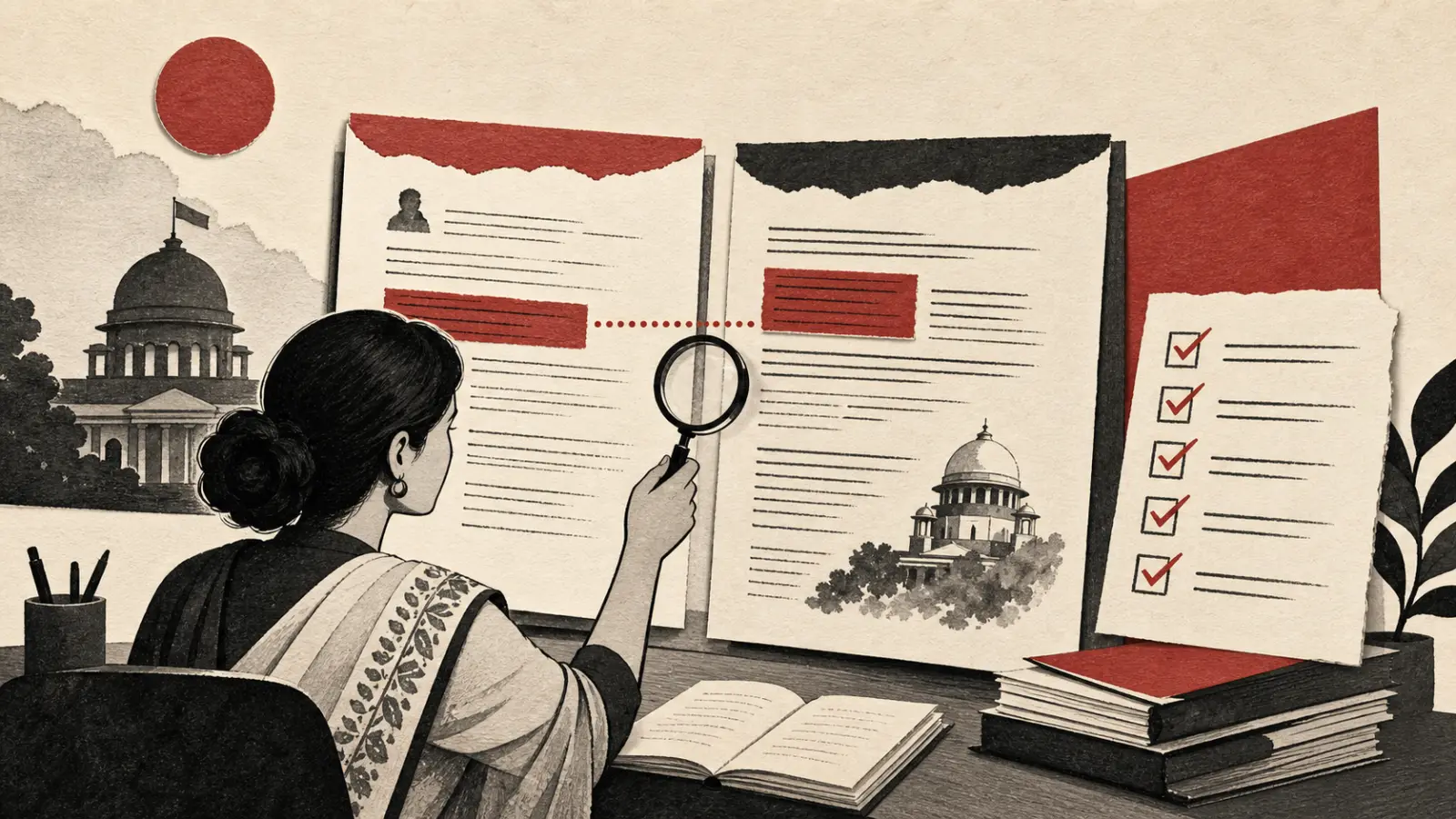
Tax case citation verification is the unglamorous work that keeps a tax note dependable. A familiar party name, a polished headnote, or a downloadable PDF is not enough. The researcher still needs to establish that the document is the right order, the quoted passage says what the draft claims, and later developments have not changed its usefulness.
Tax research adds a particular complication: the same dispute may pass through assessment, first appeal, the Income Tax Appellate Tribunal, a High Court, and the Supreme Court. Connected assessment years can produce similar-looking orders with different facts. A careful verification record lets the next reviewer see exactly what was checked and what remains uncertain.
What should a tax citation verification record contain?
Build the record around the proposition, not around a folder full of PDFs. Each row should connect one sentence in the draft to one identifiable passage and its procedural context.
| Field | What to capture | Why it matters |
|---|---|---|
| Proposition | The precise statement for which the authority is cited | Prevents a real case from being attached to an unsupported claim |
| Case identity | Cause title, appeal number, assessment year, forum, bench, and date | Separates similar proceedings and connected years |
| Source | Official order page or court record, plus a saved copy where permitted | Makes the check repeatable |
| Pinpoint | Paragraph or page, with the document version identified | Allows a reviewer to inspect context quickly |
| Procedural stage | Assessment, appeal, remand, reference, or final disposition | Stops an interim direction being described as a final holding |
| Treatment | Followed, distinguished, questioned, reversed, or unresolved | Shows how later decision-makers have used the proposition |
| Statutory context | Provision, relevant version, and material amendment note | Tax conclusions are often date-sensitive |
| Verification trail | Researcher, reviewer, access date, and open questions | Creates accountability without implying certainty |
The ITAT judicial portal provides access to tribunal orders. The Supreme Court Reports search and eCourts High Court Services are useful official routes for later stages. Availability and search behaviour can change, so record the route and access date rather than writing “verified online.”
How do you confirm that an ITAT order is the correct document?
Begin with the appeal number, bench, decision date, parties, and assessment year. Party-name searches alone can return multiple years, cross-appeals, stay applications, or orders after remand. Open the order and compare its first pages and operative section with the portal entry.
Then reconstruct the minimum procedural chain. Identify who appealed, what the challenged order was, which grounds were pressed, and what the tribunal actually directed. Words such as “allowed for statistical purposes” carry procedural meaning that cannot be reduced to a simple win or loss label.
Use this identity check:
- Match the ITA or other proceeding number exactly.
- Confirm the assessment year and whether several years are disposed of together.
- Check the bench, member names, hearing date, and pronouncement date.
- Separate assessee appeals, departmental appeals, cross-objections, and stay proceedings.
- Note whether the order is ex parte, recalled, rectified, or passed after remand.
- Read the operative paragraphs instead of relying on a search snippet or digest.
For a reusable research structure, pair this process with Gotham’s legal research workflow for India. Teams that use generated summaries should also apply the source checks in evaluating legal AI accuracy.
Does the cited passage support the tax proposition?
Search within the order for the quoted words, provision, or factual issue. Read the whole ground and the reasoning around the passage. Tax orders frequently reproduce submissions and earlier decisions before stating the bench’s own conclusion. A sentence in the department’s argument is not the tribunal’s finding merely because it appears in the order.
Classify the passage before using it:
- Is it a factual recital, a party submission, a quotation, a finding, or an operative direction?
- Which assessment year and transaction does it concern?
- Did the bench decide the legal issue, or restore it for fresh examination?
- Does the conclusion depend on evidence or procedural conduct specific to the case?
- Is there another member’s opinion, a larger-bench ruling, or a jurisdictional court decision that changes the weight of the passage?
Do not turn fact-specific language into a universal rule. If the proposition needs qualifications, put them in the draft. A narrower, accurate explanation is more useful than a confident sentence that the order cannot carry.
How should later history be traced through the courts?
Search beyond the tribunal order using party names, appeal numbers, reported citations, neutral citations, and distinctive phrases. On High Court services, check case status and orders rather than assuming that a reported admission or dismissal tells the whole story. At the Supreme Court level, compare the cause title and underlying appeal carefully because party order and naming conventions may change.
A practical later-history sequence is:
- Search the ITAT order for cited jurisdictional High Court and Supreme Court authority.
- Search the High Court service for an appeal connected with the parties and decision.
- Open each relevant order and identify whether the court addressed the same question.
- Check for review, recall, rectification, remand, or subsequent proceedings.
- Search later decisions using both the case name and the proposition’s distinctive wording.
- Record adverse and ambiguous treatment, not only decisions that agree.
- Recheck the governing statutory text and effective dates through India Code and relevant official tax materials.
A dismissal without a reasoned discussion should not automatically be restated as broad approval of every proposition below. The responsible tax professional should determine the effect of the procedural history in the specific matter.
What discrepancies deserve immediate escalation?
Some errors are clerical. Others change the analysis. Treat uncertainty as a finding to manage, not as a nuisance to hide.
| Discrepancy | Safe workflow response |
|---|---|
| Order cannot be located on the expected official route | Recheck identifiers, document the search, request the author’s source, and mark reliance unresolved |
| Assessment year differs | Stop and determine whether the cited reasoning applies to the year in the draft |
| Passage is a submission or quotation | Replace the characterisation with the bench’s actual finding, if any |
| Matter was remanded | Describe the limited procedural outcome and avoid presenting it as final resolution |
| Later court treatment is unclear | Add the competing records and send the point for professional review |
| Provision has changed | Identify the version relevant to the transaction and rewrite the temporal scope |
| PDF text conflicts with page image | Verify against the image and another official record before copying text |
| Connected appeal reaches a different result | Map the parties, grounds, years, and procedural posture before drawing a conclusion |
Gotham’s broader case-law citation checklist offers a second-review framework for non-tax authorities too.
How can a team review many tax citations consistently?
Use a shared matrix with controlled fields, but leave room for short explanations. A status such as “verified” is too vague unless it records identity, proposition, pinpoint, treatment, and statutory context. Assign a second reviewer to authorities that determine the conclusion or requested relief.
The workflow can be staged:
- Extract every authority and the proposition beside it.
- Deduplicate repeated authorities while retaining every proposition link.
- Run identity and source checks.
- Run proposition and context checks.
- Trace later history and statutory changes.
- Route contradictions and uncertainty to the responsible professional.
- Freeze the reviewed version and record the research cut-off date.
- Recheck material authorities before filing, delivery, or publication.
Software can help find missing pinpoints, duplicate citations, or inconsistent party names. It cannot decide by itself whether a tax precedent governs a client’s facts. If your team wants a clearer audit trail across research, source review, and approvals, discuss the workflow with Gotham or review the product’s research and matter workflows.
What should the final pre-delivery check ask?
Before the work leaves the team, ask whether another reviewer can reproduce each material conclusion from the record. Confirm that official sources were preferred, limitations were stated, and unresolved points are visible. Check that no headnote, summary, or AI output is cited as if it were the underlying order.
Finally, read the draft once without the verification table. Does its language match the strength of the sources? “The tribunal held” may need to become “the bench restored the issue” or “on the facts recorded in that order.” That small editorial correction often carries more value than adding another citation.
This article is general procedural information, not tax or legal advice. Citation weight, limitation, forum practice, and the effect of later proceedings require review by a qualified professional for the relevant facts and date.