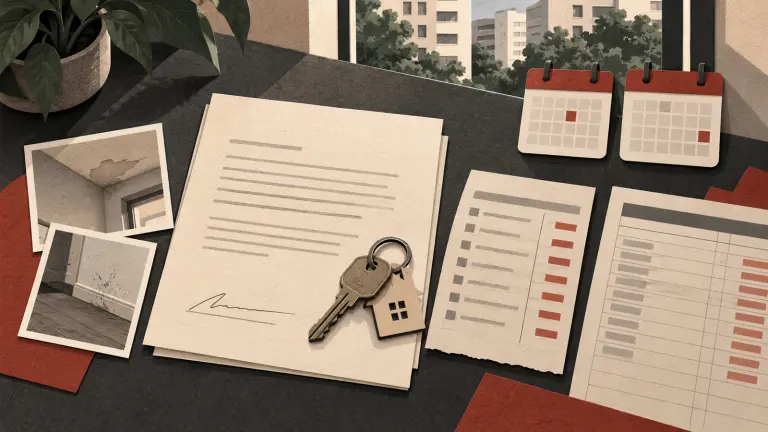
A Singapore landlord’s failure to return a rental deposit calls for two separate checks: what the signed tenancy agreement says about repayment and deductions, and whether the Small Claims Tribunals (SCT) can hear this particular dispute. Preserve the lease, proof of payment, move-in and move-out condition records, messages, and any itemized explanation for deductions. Then check the lease term, claim amount, filing deadline and where the landlord can be served before choosing the SCT route.
Singapore’s Small Claims Tribunals eligibility guide lists claims relating to residential tenancy agreements that do not exceed two years. It separately says a claim must be filed within two years of the event creating the cause of action, with a usual value cap of S$20,000 or S$30,000 if both parties sign a Memorandum of Consent. A respondent located outside Singapore is listed as ineligible, and a claim must be served in Singapore. These are distinct requirements, not a single general “two-year rule.”
There is no universal statutory 14-day refund promise in these sources. A 14-day period may instead be a term of the parties’ contract. The signed agreement, later variations, move-out arrangements and communications determine the starting point and what sums may be retained. If a lease term, respondent location, service route or deposit clause is disputed, take Singapore legal advice before relying on a quick online answer.
Start with the tenancy agreement, not a standard-form assumption
Find the signed tenancy agreement and any renewal, extension, inventory, handover form or later settlement. Locate the exact deposit clause. It may say the landlord holds the deposit as security, describe when it is to be refunded, identify obligations it secures, or permit specified deductions. A verbal statement by an agent or a common market practice does not replace the wording that applies to your tenancy.
Separate the deposit issue into questions: how much was paid, when the tenancy ended and possession was returned, what the contract says about repayment, what deductions were identified, and what facts support each deduction. If the contract promises repayment within 14 days, record the exact language and calculate the date from the contractual event it identifies. Do not assume the same period applies to every Singapore rental agreement.
A landlord may assert unpaid rent, damage, cleaning, missing items, air-conditioning servicing, or another contractual sum. Those are not interchangeable. Ask the landlord to identify each amount, its contractual basis and the evidence supporting it. A demand that says only “repair costs” makes it difficult to understand what is being claimed, but missing detail by itself does not decide whether a deduction is valid.
The State Courts’ published version of JJK v JJL, [2026] SGSCT 28, reviewed on 25 October 2026, is a useful recent illustration. The court’s page states that the grounds remain subject to final editorial corrections approved by the court and/or redaction. The tribunal considered the exact deposit clause and the landlord’s asserted defects. For that agreement, it explained that the landlord had to establish the clause relied on, what it required, the tenant’s breach and the resulting loss. The landlord proved some deductions, not all, and the tribunal ordered a partial refund. The decision expressly turns on its contract and findings. It does not mean every tenant automatically receives the full deposit or that every landlord always bears the same burden regardless of the agreement.
Check SCT eligibility before preparing a claim
The lease-duration condition is easy to confuse with the deadline. The Courts list residential tenancy agreements not exceeding two years as an eligible category. That is a subject-matter rule. Separately, SCT claims must be filed within two years of the event creating the cause of action. A tenancy may fit one test and fail the other.
For a longer residential tenancy, the lease-duration test can be central even if a final agreement states a short deposit-refund period. Do not assume that a short final extension makes the matter eligible if the parties’ overall arrangements lasted longer. Review each agreement and renewal, then check the Courts’ current eligibility page and seek advice if the structure is unclear.
Other checks matter too. The SCT’s general claim limit is S$20,000, extendable to S$30,000 by a Memorandum of Consent signed by both parties. The Courts say the claim cannot be divided into separate SCT proceedings solely to fit under the limit. A tenant’s move abroad is not the same issue as an overseas landlord: the claimant should check participation and filing steps, while the respondent must meet the tribunal’s jurisdiction and service rules.
Use the Courts’ online pre-filing assessment through the Community Justice and Tribunals System as an initial screen. The Courts say the assessment is not conclusive and is not legal advice. A claim may be discontinued if it falls outside the tribunal’s jurisdiction. If the lease exceeds the permitted duration, the landlord is outside Singapore, the amount exceeds the cap, or the cause-of-action date is uncertain, ask a Singapore lawyer about a civil-court route rather than filing based on assumptions.
Build a record for each disputed deduction
Make a chronology and arrange the evidence by event. Keep original files and preserve their context. A dated photo of a mark is more useful when it can be connected to a room, move-in or move-out inspection, and the specific item named in the landlord’s deduction. Avoid changing the original image or deleting the surrounding message thread.
| Issue | Records to preserve | Question the records help answer |
|---|---|---|
| Deposit paid | Bank transfer, receipt, agreement, agent or landlord acknowledgment | How much was paid, by whom, and to which party? |
| Contract terms | Signed lease, renewals, inventory, addenda and written variations | When should the deposit be returned, and what obligations may it secure? |
| Starting condition | Check-in report, dated photos or video, repair requests | Was the alleged defect already present or reported? |
| Handover | Move-out inspection, key-return message, signed handover form, witness details | When was possession returned, and what condition was recorded? |
| Each deduction | Itemized list, cited clause, photographs, quotation, invoice and proof of payment if available | What breach is alleged and how was the amount calculated? |
| Demand and response | Complete email or message thread, payment details, delivery records | Was repayment requested, and did the landlord acknowledge or dispute it? |
The Courts’ filing and service guide identifies tenancy agreements, stamp-duty certificates, photographs, emails and messages among documents that may support a claim. Check the current CJTS instructions for formats and document requirements. Keep the original signed documents, and prepare a one-page index so each item in your explanation points to a record.
For an alleged cleaning charge, ask what work was done, what clause makes the tenant responsible, whether the condition was recorded at handover, and how the charge was calculated. For a damaged fixture, compare the check-in and check-out evidence and ask for the repair scope and supporting estimate or invoice. For unpaid rent, reconcile the rent ledger and payment receipts rather than mixing arrears with damage. The purpose is to make each item understandable, not to argue that a photo or invoice alone proves the entire claim.
A focused written request can help clarify the dispute. Identify the property, tenancy end date, deposit amount and clause. Ask the landlord to state the amount to be refunded, identify every proposed deduction, cite the agreement term relied on, and provide the supporting records. Give a reasonable response date. Keep proof that the request was sent. A demand letter is a practical step, not a universal statutory prerequisite to an SCT claim based on the Courts’ guidance reviewed here.
What the SCT process involves
If the eligibility checks fit, filing is through CJTS. The Courts’ guide describes filing the claim, serving the claim and Notice of Consultation within seven days, then filing a Declaration of Service with proof before the first consultation. The guide says a claim cannot be served outside Singapore. It identifies personal delivery and registered post as methods and says the registrar may direct another method, such as email, if ordinary service cannot be completed. Follow the current directions for the specific case; do not substitute an informal email to the landlord for formal service without permission.
Parties attend a consultation with a registrar, who may help resolve the dispute. The Courts also provide eNegotiation and eMediation through CJTS. If the dispute is not resolved, it may proceed to a hearing before a tribunal magistrate. SCT proceedings are designed for parties to present their own cases; the Courts say lawyers cannot represent parties in SCT proceedings. That does not prevent seeking independent legal advice before filing or about another court route.
Filing itself does not guarantee repayment. The Courts provide a separate process to enforce an order if the landlord does not comply. Keep your case focused on contract terms, dates, payments and evidence.
Decision table: what should you check next?
| Situation | Next step to assess | Main caution |
|---|---|---|
| Agreement states a refund date and that date has passed | Compare the clause with the move-out date, payment record and landlord’s explanation | Do not treat a contractual 14-day term as a universal statutory rule |
| Residential tenancy agreement is no longer than two years and claim is within value and time limits | Complete the current SCT pre-filing assessment and prepare supporting records | The pre-filing assessment is not conclusive; respondent location and service still matter |
| Tenancy or connected renewal arrangements exceed two years | Obtain advice on whether the SCT has jurisdiction and which civil route may apply | Do not assume a short extension automatically restarts eligibility |
| Landlord is outside Singapore or cannot be served locally | Ask the Courts about jurisdiction and service, then get advice on alternatives | SCT guidance lists an overseas respondent as ineligible and does not allow service outside Singapore |
| Deduction is for damage or cleaning | Request the clause, alleged condition, work scope and supporting amount | A label, photograph or invoice alone may not settle liability |
| Claim is above S$20,000 | Check whether both parties will sign the required consent for the higher cap or seek advice | Do not split claims just to fit below the limit |
| Cause-of-action date may be close to two years | Seek advice promptly and verify the correct filing date | Negotiation or a demand should not be assumed to pause the SCT filing deadline |
Fictional example: a deposit withheld after a longer tenancy
Maya and two flatmates rent a Singapore condominium under a series of written agreements over three and a half years. They pay a deposit equal to two months’ rent. The final agreement says the deposit is refundable within 14 days after the tenancy ends, subject to specified sums owing. After the keys are returned, the landlord says through an agent that there are cleaning and repair costs but provides no itemized breakdown. More than a month later, no balance has been paid.
Maya first saves every signed agreement and extension, the deposit transfer, move-in and move-out records, dated room photographs, the key-return message, and the complete communication with the landlord and agent. She asks the landlord directly for the amount held, each deduction, the clause relied on, the alleged condition and an estimate or invoice. She separately calculates the date under the final agreement without calling it a statute-wide deadline.
Before filing, Maya notices that the tenancy period exceeds two years. She checks the Courts’ eligibility guidance and gets advice on whether the sequence of agreements qualifies for the SCT; she does not assume that the last agreement alone resolves the issue. She also identifies the landlord’s Singapore address for service and checks the value and cause-of-action deadline. This fictional example does not decide that Maya can use the SCT or that the landlord must refund a particular amount. The documents, contract wording and jurisdiction remain decisive.
Common mistakes to avoid
- Treating a written 14-day refund clause as a universal statutory deadline for all Singapore rentals.
- Mixing up an eligible residential agreement of no more than two years with the separate two-year filing deadline.
- Assuming a tenancy lasting more than two years is SCT-eligible because a later extension is shorter.
- Assuming an overseas tenant and an overseas landlord present the same eligibility problem.
- Asking only the agent when the signed agreement identifies the landlord as the deposit holder or contracting party.
- Accepting a lump-sum deduction without asking what clause, condition and loss support each amount.
- Claiming that ordinary wear always defeats a deduction or that every repair invoice proves tenant responsibility.
- Editing or deleting original photos, handover records or messages when preparing evidence.
- Missing the formal service steps after filing or assuming an informal email counts as court service.
- Treating a demand, mediation attempt or online assessment as a binding ruling on jurisdiction or liability.
Tenant’s deposit-dispute checklist
- Identify the landlord and tenant named in each signed agreement, including renewals and variations.
- Locate the deposit clause, refund trigger, permitted deductions and any move-out settlement.
- Confirm the deposit amount and payment recipient with bank records or receipts.
- Record the tenancy end date, key-return date and contractual refund date.
- Preserve original check-in and check-out evidence, inspection forms, photos, messages and repair records.
- Ask for each deduction to be itemized with its contractual basis and supporting amount.
- Check SCT subject matter, lease duration, claim value, two-year filing deadline, respondent location and service requirements separately.
- Use the current Singapore Courts pages and CJTS assessment; seek Singapore advice if eligibility or the contract is unclear.
- If filing is appropriate, follow formal filing, seven-day service and Declaration of Service instructions.
- Keep every communication factual, preserve proof of delivery and plan separately for enforcement if an order is not followed.
For a related service-fee dispute, see our guide to Singapore freelance payment claims. For a broader evidence handoff, see how to export litigation evidence and how to build a case chronology. You can also explore legal workflows or contact Gotham.
Questions about Singapore rental deposits and SCT eligibility
Is a Singapore landlord required by statute to return every deposit within 14 days?
There is no universal 14-day statutory refund rule established by the sources discussed here. A 14-day deadline may be stated in a particular tenancy agreement. Read the signed terms and identify the date on which the contractual refund obligation fell due.
Can I take a rental deposit dispute to Singapore's Small Claims Tribunals?
Possibly. The SCT's listed residential-tenancy category covers a tenancy agreement for residential premises not exceeding two years. Claim value, filing within two years of the cause of action, respondent location and service in Singapore, and other eligibility conditions also apply. Use the Courts' current pre-filing assessment.
Does a tenancy longer than two years automatically qualify if the final renewal was short?
Do not assume that. The Courts describe the eligible category by reference to a tenancy agreement that does not exceed two years. How a renewal, extension or connected set of agreements affects jurisdiction can require examination of the documents and facts. Get Singapore-specific advice before relying on the SCT route.
Is the two-year SCT lease limit the same as the two-year filing deadline?
No. One is a subject-matter eligibility rule for residential tenancies; the other is a deadline to file an eligible SCT claim, measured from the event creating the cause of action. They are separate tests.
What evidence should I collect if the landlord deducts cleaning or repair costs?
Keep the tenancy agreement and deposit proof, move-in and move-out inspection records, dated original photographs or video, handover documents, messages about defects, and the landlord's itemized explanation and supporting estimates or invoices. Organize each deduction by contract clause, alleged breach and amount.
Can a tenant who has moved overseas use the SCT?
The Courts' published eligibility guidance identifies the respondent's location and Singapore service as constraints; it does not say that a claimant's overseas residence alone disqualifies them. The claimant must still meet identity, access, participation and evidentiary requirements and must serve the respondent as directed. Confirm the current process with the Courts.
What if the landlord is overseas or I cannot serve them in Singapore?
The Courts state the SCT can hear only claims served on a respondent in Singapore and list a respondent located outside Singapore as ineligible. If local service cannot be completed, ask the SCT about directions and obtain advice on another forum before assuming overseas service is available.
Does the landlord have to return the entire deposit if there is a dispute?
Not automatically. The agreement determines what obligations the deposit secures and what deductions may be made. A 2026 SCT decision analyzed the specific wording and required proof of the contractual basis, breach and loss for deductions in that case; it ordered a partial refund rather than the entire deposit.
General information, not legal advice. Singapore tenancy rights, contractual deposit terms, tribunal jurisdiction, service and limitation depend on the agreement and facts.
How Gotham researches and reviews field guides