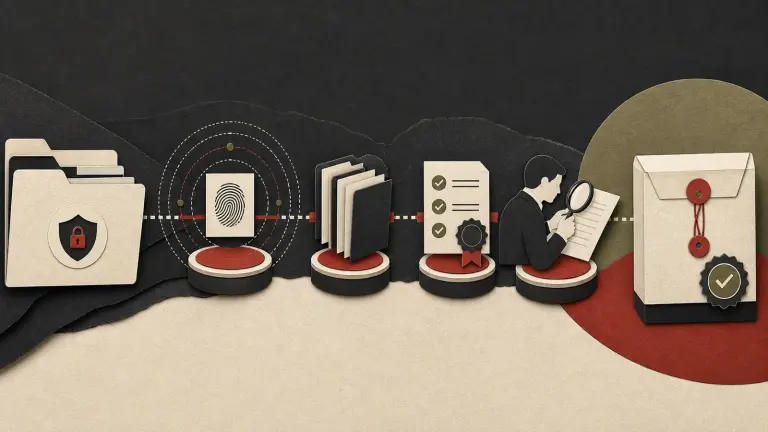
A legal team should export evidence for a claim or dispute by defining the request and date range, identifying custodians and sources, preserving original data, selecting an agreed production format, checking privilege and redactions, and recording every item in a manifest. Keep a copy of the source and a verified production set. A PDF export, hash value or certificate can support integrity and handling, but none alone proves that a document is authentic, admissible, complete or relevant.
This workflow focuses on producing or sharing evidence from a controlled collection. It is distinct from general preservation or a litigation hold: preservation protects potential evidence from loss; export selects and packages specific material for a lawyer, tribunal, court or counterparty.
Start with the request and intended recipient
Before exporting, write down what the recipient asked for, who authorized the response, why the material is being produced, and the deadline. Identify whether the production is for internal counsel, an insurer, a regulator, a counterparty, arbitration or a court. The intended use affects scope, format, confidentiality, privilege review and certification.
Translate the request into a production plan: people or custodians, systems, date range, search terms, document types, attachments, conversation channels, relevant contract families, and excluded categories. State what is unknown. Do not search or disclose an entire mailbox because a request uses a broad phrase such as “all communications” without clarifying authority and scope.
If the request comes from a regulator or court, counsel should review the actual order, statute, procedural rule and response deadline. The Code of Civil Procedure, 1908 on India Code includes rules on discovery and inspection, including Order XI and section 30, but procedure differs by forum and case type. Commercial disputes may involve additional rules under the Commercial Courts Act, 2015. Do not treat a voluntary export protocol as a substitute for an applicable court order.
Separate preservation, collection and production
These are three related but different steps:
| Stage | Purpose | Output |
|---|---|---|
| Preservation | Prevent likely relevant material from being deleted or changed | Hold instructions, custodian acknowledgments and preservation record |
| Collection | Gather data from approved sources while recording method | Read-only source copies or forensic acquisition with collection notes |
| Production/export | Select responsive material, review it, and package a recipient copy | Manifest, files, redactions, exceptions and delivery record |
Preservation should usually begin as soon as a dispute is reasonably anticipated, based on counsel’s assessment and applicable duties. It does not mean that every collected file will be disclosed. Collection should not silently overwrite source systems. Production is a separate decision after responsiveness, privilege, privacy, confidentiality and format review.
When a business receives a federal civil subpoena for its own records, production planning begins with the legal process and response deadline, not with an export button. Identify the issuing court, preserve potential sources, assess Rule 45 scope and burden, and have counsel resolve privilege before collection is packaged. Our Rule 45 subpoena response guide covers that recipient-side intake; this article addresses the later evidence export controls.
The litigation hold process covers preservation controls. This article begins after sources are identified and asks how to create a traceable export set. A litigation readiness plan helps assign owners and escalation paths before a production request arrives.
Build a scope and source manifest
Assign a stable ID to every source and produced item. Record the custodian or system, collection date, source path, period covered, method, file format, size, hash algorithm and value where appropriate, reviewer, production status and exception. For email, preserve attachments and parent-child links. For chat, retain conversation context and participant details. For cloud records, note the export method and account or workspace scope.
Do not make the exported PDF the sole record where native data matters. Native spreadsheets may contain formulas, hidden tabs or metadata that a printout omits. Email messages may need headers and attachment links. Audio or video may need the original format plus a readable or listenable access copy. Keep the original file and any conversion as linked records.
A manifest should answer: what was collected, from where, by whom, when, using which method, what was selected for production, what was withheld or redacted, and what transformation occurred. It should not expose privileged substance in a broad delivery note.
Preserve native files and create review copies carefully
Keep an immutable or access-controlled source copy. Create separate working copies for review, redaction and conversion. Record the relationship between source and derived copy. If a file is converted to PDF, retain the original and note software, settings, date, page count and any conversion exception.
For spreadsheets, inspect formulas, hidden sheets, comments and links before deciding whether a PDF is an adequate production format. For messaging, preserve complete threads and attachments where responsive. For scanned documents, retain the image original and any OCR layer separately. Never edit the only source file to remove a name or sensitive field.
Redaction must be irreversible in the delivered copy. A black rectangle over searchable text may leave the underlying words extractable. Use a validated redaction method, test the final file by searching and copying text, inspect page images, and ensure metadata and attachments do not reveal excluded material. Keep a sealed or restricted unredacted source under the approved retention controls.
Apply legal review and technical review as separate gates
Legal review determines responsiveness, privilege, confidentiality, relevance, scope, personal information and whether an exemption or redaction applies. Technical review checks file integrity, completeness, format, metadata, attachment links, rendering and whether redactions are actually removed. One gate cannot replace the other.
| Review gate | Questions | Record of completion |
|---|---|---|
| Scope | Is the file within the authorized request and date range? | Responsive/non-responsive reason and reviewer |
| Legal | Is it privileged, confidential, sensitive or subject to restriction? | Decision, redaction basis and approval |
| Technical | Does it open, render and retain expected metadata or relationships? | Format checks and exceptions |
| Production | Does the manifest match the final folder and delivery count? | Final QC sign-off and package hash |
| Delivery | Was the package sent to the authorized recipient securely? | Receipt, date, channel and access expiry |
Apply least privilege to the review workspace and delivery channel. Confirm recipient identity, encryption or approved transfer method, password handling, expiry and access logs. Do not put a password in the same message as the link if policy requires a separate channel.
What do hashes and chain-of-custody records establish?
A cryptographic hash can help detect whether a file changed between two points when the same algorithm and exact bytes are compared. It does not prove who created the file, that the file is complete, that it is true, or that it is legally admissible. A hash is one integrity control within a documented process.
A custody log records who collected, accessed, copied, transformed, reviewed and delivered the material, when it happened, and why. Include storage location, access restrictions, transfer method, tool or export settings, hash values, and any exception. For a collaborative review platform, preserve an access/export log and identify the responsible operator. Keep clocks and time zones consistent.
For electronically stored information in India, consult the Bharatiya Sakshya Adhiniyam, 2023. Sections 61–63 address electronic records and proof; section 63(4) and its Schedule set out certificate particulars for specified computer outputs. Section 75 addresses certified copies of public documents, and section 170 contains transitional savings. Ask counsel which provisions apply to the particular proceeding and record.
A section 63 certificate is not a general seal of truth. It addresses statutory proof conditions for the relevant electronic output. It does not independently establish relevance, authorship, lack of alteration before collection, completeness or admissibility over all objections. The collection facts and appropriate certifier matter. For practical source capture, review the BSA electronic-evidence checklist; for file organization across a matter, see the litigation document organization guide.
For a US federal proceeding, Federal Rule of Evidence 502 addresses the effect of certain disclosures on attorney-client privilege and work-product protection. Read the current official Federal Rules of Evidence PDF from the US Courts, which is amended through 1 December 2025. Rule 502 is jurisdiction- and context-specific; it does not define privilege or waiver for an Indian proceeding, and applicable state law may govern privilege in some US civil cases.
Worked example: exporting a customer dispute file
A company receives a request from its external counsel for communications and transaction records concerning a service outage from 1 to 10 May. Counsel confirms the request scope, custodians and deadline. IT preserves relevant mailboxes and service logs; a legal operations reviewer collects source copies and records collection time and method.
The team creates a manifest linking each email to its attachments and each service log to its system. Counsel identifies responsive messages and reviews privilege and customer personal data. Technical staff render the selected records, validate attachments and apply redactions to a production copy. A second reviewer confirms that redacted text cannot be searched or recovered. The final manifest records source IDs, production IDs, withheld categories, file hashes and package count. The delivery uses an approved secure channel; access is logged and later expired.
If a log could not be exported with its native metadata, the team records the limitation and asks counsel whether another format or explanation is needed. It does not state that a hash proves the log’s truth. This fictional example shows role separation; it does not prescribe compliance with any particular order.
How should the export be delivered and closed?
Before transfer, reconcile every production ID against the approved manifest. Confirm file count, attachment count, redaction status, naming, readability, folder structure and recipient authority. Save the exact delivered package and its hash or other approved integrity record. Record the channel, time, recipient and receipt confirmation.
After delivery, retain the manifest, review decisions, source linkage and delivery evidence under the organization’s approved retention plan and any litigation hold. Record corrections or supplemental production as a new package version. Never silently replace a file after delivery. Notify counsel about any discovered omission or mistaken disclosure and follow their response protocol.
Evidence-export checklist
- Confirm request, authority, recipient, forum and due date.
- Define custodians, systems, date range, search method and excluded sources.
- Preserve source data and distinguish preservation from production.
- Record collection method, operator, timestamp, time zone and source path.
- Keep native originals and link every derived or converted file.
- Review responsiveness, privilege, confidentiality and privacy separately.
- Apply and test irreversible redactions on production copies.
- Validate file readability, attachments, page counts and manifest matching.
- Calculate hashes where appropriate and document what they do and do not prove.
- Obtain any required certificate from a qualified person with accurate particulars.
- Deliver through an approved secure method to verified recipients.
- Retain the exact package, manifest, approvals, delivery record and exceptions.
Frequently asked questions
Is a PDF export enough for a court or counterparty?
Not always. The required format depends on the request, forum, source and purpose. A PDF can be convenient for review, while native files may retain formulas, metadata, headers or relationships. Keep native originals and ask counsel what the recipient or court requires.
Does a hash prove that evidence is authentic?
No. A hash can help show whether exact file bytes changed between measured points. It does not prove authorship, truth, completeness, provenance before hashing or admissibility. Keep collection notes and custody records too.
Is a BSA section 63 certificate the same as admissibility?
No. Section 63 sets proof conditions for specified electronic or computer-output records. A certificate does not decide relevance, authenticity, authorship, completeness or every objection. Counsel should identify the applicable law, source and certifier for the proceeding.
Should legal and IT review the same files?
They have different responsibilities. Legal reviewers assess scope, privilege, confidentiality and redaction decisions. Technical reviewers verify collection, rendering, metadata, attachments, hashes and package integrity. Both gates should be recorded.
How do you redact a PDF safely?
Use a true redaction function that removes underlying text and selected metadata, then test the delivered copy by searching, copying text and inspecting page images. Keep an unredacted source restricted and separate from the production package.
What is the difference between preservation and export?
Preservation prevents relevant material from being lost or altered. Export selects responsive material, reviews it and packages a recipient copy with records of transformations and delivery. Preserving a file does not mean it should be produced.
What if a file cannot be exported in native form?
Record the limitation, source system, export method and any conversion. Preserve the closest available source and ask counsel whether an alternative format, explanation or additional certification is needed. Do not describe the substitute as identical without verification.
Closing principle
A reliable evidence export is a controlled, reviewable package, not just a folder of PDFs. Keep native sources, scope decisions, redactions, technical checks, legal approvals, hashes and delivery records linked. That makes it possible to explain what was produced, how it was prepared and what limitations remain. For broader matter planning, see Gotham’s litigation readiness plan and India legal research solution; contact Gotham or visit the home page.
This is general operational information, not legal advice. Counsel must determine production obligations, privilege, redaction, format and admissibility under applicable law and forum rules.
How Gotham researches and reviews field guides