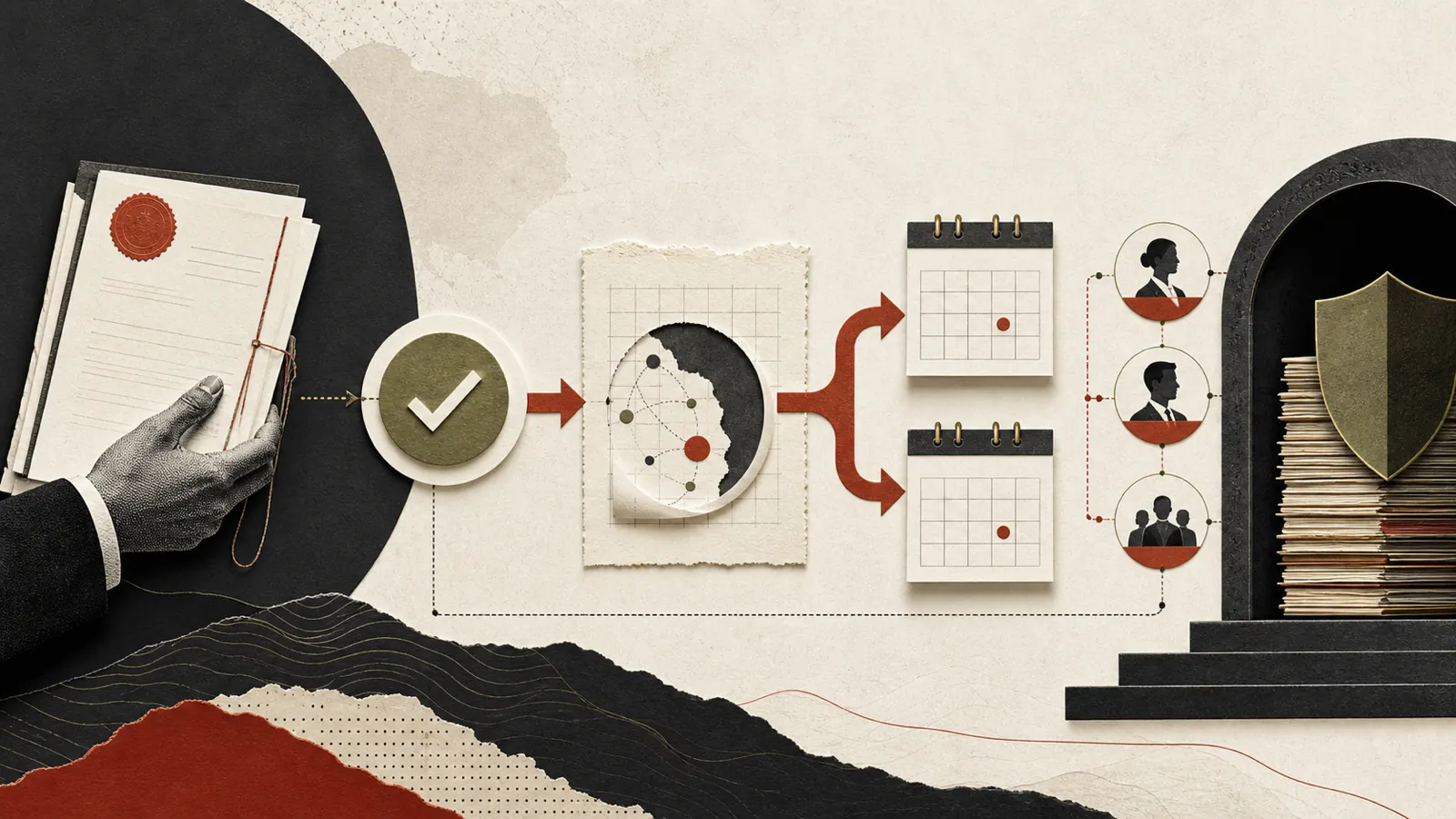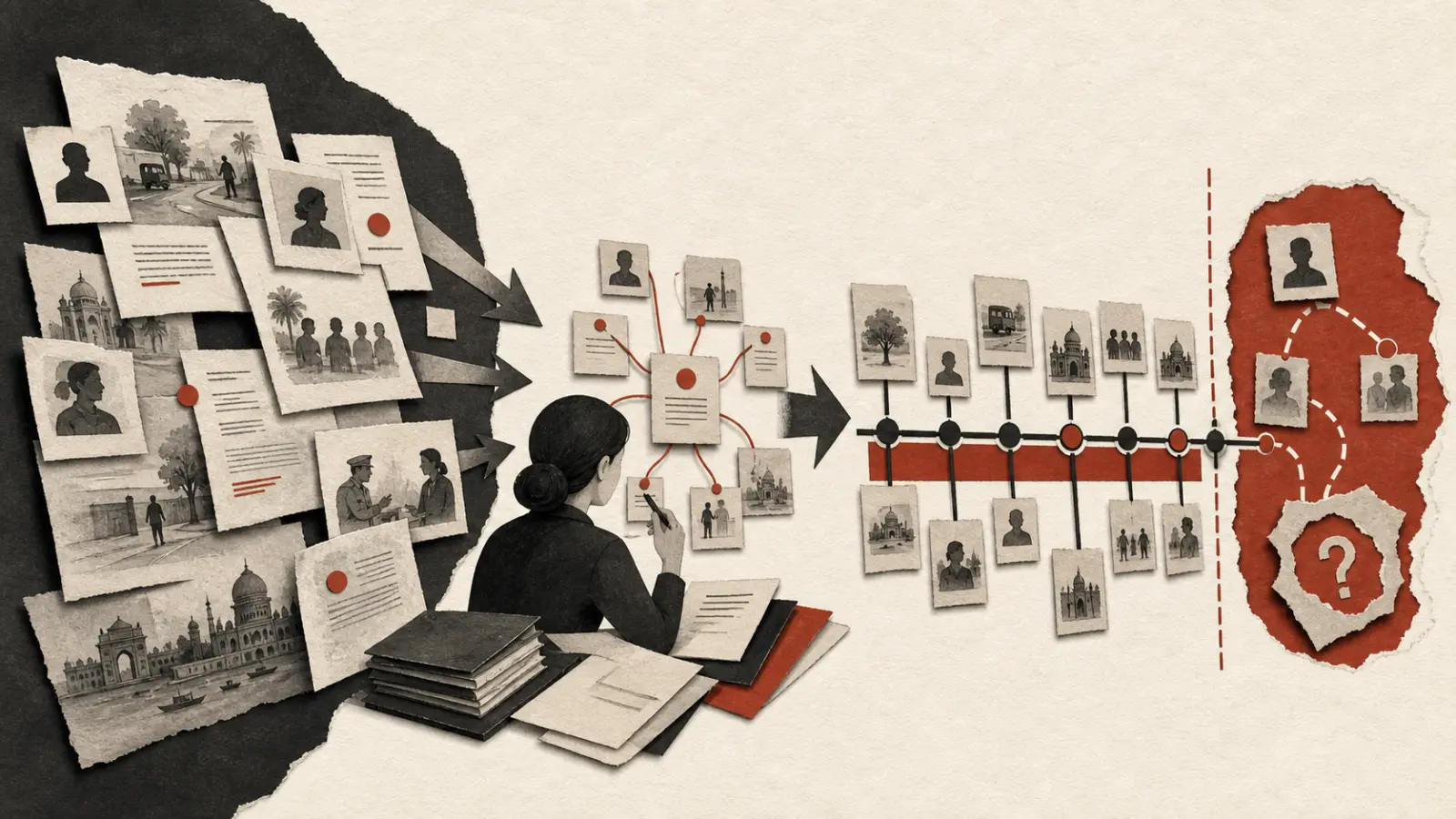
A case chronology preparation workflow turns a disordered record into a sequence that a lawyer can inspect, test, and revise. Its value is not the number of dates extracted. The useful chronology links each event to its source, distinguishes established facts from allegations, preserves ambiguity, and shows which entries have passed legal review.
This guide addresses operations, not admissibility or litigation strategy. The Bharatiya Sakshya Adhiniyam, 2023 on India Code contains provisions relevant to electronic or digital records. Official case and order sources include eCourts Services and the Supreme Court of India. Counsel should determine the law and procedure that apply to the actual record and forum.
This page owns the team operating process: scope, source inventory, extraction, review, export, and maintenance. Practitioners who need a row-level drafting template should use the case chronology drafting guide; teams comparing products should use the litigation chronology software checklist. Keeping those intents separate prevents a workflow guide from competing with a template or buyer page.
What is the quickest defensible chronology workflow?
Start with a matter scope and a source register. Extract candidate events with document IDs and pinpoint passages, then separate event dates from document dates and label allegations or disputed accounts. Have a reviewer check both the entries and the missing periods. Issue a dated export from the reviewed master, recording the source cut-off, exclusions, version, and recipients. Reopen the review when new material changes an event or fills a gap.
| Stage | Output to hand to the next reviewer |
|---|---|
| Scope | Purpose, date range, source collections, access rules, and cut-off |
| Inventory | Stable document IDs, provenance, and missing-source list |
| Draft | Neutral events with date status, attribution, and source pinpoints |
| Review | Checked entries, open conflicts, omissions, and named decisions |
| Export | Audience-specific view, manifest, version, and change route |
The detailed controls below explain each stage. For the event-row fields and a reusable drafting format, use the drafting guide.
What question should the chronology answer?
Define the chronology's job before reviewing documents. A master factual chronology, procedural history, witness timeline, transaction sequence, and limitation-focused chronology need different inclusion rules. Without a purpose, reviewers either collect every timestamp or select only facts that fit an early theory.
Write a short scope statement containing:
- the matter, forum, and procedural stage;
- the question or use the chronology supports;
- the relevant date range and time zone;
- included and excluded source collections;
- important actors, issues, and event types;
- treatment of privileged or restricted material;
- the research and document cut-off date; and
- reviewer roles and intended output.
Keep a broad master dataset and create focused views from it. A witness interview may need only events involving one person. A hearing team may need procedural milestones and contested factual sequences. Maintaining separate spreadsheets for each view invites silent divergence.
Gotham's litigation workflows can be assessed as a way to structure the work, while the matter protocol defines scope and legal review.
How should source documents be inventoried?
Create a source register before extracting events. Assign each item a stable document identifier and preserve the original. Record filename, document type, custodian or source, collection date, hash where the team's protocol uses one, language, page count, OCR state, and access label.
| Source field | Purpose | Quality check |
|---|---|---|
| Document ID | Stable chronology citation | Never reuse an identifier |
| Source or custodian | Provenance and follow-up | Distinguish sender from collector |
| Native and rendered files | Review and presentation | Link both without treating them as duplicates |
| Date collected | Collection history | Use a timestamp and time zone |
| OCR status | Search reliability | Flag handwriting and low-quality scans |
| Duplicate family | Reduces repeated review | Preserve differences and authoritative copy |
| Access label | Limits exposure | Match current matter permissions |
Do not discard a duplicate merely because the visible pages look identical. Email context, file metadata, annotations, signatures, or collection source may differ. Group duplicates for review, then let the responsible team decide how they should be treated.
For court documents, verify the case number, parties, court, date, coram where relevant, and document type against the available official record. A later uploaded order can refer to an earlier oral event; the upload date is not necessarily the event date.
Which fields should every chronology entry contain?
Each entry should be understandable without pretending the source proves more than it does. Use structured fields so a reviewer can filter and audit the result.
| Field | What to record | Common error |
|---|---|---|
| Event date | Exact, approximate, range, or unknown | Forcing an uncertain date into one day |
| Document date | Date of the source record | Confusing it with the described event |
| Neutral event | What the source states happened | Turning an allegation into a fact |
| Actor and recipient | Normalised entities and stated roles | Merging people with similar names |
| Source pinpoint | Document ID, page, paragraph, or message | Linking only to a folder |
| Attribution | Who says or records the event | Omitting that a statement is contested |
| Issue tags | Controlled matter topics | Using ad hoc synonyms |
| Review state | Candidate, checked, disputed, excluded | Treating extraction confidence as approval |
| Analyst note | Separate interpretation or follow-up | Mixing strategy into the factual summary |
Retain the source's original date expression. 03/04/2024 is ambiguous unless context resolves it. Record a normalised date only after review, and keep the interpretation note. For “early May” or “about two weeks later,” use a range or approximate field rather than invented precision.
How should events be extracted from the record?
Review in batches with a written extraction protocol. Define what counts as an event, how repeated references are handled, how quoted earlier events are recorded, and which fields are mandatory. Begin with anchor documents such as pleadings, contracts, formal notices, orders, and key correspondence, then expand to supporting records.
For every candidate event:
- open the full source and locate the passage;
- identify event date separately from record date;
- write a neutral one-sentence summary;
- preserve attribution, qualification, and uncertainty;
- cite the precise page, paragraph, exhibit, or message;
- tag actors and issues using the controlled vocabulary; and
- assign the appropriate review state.
AI-assisted extraction can surface dates and entities, but it may mistake a deadline for an event, a quoted email for the current speaker, or an allegation for a finding. Require a source citation for every candidate and let the reviewer open enough surrounding context. Gotham's legal corpus and practice workspace may support connected review, subject to the team's own validation and security assessment.
How should conflicting dates and accounts be handled?
Do not “clean up” a contradiction by selecting the version that appears most plausible. Create separate attributed entries or a linked conflict group. State what each source says, why the records appear connected, and which question remains open. A lawyer may later resolve the issue, or the contradiction itself may matter.
Use a reconciliation table:
| Conflict ID | Account A | Account B | Related sources | Status and owner |
|---|---|---|---|---|
| C-014 | Attributed event and date | Competing attributed event and date | Pinpoint citations | Open, named reviewer |
Distinguish correction from alteration. If the team confirms that a date was entered incorrectly, preserve the earlier value in history and record the reason, source, editor, and timestamp. Never overwrite an issued chronology without creating a new version.
Procedural events need similar care. The date of an order, date it was uploaded, date a party received it, and compliance deadline can all differ. Record each event separately when it affects the matter.
How should electronic records be represented?
Electronic records introduce time zones, thread duplication, attachments, message edits, and metadata that can disappear when content is printed. Preserve the available native record under the matter's collection protocol and link any review rendering to it. Do not infer authenticity, authorship, or admissibility from a filename or software display.
For an email or message event, consider recording:
- native message identifier where available;
- sender, recipients, copied recipients, and stated account;
- sent timestamp with time zone and normalised display time;
- attachment identifiers;
- whether the event is in quoted history or the current message;
- collection source and rendering method; and
- any gap, truncation, or conversion warning.
The BSA addresses electronic or digital records, including statutory conditions that may be relevant in a proceeding. Counsel should design collection, preservation, and proof for the matter. The companion electronic evidence checklist can support issue spotting but does not replace that assessment.
How should legal review and quality control work?
Use at least two distinct states: extracted and legally reviewed. An extractor can check transcription and source links, while the responsible lawyer assesses relevance, characterisation, privilege, and use. For high-impact entries, consider a second review or explicit approval.
Run quality checks across both entries and coverage:
- Every material event has a stable pinpoint source.
- Event dates and document dates occupy separate fields.
- Allegations and statements are attributed.
- Approximate, inferred, and disputed dates are labelled.
- Entity names and issue tags use the matter vocabulary.
- Conflicting accounts remain visible and linked.
- Privileged analysis is separated and access-controlled.
- Court documents match official records where available.
- New productions trigger duplicate, gap, and re-review checks.
Sample omissions, not only populated rows. Compare the chronology against the source register, key pleadings, and known milestones. A beautifully cited timeline can still be incomplete because one collection or date range was never reviewed.
Run a ten-entry handoff test
Before expanding the workflow, give a reviewer ten entries they did not prepare: three ordinary events, two disputed dates, two procedural events, one electronic message, one event supported by multiple sources, and one excluded candidate. The reviewer should be able to answer all of these questions without speaking to the extractor:
- Which source and pinpoint support the entry?
- Is the date exact, approximate, inferred, disputed, or unknown?
- Is the wording a neutral event, an attributed account, or an analyst note?
- Which document and event dates are being shown?
- What review state applies, and who last changed it?
- What other entry or conflict record would change its interpretation?
Record failures by field. If four reviewers cannot locate a pinpoint, fix the source-link design. If they disagree about allegation versus fact, fix the event-writing protocol. If an export hides disputed status, fix the output before adding more extraction volume. This test turns a general quality discussion into observable workflow defects.
The litigation chronology software guide describes selection criteria for teams considering a dedicated tool. Test the evidence trail and reviewer experience on representative matter documents.
How should the chronology be exported and updated?
Generate audience-specific outputs from the reviewed master. A client update may use a concise set of agreed milestones. Counsel preparation may require every source and conflict note. A filing team may need an annexure formatted under applicable rules. Each export should state its purpose, source cut-off, review state, generation date, and any exclusions.
For a claims or disputes handoff, issue a packet rather than an unexplained timeline file:
| Packet item | What the recipient should be able to check |
|---|---|
| Chronology view | Event date and status, neutral description, attribution, source ID, and pinpoint |
| Source manifest | Document IDs, file versions, provenance, access restrictions, and any unavailable originals |
| Open-issues log | Conflicting accounts, missing periods or attachments, unverified dates, and the assigned reviewer |
| Export record | Purpose, audience, source cut-off, generation time, reviewer state, version, and recipients |
Test the packet with someone who did not build it. Ask them to open a material event's source passage, identify any disputed status, and locate the version used for a decision. If a link, restriction, or excluded source prevents that check, record the limitation and fix the packet before relying on the export. Counsel should decide the form and evidentiary requirements for any filing.
Protect the master from edits made in an exported spreadsheet. If a reviewer comments offline, reconcile those comments through an assigned change process. Store the issued export as its own record with a version, recipients, and link back to the master dataset.
New orders, productions, interviews, and corrected records should trigger an update queue. Ask which existing entries are contradicted, superseded, or newly supported. Preserve prior issued versions so the team can tell what information was available at an earlier decision point.
When is a case chronology ready to use?
Readiness depends on purpose. Before using a chronology for advice, witness preparation, a filing, or a hearing, the responsible lawyer should confirm that the source universe and limitations are stated, critical entries have been reviewed, disputes remain visible, and the output matches the forum and audience.
A strong case chronology preparation workflow does not force the record into a neat story. It gives the legal team a faithful, navigable account of what each source says and where uncertainty remains. To map an evidence-linked chronology around your matter process, contact Gotham or review Gotham's security approach as part of your technology diligence.