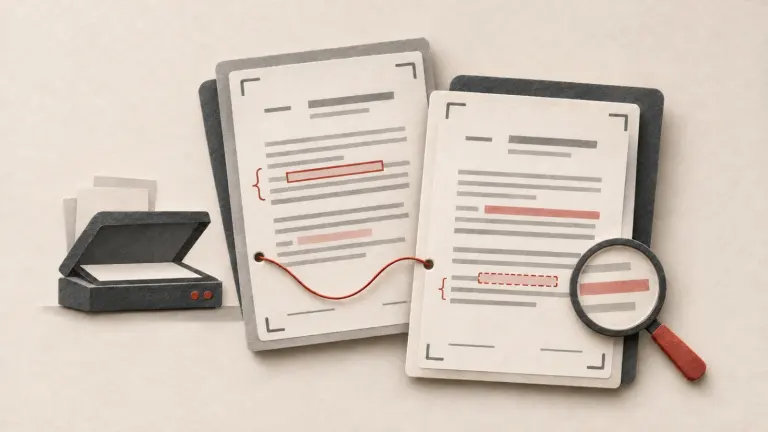
An English working translation can help a legal team review a contract, order, pleading, letter, or evidence file written in another language. Reviewers need to know which source version it came from, what changed, which passages need attention, and who checked it.
Treat translation as document control as well as language work. Preserve the original and link the working translation to one source version. Compare legal and commercial meaning against the source, not only the translated prose. Before signing, filing, serving, or sharing a translation externally, confirm the recipient's current requirements with the responsible lawyer. A generated working copy is not proof of certification or acceptance.
First decide what the translation is for
Before choosing a language pair or starting a job, write one sentence describing the intended use. “Help the disputes team understand the chronology before counsel reviews the record” is more useful than “translate this file.” A team preparing an English discussion copy may need different checks from a team assembling material for an external filing or sharing a draft with a client.
Record four items:
| Item | Example question |
|---|---|
| Reader | Who will use the translation, and what decision or review will it support? |
| Purpose | Is this for internal triage, clause review, a client discussion, negotiation, or formal submission? |
| Source | Which document, version, date, and language are being translated? |
| Output | Does the reviewer need a readable copy, an editable working file, a bilingual comparison, or a translation with a review record? |
Preserve the source before translating
Choose the exact saved document version and keep it unchanged. If the source arrived by email or through a portal, retain the received file and enough context to identify where it came from. Give the working translation a separate identity; do not replace the original file or label the translated copy as the authoritative executed, filed, or received record.
Capture a small source manifest before work begins:
- matter or project identifier;
- neutral document title and document type;
- source file name and saved version identifier;
- date received or saved, if known;
- source language, including any uncertainty or mixed-language passages;
- requested target language;
- person who requested the work and its purpose; and
- any pages, annexures, schedules, tables, stamps, handwriting, or attachments that are missing or unreadable.
The manifest should distinguish a known fact from a guess. If the file is an unsigned draft, say so. If a scan cuts off a page number or a handwritten note cannot be read, record that limitation instead of silently filling it in. A later reviewer needs to know which material was present when the translation was prepared.
Bind the translation to the selected version
Do not translate from a folder search result or a filename that happens to look current. Open the saved record, verify the version, and confirm that the file is ready to process. If the document changes while work is underway, pause and decide whether the existing translation still serves the task. A translation of an earlier draft does not automatically describe a later signed copy or amendment.
When a document system supports version-bound translation, use the source version it identifies and keep the resulting translation linked to that version. Record the target language, translation revision, date, requester, reviewer, and any correction made. If the system provides a quote or estimate before processing, inspect it and approve only the work the team intends to request. Re-check the source identity and estimate if either changes before approval.
For a manually managed workflow, use a naming pattern that makes the relationship visible without exposing sensitive details. For example:
MATTER-2041_agreement-source_v03_mr-IN.docx
MATTER-2041_agreement-working-translation_v01_en-IN.docx
Use the firm's own matter identifier and language labels. Do not put client names, legal strategy, privileged descriptions, or personal information in filenames unless the firm's approved policy requires it. Keep the original and translated working copy in the same controlled matter location, with access limited to people who need them.
Review meaning, not just fluency
A fluent translation can still reverse a legal or commercial position. Have a human reviewer competent in both languages and the document's subject compare important passages side by side. Software can flag issues, but a qualified person must decide whether the wording preserves the meaning needed for the task.
Use a focused review table rather than rereading an entire file without a record:
| Check | What to compare | Why it deserves attention |
|---|---|---|
| Parties and names | Party names, entity suffixes, defined names, signatories, addresses | A spelling variation can make a reviewer think two people or entities are different. |
| Obligations and permission | Must, may, shall, is entitled to, is prohibited from, and who acts | Modal verbs can alter whether a step is required, allowed, or barred. |
| Negation and conditions | “Not,” “unless,” “only if,” exceptions, provisos, and conditions | A missed qualifier can change the direction or scope of a sentence. |
| Dates and time periods | Calendar dates, duration, start/end points, and sequence | The number may be right while the event from which it runs is wrong. |
| Money and quantities | Amounts, currencies, percentages, units, decimal separators, and totals | Numerals can be copied incorrectly or formatted differently across languages. |
| Defined terms | Capitalised terms and each later use | A translated phrase may not map consistently to the same defined term. |
| Cross-references | Clause, paragraph, annexure, schedule, and page references | A reference may point to the wrong place after layout or extraction. |
| Tables and lists | Row order, column labels, bullet scope, merged cells, and footnotes | Text extraction can detach a value from the heading that gives it meaning. |
| Stamps, signatures, and notes | Labels, seals, marginalia, handwritten additions, and signature blocks | A clean body of text can omit an important mark or qualification on the page. |
For each issue, keep the source wording, proposed translation, reviewer's note, decision, and status. Mark unresolved wording clearly. If a scan is unclear, note the page and request a better copy. Do not guess just to make the translation look complete.
Create a terminology sheet for repeated work
For a contract family, long matter file, or batch of related records, start a small glossary before translating all documents. Include the source term, approved target wording, context, decision owner, and date. Distinguish a party's chosen defined term from an ordinary word that happens to have the same spelling. Record alternate renderings where the right choice depends on context.
The glossary supports review; it does not override the source. Flag ambiguous, technical, archaic, or locally specific terms for the bilingual lawyer. Apply an approved correction to related documents only after checking that the context matches.
Keep machine review and human review distinct
Use machine review to flag passages for attention. Check each finding against the original and translated text. A “no issue found” result does not prove every passage is faithful, and a machine finding is not a legal conclusion.
Record human review separately: the reviewer, relevant language competence or role, passages checked, changes made, unresolved questions, and purpose. If the reviewer edits the translation, create a new revision and retain the prior review record. This gives the next person a clear handoff.
Machine review does not make a translation certified, sworn, attested, court-approved, or legally accurate. Check any official or recipient-specific requirements with the responsible lawyer and arrange that process separately.
Check formal translation and filing requirements separately
The Government of India’s Central Translation Bureau describes professional translation, translator training, and terminology resources for government organisations. That is an example of a distinct institutional translation function, not a requirement for private legal teams. For court filing, the Supreme Court e-Committee’s August 2018 e-Filing user manual directs users to follow the rules of the concerned court and notes that a court may require physical submission as well. It is portal guidance, not a universal translation standard. Check the current instructions of the relevant court or recipient before treating an internal working copy as ready for formal use.
Export only after the review record is clear
Before downloading a Word or PDF copy, confirm the translation revision and its source version. Reopen the export separately. Check page order, headings, tables, footnotes, page breaks, stamps, and signature blocks. Make sure it does not make a draft look executed or hide which language is the original.
Keep the working copy, source, manifest, glossary, and review record together under the team's document controls. When handing it to a colleague, state its purpose and limits.
Revisit the translation when the source changes
Treat an updated source as a new review event. Compare its version with the translation record. Decide whether it needs a full translation or a focused update, then identify affected clauses, pages, schedules, and related documents. Have a reviewer check that the new source is not paired with an outdated translation.
Use a short change record:
- identify the new source version and the prior version;
- record the differences that matter to the requested task;
- create a new translation revision or mark the old one superseded for that purpose;
- review the changed passages and their surrounding context; and
- record who approved the new working copy and when.
This prevents a reviewer from mistaking an earlier negotiation draft's translation for the signed agreement's translation.
A practical handoff checklist
Before marking an internal working translation ready for its stated purpose, confirm:
- The intended reader and use are recorded.
- The original file is preserved and the selected source version is identified.
- The source and target languages are confirmed, including mixed-language or unreadable sections.
- The output is labelled as a working translation and linked to its source.
- Names, defined terms, obligations, negation, dates, amounts, references, tables, notes, and signatures were checked against the source.
- A bilingual human reviewer recorded what was checked and what remains unresolved.
- The exported Word/PDF copy was reopened and its structure checked.
- The source, translation revision, glossary, and review record are stored together under approved access controls.
- A change in the source version will trigger a recorded re-review decision.
- Formal external use has been separately checked with the responsible lawyer and recipient.
Gotham's DMS translation workflow is one example of a version-linked process: it selects a saved document revision, requires an approved estimate before work is accepted, stores a translation revision, and provides separate machine-review and human-check steps. It can export a completed revision to Word or PDF. Language pairs and availability should be checked in the product for the actual document. Its machine review is not a human check, and a working output is not certified. Teams should evaluate the workflow against their own review standard, access policy, and use case.
For related controls, see Gotham’s legal document naming and version-control guide and court-filing quality-control checklist. You can also explore Gotham workflows or contact the team about a document-review process.
This guide describes an internal document workflow, not a legal opinion or a promise that an output meets a recipient's requirements. Confirm those requirements before formal external use.
This is operational guidance for preparing an internal working translation. It is not legal advice, a certified translation, or confirmation that a translation meets any court, authority, contract, or filing requirement. Check the recipient's current requirements and obtain appropriate bilingual and legal review.
How Gotham researches and reviews field guides