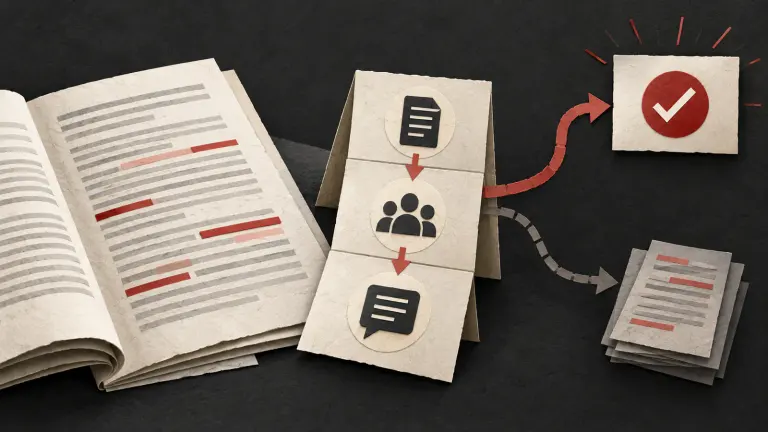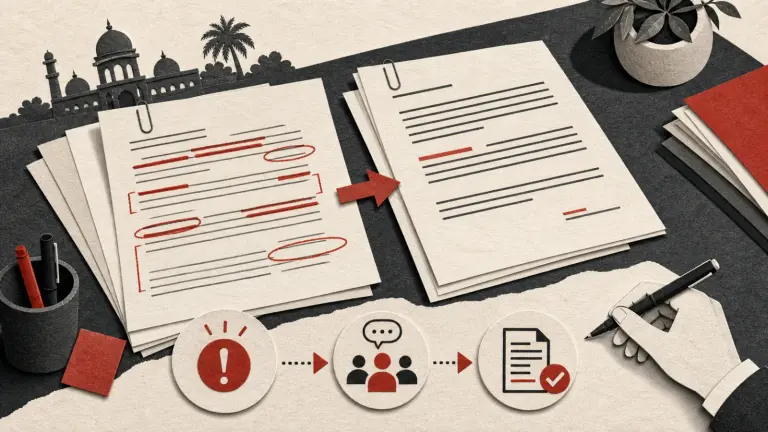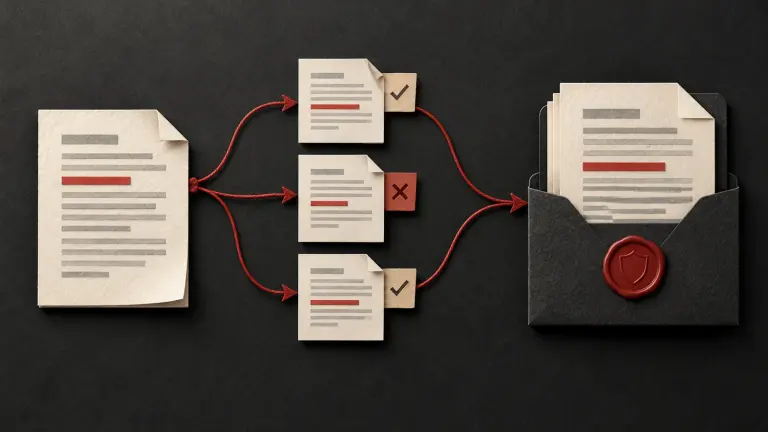
Legal document automation needs controlled template changes so reviewers can tell which approved language generated a document, who authorised the release, and what happens to work already in progress. A practical system keeps a versioned source, named approvers, effective date, testing evidence, access controls, and a route to pause or roll back a bad release. Indian law does not prescribe one universal template-versioning workflow; these are governance practices an organisation should design with its counsel and operating teams.
This guide focuses on the lifecycle of a template change, not on what legal position a clause should take. A template is a starting point for a transaction, not an automatic substitute for review of the parties, facts, law, and final signed instrument.
Why template changes need a controlled path
Templates change for many reasons: a law or regulation changes, a product or process changes, an identified risk recurs, a clause is clarified, a business team negotiates a new fallback, or an operational owner changes. Without a controlled release, one team may use last month’s form, another may copy a clause from a completed contract, and a third may generate a document with a different clause library than the one the legal team approved.
The risk is not only outdated language. A local edit can alter a defined term, cross-reference, liability cap, notice route, data obligation, or signature block elsewhere in the document. A template system can also turn a lawyer’s approved wording into a broken document if the variable mapping, conditional logic, or format changes. The control process should therefore answer both “Is the legal text approved?” and “Does the released template produce the intended document?”
The Indian Contract Act, 1872 supplies primary legal context for agreements, consent, and performance. It does not mandate a specific internal template version-control design. Organisations should not describe their chosen approval matrix, naming convention, or testing checklist as a statutory requirement unless a particular law, regulator, contract, or policy actually says so.
Define what is being controlled
Separate the template package into identifiable items. One “template” may include a base agreement, schedules, clause alternatives, definitions, data-protection annex, document-generation rules, form fields, signer instructions, and guidance notes. Record each item’s owner and version relationship. A clause bank update should not silently change every agreement that references it unless that is the deliberate and reviewed release.
For each controlled template, capture:
- document family, business purpose, party-side perspective, and intended jurisdiction;
- owner responsible for proposed changes and operational maintenance;
- legal approver and any business, privacy, security, tax, finance, or compliance reviewers;
- source version, change request, rationale, and affected provisions;
- effective date and transactions or users to which the new version applies;
- variables, conditional rules, linked clauses, annexes, and output format;
- review cadence or triggering events, where the organisation chooses to set one; and
- retirement, archive, rollback, and access rules.
Version identifiers should be unambiguous. A date can help, but a semantic version or controlled release ID may be more useful when several template components change independently. The identifier should travel with the generated document record even if it is not printed into the contract itself.
A workable change-control sequence
| Stage | Minimum decision record | Owner to identify |
|---|---|---|
| Request | Problem, proposed change, affected document families, urgency | Requester and template owner |
| Legal analysis | Current wording, proposed wording, legal/business reason, risks | Counsel accountable for interpretation |
| Cross-functional review | Operational, data, security, finance, tax, or product effects | Relevant subject-matter owner |
| Approval | Exact text, exceptions, approver authority, conditions | Named delegated approver |
| Build | Template version, logic, variables, annexes, source files | Document operations or system owner |
| Test | Representative scenarios and expected output | Legal reviewer plus functional tester |
| Release | Effective time, audience, permissions, communication | Release owner |
| Monitor | Defects, user feedback, exceptions, rollback trigger | Template owner and support route |
- Open a change request. Describe the issue and the affected documents. Link the actual clause, transaction examples, source guidance, and any deadline. Avoid asking an approver to evaluate a redline with no context.
- Decide the scope. Confirm which business lines, contract types, sides, regions, languages, and active negotiations are affected. Do not make a global change because one deal exposed a local exception.
- Review legal meaning and dependencies. Compare existing and proposed text; inspect definitions, schedules, remedies, notices, privacy commitments, and related provisions. Identify whether the change is required by law or chosen as policy, and record the source for that claim.
- Route to accountable reviewers. Counsel reviews legal effect. Operational owners validate whether the business can perform the obligation. Security, privacy, tax, finance, procurement, or product teams join when the change affects their commitments. Keep final approval with a person who has delegated authority.
- Approve an exact release candidate. Record the actual text and logic approved, version identifier, approver, decision date, any approved fallback, and conditions. A discussion in chat is not a release record unless the organisation’s process explicitly treats it as such and preserves it reliably.
- Build and test the automation. Check data fields, optional sections, defined terms, numbering, cross-references, page breaks, signatures, and output formats. Test scenarios that exercise both inclusion and omission rules.
- Release deliberately. Set the effective time and user group, prevent accidental use of the superseded version, publish change notes, and preserve the prior version for records and in-flight matters.
- Monitor and correct. Capture defects, provide a pause/rollback route, identify documents generated during a bad release, and decide whether users need notice or re-review.
Review the automation as well as the words
A clause can be legally approved but technically misapplied. For example, a data-protection schedule might appear only when a dropdown is selected, while the intake form maps the answer to the opposite value. A liability cap may use a field that is blank in one entity’s document. A template may also insert a defined term that no longer appears in the body.
Use representative test cases rather than one “happy path.” Include a normal transaction, optional schedules, a fallback clause, an empty or invalid field, a long party name, and relevant locales. Compare generated output to a reviewed reference and inspect both rendering and text.
Keep tests proportional. A small change to a footer may need a narrower review than a change to indemnity logic or execution blocks, but the reason for the selected scope should be recorded. Never let a model or automation release consequential legal wording without a human accountable for the legal and policy decision.
Manage in-flight matters separately from the current version
When a new template is released, decide whether it governs only new requests, also applies to unsigned drafts, or requires a transition plan for active negotiations. Do not silently regenerate an existing draft and overwrite the document that the parties negotiated. Pin each matter to the source version used and record any later manual change or approved exception.
For executed agreements, retain the final signed version and the relationship to the template that generated it where known. A new template does not amend a signed agreement by itself. Any amendment must follow the contract’s amendment mechanism and applicable authority, execution, stamping, or registration requirements. Those requirements vary with the instrument and transaction; involve counsel rather than treating the template system’s “approve” button as execution.
The Information Technology Act, 2000 includes provisions concerning legal recognition of electronic records and signatures and section 10A on contracts formed through electronic means. It does not mean that every workflow click proves valid execution, authority, or compliance with transaction-specific formalities. Check the statute and its exclusions, the nature of the instrument, the signatory’s authority, and the applicable process.
The Bharatiya Sakshya Adhiniyam, 2023, particularly sections 61–63, concerns electronic records and their proof in evidence. It is relevant to preserving and explaining electronic approval or document records when a dispute later arises, but it does not prescribe this template governance framework. Preserve records accurately and ask counsel how the applicable evidence requirements affect a particular proceeding.
Worked example: updating a supplier agreement
Fictional example: A company wants to update its supplier agreement after its privacy team identifies a need for clearer incident escalation and data-handling responsibilities. Procurement asks the automation administrator to replace the clause immediately in the shared template.
The administrator opens a change request rather than editing the live template. Counsel reviews the proposed obligations against the company’s current contract positions and applicable legal duties. Privacy and security confirm which response timelines and controls the company can actually support. The approved wording includes a defined fallback for lower-risk suppliers and an escalation trigger for unusual data categories. The release record stores the exact text, version, owners, date, and reason; it does not claim that every new sentence is directly required by statute.
The document operations owner updates the template logic and tests a standard supplier, a supplier with the fallback, a supplier with no data processing, and a missing intake answer. Reviewers compare generated clauses and cross-references. The new version is released for new requests on a stated date. Existing negotiations remain pinned to the previous version unless counsel and the business owner approve a documented transition. The old template is marked superseded, kept in the controlled archive, and removed from ordinary user selection. If a defect appears, the owner can pause the release and identify documents generated since deployment.
This example is fictional. It shows an operational method, not a claim that the law demands a particular approval committee or retention period.
Common failure modes and safeguards
- A live template is edited directly. Require a request, approval, and staged release.
- The change rationale is missing. Record the source, risk, policy choice, or operational problem.
- Only counsel reviews a performance promise. Include the owner who must deliver the promise.
- A clause is reviewed without its dependencies. Inspect defined terms, schedules, remedies, and linked provisions.
- Testing covers one output. Exercise variable logic, fallback paths, and different document lengths.
- Old and new versions remain equally available. Mark status clearly and control who can select each one.
- An active negotiation is silently migrated. Pin its version and document any transition decision.
- Approval is confused with signature. Keep drafting, internal approval, execution, and contract amendment as separate events.
- A system claims legal compliance automatically. State what the tool actually does and retain human legal review.
- No rollback owner exists. Name who can pause a release and how affected documents will be identified.
Template change-control checklist
- The request identifies the business problem and affected document families.
- The change record distinguishes law, policy, drafting preference, and process choice.
- Legal and relevant operational reviewers are named.
- The exact approved text, conditions, and fallback are preserved.
- Version ID, effective date, owner, and applicability are clear.
- Automation variables, logic, cross-references, and output are tested.
- New requests and in-flight matters have an explicit transition rule.
- Superseded versions remain available to authorised users for traceability.
- Execution and amendment steps are kept separate from internal approval.
- A pause, rollback, incident record, and affected-document review route exists.
For clause-level approval thresholds, see the contract redline playbook. Use the contract redlining workflow for negotiation stages and legal document naming and version control for file identity. The electronic evidence checklist under the BSA addresses preserving and explaining digital records. To discuss document workflows with Gotham, visit legal workflows or contact the team.
Frequently asked questions
Does Indian law require a company to version-control its contract templates?
There is no single general statute that prescribes the specific lifecycle in this guide for every organisation and template. Other legal, regulatory, contractual, records, or governance duties may affect particular documents. Treat this as an operational control framework and have counsel identify any binding requirements for the business and transaction.
Who should approve a legal template change?
The right approvers depend on what changes. Counsel should own legal interpretation; the business owner should confirm commercial authority; and privacy, security, finance, tax, procurement, or product specialists should review commitments that fall within their responsibility. The organisation should identify delegated approvers rather than assume one universal role.
Should an existing draft automatically move to the newest template?
Usually the transition should be an explicit matter-level decision. Preserve the version that generated the negotiated draft and document any migration, re-review, or exception. A new template release does not itself amend a signed agreement.
How should a team test automated document templates?
Test representative combinations of fields, optional clauses, fallbacks, schedules, and missing or unusual data. Compare the generated text with an approved reference and inspect layout, numbering, defined terms, signature areas, and cross-references. Have a qualified reviewer verify consequential changes.
Does an electronic approval workflow mean the contract is signed?
Not necessarily. Internal approval, authority to sign, execution by the parties, and compliance with transaction-specific formalities are distinct questions. The Information Technology Act recognises electronic records and signatures in defined circumstances, but the instrument and process must be assessed specifically.
What should be retained when a template is retired?
Keep enough controlled information to identify the old version, its approved text and logic, effective dates, approval record, and relationship to documents generated from it. Retention duration and access restrictions should follow the organisation’s legal and records policies rather than an invented universal period.
Can document automation decide whether a clause is legally acceptable?
It can help compare text, apply configured rules, or flag deviations, but it cannot replace a lawyer’s contextual judgment about the parties, transaction, law, and linked provisions. Keep an accountable person able to review, reject, edit, and escalate the output.
Is a hash enough to prove which template generated a contract?
A hash can help show whether two byte sequences match, but by itself it does not prove who approved a template, who generated a file, or whether the contract was executed. Use hashes as one element of a documented provenance record.
Organisations can adapt the lifecycle to their own authority structure and risk. Gotham’s contract review workspace and workflow overview connect intake, review instructions and document work; contact Gotham to map a repeatable template-review process for your team.
This article is general operational information, not legal advice. Organisations should set template controls with qualified counsel and adapt them to their documents, authority structure, and systems.
How Gotham researches and reviews field guides