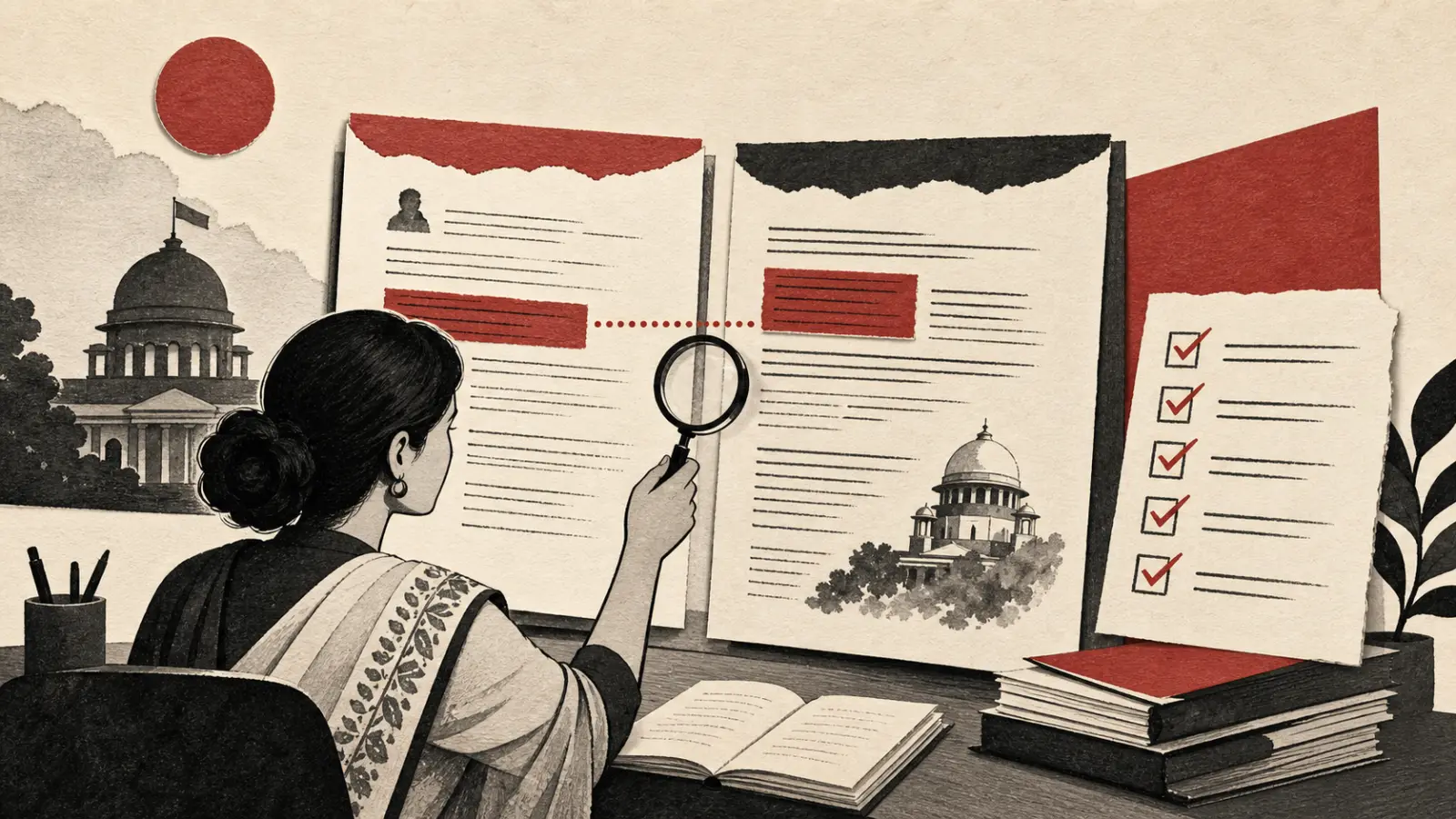
A law firm knowledge management system should help a lawyer answer two questions quickly: “What do we know?” and “Can I rely on it for this matter?” A folder full of old opinions answers only the first, and often badly. Useful knowledge carries sources, jurisdiction, effective dates, owners, review status, permissions, and a clear route back to primary material.
In India, authoritative research may involve official legislation, delegated legislation, gazette notifications, judgments, orders, and court rules. India Code provides central legislation and related material within its scope. The eGazette portal and official court websites are also important source channels. Coverage and currency must be checked rather than assumed.
What belongs in a law firm knowledge system?
Separate reusable knowledge from matter evidence. A research note, approved clause, playbook, tribunal guide, expert list, and post-matter learning can be reusable. A client's confidential document remains governed by the matter and should not become searchable firm-wide simply because it contains a useful passage.
| Knowledge type | Required context | Typical owner |
|---|---|---|
| Research memo | Question, jurisdiction, sources, cut-off date, reviewer | Practice lawyer |
| Precedent document | Use case, approved clauses, limitations, review date | Precedent committee |
| Court or forum guide | Official sources, local practice notes, verification date | Litigation knowledge lead |
| Checklist | Trigger, steps, decision gates, source version | Process owner |
| Matter learning | Sanitised insight, approval, access classification | Matter partner and KM team |
| Training note | Audience, learning objective, source set | Training owner |
Begin with the legal research workflow for India as a pillar. The knowledge system should preserve the source trail produced by research, not strip it away in the name of convenience.
How should authoritative sources be captured?
Save a source record, not just a downloaded PDF. Include title, issuing body, jurisdiction, document type, official URL, publication or decision date, access date, effective date if confirmed, and relationship to earlier material. Preserve the original file where permitted and a checksum or stable identifier.
For Supreme Court material, use the official Supreme Court of India website and relevant rules, judgments, orders, notices, and circulars. For legislation, verify the text and any commencement or amendment question through official materials and counsel's research process. A search-engine snippet or commercial summary can help discovery but should not become the authority attached to a legal proposition.
Apply a source hierarchy:
- Locate the official primary source.
- Confirm identity, jurisdiction, and date.
- Capture amendment, treatment, or supersession questions.
- Link the source to propositions in the work product.
- Record the research cut-off date.
- Route unresolved currency questions to a reviewer.
- Schedule review for knowledge that will be reused.
Use the citation verification checklist before publishing a memo as reusable knowledge.
How do you design metadata people will actually maintain?
Keep mandatory metadata small enough to complete and important enough to trust. Start with title, type, practice, jurisdiction, topic, source cut-off, owner, reviewer, confidentiality class, status, and next-review date. Add specialised fields only when they support a real retrieval or control need.
Controlled vocabulary helps. “Supreme Court,” “SC,” and “SCI” should not create three jurisdiction filters. Maintain a synonym map for search, but store one approved value. Let users suggest new tags without allowing uncontrolled duplication.
Status labels should be plain:
- draft: incomplete and not approved for reuse;
- reviewed: checked for the stated scope and cut-off;
- approved precedent: authorised for the described use;
- review due: not necessarily wrong, but currency needs checking;
- superseded: retained for history and linked to replacement; and
- restricted: discovery and access limited by policy.
Never use “current” as a permanent status. Currency is always current as of a date and scope.
How should precedent documents be governed?
A precedent is not a form to copy blindly. Add a cover note stating its intended use, jurisdiction, assumptions, alternative provisions, required approvals, and known limitations. Keep drafting guidance beside the clause rather than hidden in a separate email.
Precedent release checklist:
- originating matter content has been removed or properly authorised;
- client identities, facts, strategy, and privileged annotations are excluded;
- substantive owner and independent reviewer are named;
- source law and research cut-off are recorded;
- optional language and decision points are explained;
- document automation fields have been tested;
- version and replacement history are visible; and
- next review has an owner and realistic trigger.
If a lawyer modifies an approved precedent, the matter copy should diverge without silently altering the master. Useful improvements can return through a proposed-change workflow with review and attribution.
How can search return useful results without false confidence?
Search should expose why a result matched and whether it can be relied upon. Display document type, jurisdiction, status, source cut-off, owner, and access classification in the result card. Rank approved and current-for-purpose material above uncontrolled drafts, while still allowing authorised researchers to find historical items intentionally.
Test search with real tasks, not attractive demos. Ask lawyers to find a current source, a superseded memo, an approved precedent, a restricted matter learning, and a term with several synonyms. Record misses, misleading rankings, and permission leaks.
AI-assisted retrieval needs the same controls. Generated answers should link to inspectable sources, distinguish quotations from summaries, and disclose when the available corpus is incomplete or stale. The user must be able to open the underlying authority and perform legal verification. Explore Gotham's legal research workflows as one approach to source-linked work.
How should access, privacy, and security be handled?
Classify content before ingestion. Define whether an item is public, firm-wide, practice-restricted, matter-restricted, personally restricted, or subject to an ethical wall. Search indexes, previews, exports, analytics, and backups must respect the same access decision as the original document.
The Ministry of Electronics and Information Technology publishes official materials relevant to India's digital policy environment. Data-protection and security obligations require fact-specific assessment, including the applicable law, contractual commitments, client instructions, and deployment design.
Review controls for identity, least privilege, access reviews, encryption, retention, deletion, export, audit logs, incident response, and vendor access. Gotham's security page can inform evaluation, but teams should verify actual configurations and contractual commitments rather than relying on marketing descriptions.
What operating rhythm keeps the system trustworthy?
Assign a knowledge owner in each practice and a central system owner. Review high-use items more frequently than low-risk background notes. Trigger review when legislation changes, a court overrules or distinguishes a relied-on decision, a practice direction changes, or users report a defect.
| Review signal | Action |
|---|---|
| Source amendment or new notification | Assess affected propositions and precedents |
| Adverse judicial treatment | Flag linked memos and route to counsel |
| Review date reached | Confirm, revise, or mark review due |
| Search miss | Improve metadata, synonyms, or coverage |
| Permission incident | Restrict access and invoke incident process |
| Repeated local workaround | Review whether the process or content is deficient |
Archive without erasing provenance. A superseded opinion can remain important to understand an earlier decision, but it should never appear as the preferred current answer.
How can a firm start without boiling the ocean?
Choose one recurring task with obvious pain, such as finding approved research on a statute section. Inventory the best existing material, classify access, verify sources, and apply the minimum metadata. Test retrieval with lawyers who did not build the library. Fix the workflow before importing thousands of files.
Then connect knowledge creation to ordinary work. A closed-matter prompt can ask whether there is a reusable learning. A research workflow can request a source cut-off and reviewer before publication. A precedent change can create a review task. Knowledge management succeeds when contribution is a small part of completing work, not a separate annual campaign.
Use Gotham's practice solutions to consider how research and matter workflows connect, browse legal workflows, or talk to Gotham about a governed knowledge system. The goal is not a larger library. It is a smaller set of answers that people can find, inspect, and use with appropriate professional judgment.