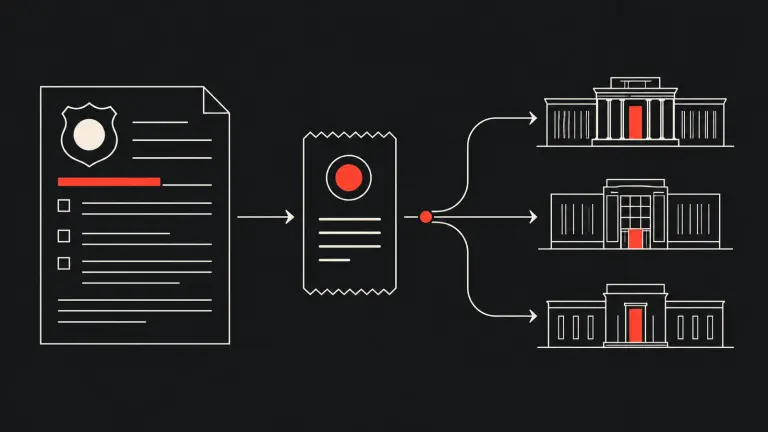
If police have not recorded your complaint, begin by establishing what you submitted, where and when you submitted it, and what response you received. The next step can depend on whether the reported facts may disclose a cognizable offence, when and where the events occurred, and whether a special statute or local rule applies. A refusal by itself does not establish whether an offence occurred or which legal route applies.
This guide summarizes the central procedure in the Bharatiya Nagarik Suraksha Sanhita, 2023 (BNSS). It is general information, not advice on an individual complaint. For a specific matter, consult a qualified Indian criminal-law advocate. Gotham's India legal research workflow guide explains how to organize source-based legal research; it does not replace counsel's advice.
Preserve the record and protect people
Write a factual chronology while events are fresh. Keep the exact complaint and attachments, date and method of delivery, any online acknowledgement or diary or receipt number, emails or messages, and any written response. Note the police station and the officer or desk contacted. If you spoke in person, record what was said as accurately as you can.
Preserve original messages, photographs, medical records and device data. Avoid editing originals. Do not circulate identifying or sensitive material publicly if doing so could expose someone to danger, violate privacy or affect an investigation. When describing events, separate what you personally saw from what someone told you. Include dates or an honest date range, places, people involved if known, witnesses, injuries or loss, and evidence that may help locate relevant records. Do not guess, embellish or force facts into an offence label.
Ask for an acknowledgement and retain your own copy. If information is given electronically under section 173(1), the informant must sign it within three days for it to be taken on record. Keep proof of that follow-up. A chronology can help counsel review the sequence; see this case chronology guide for a general record-keeping approach.
First check which procedure may apply
The BNSS came into force on 1 July 2024, subject to its commencement notification, territorial provisions, savings and any applicable special or local law. Sections 173–175 do not apply in Nagaland or the defined tribal areas unless extended by State Government notification. Section 1(2) makes exceptions for provisions relating to Chapters IX, XI and XII; those chapters do not supply the reporting procedure discussed here.
Under section 531(2)(a), an appeal, application, trial, inquiry or investigation pending immediately before commencement must be disposed of, continued, held or made under the Code of Criminal Procedure, 1973 (CrPC), as it stood immediately before commencement. For events or proceedings spanning that date, ask counsel which procedure governs rather than choosing a statute by date alone.
The primary reference is the enacted BNSS text on India Code. The National Crime Records Bureau's section compilation is marked “For Reference only”; use the statute and applicable Gazette notifications, rules and judgments as authority. The NCRB transcription of section 1(2) omits “XI,” which appears in the India Code text.
What section 173 says about cognizable information
BNSS section 173(1) allows information about a cognizable offence to be given orally or electronically to the officer in charge of a police station, irrespective of the area where the offence was committed. Oral information must be written down and read over. Information given in writing, or reduced to writing after being given orally, must be signed by the person giving it. Electronic information is taken on record when the informant signs within three days. Section 173(2) says a copy of information recorded under subsection (1) must be given forthwith and free of cost to the informant or victim.
The “irrespective of area” wording is commonly associated with the zero-FIR process. That rule concerns receiving the information; section 175(1) separately addresses investigation by reference to the local court that can inquire into or try the case. Section 173(1) does not itself set out a separate transfer procedure. Ask the receiving police station or a local advocate how jurisdictional handling works in the particular circumstances.
Section 173(3) is limited. For a cognizable offence punishable with at least three but less than seven years, the station officer may, with prior permission from an officer not below Deputy Superintendent of Police and considering the offence's nature and gravity, conduct a preliminary inquiry to assess whether a prima facie case exists. It must be completed within fourteen days; the officer may instead proceed with investigation when a prima facie case exists. This is not a general permission to delay every report.
The statute also includes specific recording safeguards for certain sexual-offence reports, including recording by a woman officer in the situations specified there and additional measures where the person reporting has a relevant disability. The categories and safeguards are fact-specific; ask for the protections that may apply and have counsel check the current text.
If the officer in charge refuses to record the information
Section 173(4) permits an aggrieved person to send the substance of the information in writing and by post to the Superintendent of Police concerned. If satisfied that it discloses a cognizable offence, the Superintendent shall investigate or direct a subordinate officer to investigate. Keep the dated, signed copy sent and postal proof of delivery. The section says that if this route fails, the aggrieved person may apply to the Magistrate.
Under section 175(3), a Magistrate empowered under section 210 may order an investigation after considering an application under section 173(4) supported by an affidavit, making any inquiry considered necessary, and considering the police officer's submission. The Supreme Court has said that recourse to the Superintendent of Police under section 173(4) is a mandatory step before invoking the Magistrate's section 175(3) jurisdiction. The application should include a copy of the section 173(4) application to the Superintendent of Police and the supporting affidavit. Ask an Indian criminal-law advocate to confirm the competent Magistrate and local filing practice.
In Om Prakash Ambadkar v. State of Maharashtra, 2025 INSC 139, the Supreme Court set aside a mechanical direction made under former CrPC section 156(3) and explained that a Magistrate must apply judicial mind to whether the allegations disclose the ingredients of an offence. The case arose under the former CrPC. It does not decide whether any particular report establishes an offence under current law.
If a complaint is against a public servant for conduct arising in the course of official duties, section 175(4) adds safeguards before a Magistrate orders an investigation: a report from an officer superior to the public servant and consideration of the public servant's assertions. In XXX v. State of Kerala, 2026 INSC 88, the Supreme Court held that section 175(4) is not standalone and must be read with section 175(3). The ordinary section 175(3) requirements, including prior recourse to the Superintendent of Police and an affidavit, also apply. The additional public-servant safeguards depend on whether the alleged act arose in the course of official duties, a fact-sensitive question. Get legal advice before filing in that situation.
If the reported offence may be non-cognizable
Section 174 addresses non-cognizable information. Police record its substance in the prescribed book and refer the informant to the Magistrate; investigation generally requires a Magistrate's order. If a case concerns two or more offences and at least one is cognizable, section 174(4) treats it as cognizable. Whether reported facts meet a legal classification is case-specific. A civil dispute, disagreement about facts or incomplete account does not by itself settle that question.
A practical sequence to discuss with counsel
- Submit a concise, signed factual report and relevant attachments. Request a dated acknowledgement or diary or receipt number. Keep copies of what you send.
- If the station refuses to record the information, make a contemporaneous factual note. For information that may disclose a cognizable offence, discuss the written representation by post to the concerned Superintendent of Police under section 173(4). Retain the exact copy and delivery tracking.
- If unresolved, complete the section 173(4) recourse before seeking a Magistrate-directed investigation under section 175(3). Ask an advocate to prepare the affidavit application and supporting record and confirm the competent forum. If the complaint concerns a public servant and conduct in the course of official duties, the Magistrate must also consider section 175(4)'s additional safeguards as interpreted by the Supreme Court.
- If anyone faces immediate danger, serious injury or an ongoing threat, prioritize emergency help, medical care and a safe place. Do not wait for an ordinary escalation letter. Use current official local emergency channels.
This is not a mandatory sequence for every possible remedy or situation. The specific section 173(4) and then section 175(3) route is sequential as described above. A complaint or acknowledgement does not guarantee an FIR, arrest, charge, investigation in a particular form or conviction. Do not confront a suspected person or publish allegations as a substitute for seeking help.
State and territory details
This is a central-law overview, not a state-specific guide. States prescribe forms and rules for aspects of recording information; police portals, addresses, supervisory arrangements and filing practice can differ. Verify any state mechanism on the official state police or government site on the day you use it. Sections 173–175 do not apply in Nagaland and the defined tribal areas unless extended by notification. Confirm territorial application and any extension with counsel or an authoritative current source.
This article does not verify current contacts, portals, rules or remedies for any particular state. Create a state-specific guide only after checking authoritative, current state sources. It also does not exhaustively audit every state rule, later judgment or Gazette amendment.
Sources and scope
Primary statute checked 29 October 2026: India Code, Bharatiya Nagarik Suraksha Sanhita, 2023 (Act 46 of 2023), including sections 1, 173–175 and 531. India Code records enforcement from 1 July 2024; the PDF's commencement footnote identifies notification S.O. 848(E), dated 23 February 2024, with an exception concerning BNSS section 106(2) in the First Schedule.
Judgments checked 29 October 2026: Om Prakash Ambadkar v. State of Maharashtra, 2025 INSC 139, and XXX v. State of Kerala, 2026 INSC 88. Read the judgments for their facts, procedural posture and reasoning. Independent criminal-law review should verify amendments and binding judgments current at publication, territorial application and extension notifications, applicable state rules, special-statute routes, competent Magistrate and filing requirements, and safeguards relevant to the reader's circumstances.
For organizing legal authorities and deadlines, see the India legal research workflow and legal deadline docketing guide. These workflow resources do not provide an opinion on a live complaint.
Questions about FIR non-registration in India
What can I do if the police refuse to register an FIR?
First establish what you reported and preserve the complaint and proof of delivery. If information about a cognizable offence was not recorded, BNSS section 173(4) describes sending its substance in writing and by post to the concerned Superintendent of Police. The appropriate next step depends on the facts and governing law; consult an Indian criminal-law advocate.
Can I approach a Magistrate directly under BNSS section 175(3)?
The Supreme Court has said that the section 173(4) approach to the Superintendent of Police is a mandatory step before an application under section 175(3). The Magistrate must consider the statutory requirements, including an affidavit and any necessary inquiry. Ask counsel to confirm the competent Magistrate and local filing practice.
Does a police refusal prove that an offence occurred?
No. A refusal by itself does not determine whether the reported facts disclose an offence or whether it is cognizable. Classification and the available procedure depend on the complete facts, current law and any applicable special statute.
Does BNSS section 173 apply throughout India?
Sections 173–175 do not apply in Nagaland or the defined tribal areas unless extended by State Government notification. Commencement, territorial provisions, savings, special laws and the procedural date can also matter. Verify the rules applicable to the particular place and events.
What should I keep after submitting a complaint?
Keep the exact complaint and attachments, proof of submission, date and method of delivery, acknowledgement or diary number, any written response, and a factual note of any conversation. Preserve original messages and records without editing them.
This article is general information, not legal advice. Criminal procedure depends on the facts, dates, territory, applicable statute and special laws. Consult a qualified Indian criminal-law advocate about a specific matter.
How Gotham researches and reviews field guides