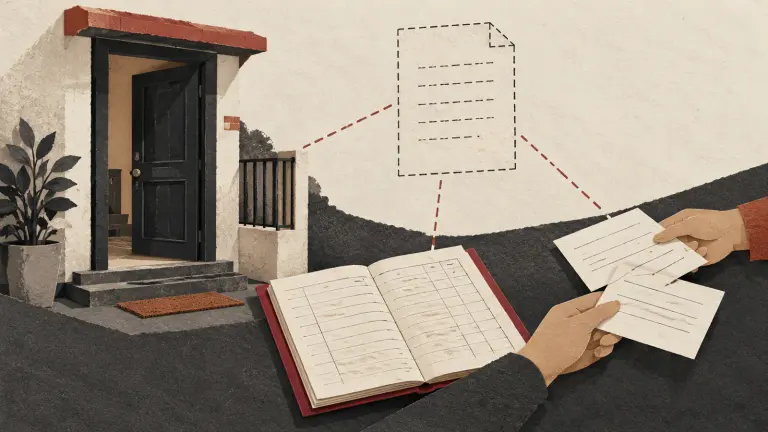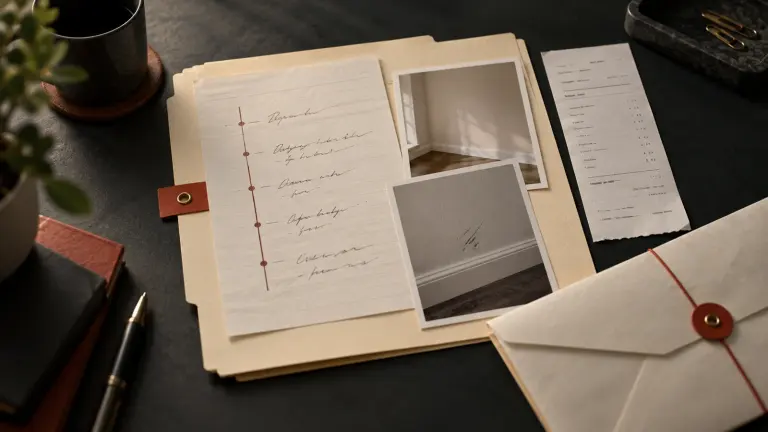
When a California landlord keeps part of a residential security deposit, the most useful first step is to build a dated record that connects the lease, move-out condition, messages, itemized accounting and supporting documents. A late statement or missing receipt can matter, but neither fact alone tells a court how the entire dispute will end. California Civil Code section 1950.5 sets rules for residential deposits, permissible deductions and accounting; the court still evaluates the evidence and the parties’ explanations.
Start with the exact amount paid, the date you gave up possession, what the landlord sent and when, and the reason for each deduction. Separate what you know from what you infer. Then decide whether a focused written request, legal advice, negotiation or a court claim is the next practical step. This guide covers California residential rentals, not commercial leases or other states’ deposit rules.
Put the dispute on a timeline
Create one chronology before writing a demand or filing a claim. Each row should identify the event, date, source document and what the record establishes. If the date is approximate, say so. If two records conflict, preserve both and flag the difference instead of selecting the version that helps your position.
| Event | Records to collect | Question to answer |
|---|---|---|
| Deposit agreed and paid | Signed lease, addenda, receipt, bank or payment-platform record | What amount was security, who received it and when? |
| Move-in condition | Inventory, dated photos/video, maintenance requests, messages | Which conditions existed before the tenancy? |
| Notice and pre-move-out inspection | Notice, inspection request, appointment messages, inspection statement | Was an inspection offered or requested, and what did it identify? |
| Move-out and return of possession | Key handoff, forwarding address, final photos/video, utility or move-out messages | When did the tenant leave and give possession back? |
| Deposit accounting | Envelope/postmark, email, portal record, itemization, refund transaction | What did the landlord send, when, and what was paid back? |
| Claimed repairs or cleaning | Invoices, receipts, estimates, before/after photos, contractor details | Does each deduction identify work, cost and a connection to the unit? |
| Dispute and response | Demand, reply, settlement offer, court papers and counterclaim | What is agreed, disputed or still undocumented? |
Use the same date convention throughout. Save the original message or statement and note when you downloaded it. A later screenshot can help show what a portal displayed, but keep the underlying file, email or bank record where possible. Avoid cropping or annotating the only copy of a photograph; make a working copy and leave the original unchanged.
What California’s deposit rule asks you to check
California Civil Code section 1950.5 governs residential security for a tenant’s dwelling. It permits deductions for specified purposes, including unpaid rent, certain cleaning, repair of tenant-caused damage beyond ordinary wear and tear, and some agreement-authorized restoration or replacement costs. The statute does not make every move-out charge valid, and it does not make every disputed deduction invalid. Match each charge to the lease, the statutory purpose and the facts about the unit.
The ordinary accounting deadline is 21 calendar days after the tenant vacates, subject to the statute’s termination-notice and fixed-term language: the landlord must provide an itemized statement and return any remaining deposit. Under section 1950.5(h)(3), a landlord may include a good-faith estimate in that 21-day accounting when landlord or employee repair work cannot reasonably be completed within that period, or specified third-party service, material or supply documentation is not yet in hand. The landlord must provide the required final statement and records within 14 calendar days after completing the work or receiving the documentation. Record notice, end-of-term and possession dates rather than treating one email date as the whole calculation.
The supporting-record rules distinguish landlord or employee labor from outside work and materials. For some lower-value combined deductions, documentation exceptions apply; a tenant can still request supporting records within the statute’s window. The exception is not a reason to assume the landlord never had to provide an itemization or return the undisputed balance. Check the current text and your dates before relying on a deadline or exception.
The law also sets photo requirements with different start dates. For tenancies beginning on or after July 1, 2025, the landlord must photograph the unit at or immediately before the start of the tenancy. For move-out deductions, photographs are required after possession returns and before repairs or cleaning, and again after that work, beginning April 1, 2025. These are distinct rules; do not apply the move-in requirement retroactively or assume a missing photo by itself resolves every deduction.
The California Department of Real Estate’s 2026 tenant and landlord guide explains the accounting, supporting documents, inspection and photograph process in practical terms. The guide is useful context, while the statute controls. Local ordinances and the facts of a particular tenancy may add issues that this statewide overview does not settle.
Compare each deduction with its evidence
Review the landlord’s statement line by line. For each entry, capture the amount, stated reason, date of work, supporting record and your response. Keep the landlord’s description intact; put your disagreement in a separate column. That lets you distinguish a missing document from a factual disagreement about condition, responsibility or price.
| Deduction | Evidence to compare | Useful follow-up |
|---|---|---|
| Unpaid rent | Lease, payment ledger, bank records, notices and move-out date | Identify the specific rent period and compare it with payments and possession dates. |
| Cleaning | Move-in and move-out condition records, cleaning description, labor or invoice record | Compare like areas and distinguish ordinary use from the stated work. |
| Repair | Before/after photographs, inspection notes, work description, invoice or estimate | Ask what condition was repaired, when it arose and how the charge was calculated. |
| Materials | Receipt, invoice or other permitted cost record | Match the item to the stated repair and check whether the same cost appears elsewhere. |
| Unfinished work | Good-faith estimate, later final accounting, completion or invoice date | Record when the estimate was sent and when the follow-up documents arrived. |
Do not treat an estimate as a final invoice, or an invoice as proof that the tenant caused the condition. Those records answer different questions. A photo can show appearance, but often cannot establish the date, cause, expected useful life or reasonable cost by itself. Pair it with the lease, inspection record, repair description and messages that explain the context.
Request missing information in a focused way
If the statement leaves a specific gap, send a concise written request identifying the tenancy, move-out date, the line item and the record you are seeking. Ask for the itemized basis, invoices or receipts, service-provider details, labor description or photographs that relate to that entry. Keep a copy and proof of delivery. A written request can clarify a dispute; it does not itself establish that the landlord acted in bad faith or change any court deadline.
The statute’s documentation rules include exceptions, including for combined repair and cleaning deductions that do not exceed $125 and for a properly timed waiver. Even where an exception may apply, the tenant can request documents within 14 calendar days after receiving the itemized statement, and section 1950.5 provides a response period after that request. Read the current statutory conditions before treating the threshold or waiver as applicable. Do not assume it eliminates the itemized accounting requirement.
If the landlord provides a later estimate or supporting records, add them to the timeline rather than replacing the first statement. Record whether the revised total changed, which work was completed and when, and whether the unclaimed balance was returned. If the accounting remains unclear, ask a California lawyer or legal aid service to assess the statute, lease, local requirements and evidence together.
Example: a late statement and a new counterclaim
Consider a fictional tenant, Maya, who rented an apartment in California, paid a $2,400 deposit, returned the keys on May 31, and later receives an itemization and a demand for additional repair costs. She has move-in photos, a short move-out video, a forwarded email asking for an inspection and a bank record of the deposit. The landlord’s statement lists cleaning, a damaged cabinet and unpaid rent; a later court response also alleges lost rent.
Maya should not infer that the entire deposit is automatically hers because the statement arrived late, or that the landlord’s later demand proves the charges. She can first set out the possession date, notice history, when the statement arrived, each listed deduction and every repayment or payment. She can then compare the lease and rent ledger, match the cabinet claim against dated condition evidence, and ask for the specific labor, invoice or estimate records allowed by the statute. She should keep the counterclaim as a separate issue with its own amount, factual basis and documents.
If she is considering small claims, she can prepare a short exhibit list in the same order as the chronology: lease and deposit proof; move-in and move-out condition records; notice, inspection and handoff communications; itemization and supporting records; and the written request and response. The illustration does not predict the court’s ruling. The judge may evaluate credibility, the statute, the contract, the evidence and any counterclaim together.
Is small claims the right forum?
Section 1950.5 permits a security-deposit action in small claims when the damages claimed fit the jurisdictional amount allowed by Code of Civil Procedure sections 116.220 and 116.221. The limit can depend on who is bringing the claim and the type of party involved. Check the current California Courts instructions for the claimant, amount, filing steps, venue, service and any counterclaim before choosing the forum. A larger demand, complicated ownership issue or substantial counterclaim may warrant legal advice before filing.
Do not assume a claim for the full deposit plus penalties fits simply because the deposit amount does. The statute permits a court to award actual damages and, where the landlord acted in bad faith, statutory damages up to twice the security; that remedy is not automatic. Ask counsel how the requested amount, available proof and current jurisdictional limit interact. A filing decision should account for the amount you can prove and the response you may need to defend against, not just the headline figure.
Common mistakes that weaken an otherwise useful record
- Starting with a demand amount before reconciling the deposit, refund and each disputed charge.
- Treating the 21-day period as a complete answer without checking when possession returned, what notice was given and whether a statutory estimate applied.
- Assuming that an absent receipt automatically makes every deduction invalid, or that an estimate proves a final expense.
- Treating all cleaning, repainting or repair charges alike without comparing the move-in baseline, ordinary wear and the specific work.
- Mixing a deposit accounting dispute with a separate rent or lost-rent claim instead of tracking each allegation and its evidence.
- Editing the only copy of a photo, message or statement and losing the original date or context.
- Naming a dollar amount that does not account for the current court limit, party type, counterclaim or what the records support.
A practical preparation checklist
- Save the lease, addenda, deposit receipt and proof of every rent or deposit payment.
- Record notice, move-out, key-return, possession and forwarding-address dates with their source documents.
- Preserve move-in and move-out photographs, inspection requests, inspection notes and handoff messages.
- Put every itemized deduction, refund, estimate and later receipt on a separate line in one table.
- Send a focused written request for specific missing records and preserve the response.
- Separate the landlord’s allegations from your evidence and any amount you dispute.
- Check current California statutes, court instructions, local rules and filing limits; seek legal advice where a deadline, counterclaim or legal remedy is uncertain.
For a different jurisdiction, our Singapore rental deposit and Small Claims Tribunals guide explains Singapore-specific eligibility, the Japan move-out cleaning charge guide addresses a separate residential deposit system, and the India oral-tenancy deposit guide covers proof when there is no written lease. They are comparisons, not California rules. Explore Gotham’s workflow examples for source-linked legal work, or contact the team to discuss document review. A workflow can help teams organize records; it does not decide whether a deduction is lawful or predict a court result.
Questions about California security deposit disputes
Does a late California deposit statement mean I automatically get the whole deposit?
No automatic result follows from lateness alone. Section 1950.5 sets accounting duties and addresses consequences for bad-faith noncompliance, but dates, notice, possession, any permitted estimate and the evidence matter. Have a California lawyer assess the timeline and remedy.
Can a landlord use a good-faith estimate after the 21-day period?
The landlord may include a good-faith estimate in the 21-day itemized accounting only in the circumstances listed in section 1950.5(h)(3). If those conditions apply, the final statement and supporting records are due within 14 calendar days after the repair is completed or the third-party documentation arrives. The estimate is not permission to send the first accounting after the deadline.
Does the $125 threshold remove the duty to send an itemized statement?
No. The documentation exception concerns supporting records for certain combined deductions. It does not erase the separate itemized accounting and refund requirements; statutory details and any waiver should be checked.
What evidence should I bring to a small-claims deposit case?
Organize the lease and deposit proof, dated condition records, notice and possession timeline, itemized deductions, receipts or estimates, refund record, and written communications. Keep originals and arrange copies by issue and date.
Can I ask for bad-faith damages in a security-deposit case?
California Civil Code section 1950.5 allows statutory damages up to twice the security where the required bad-faith showing is made, in addition to actual damages. An award is for the court to decide from the evidence, not a guaranteed multiplier.
General information, not legal advice. This guide concerns California residential security deposits and evidence organization. The statute, local rules, tenancy dates, lease and facts can affect the analysis. Consult a California attorney or legal aid service about your specific claim, defenses, deadlines and court procedure.
How Gotham researches and reviews field guides