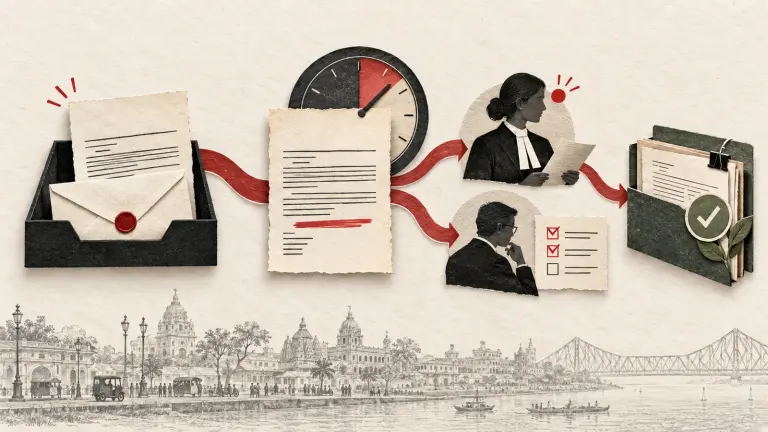
If a legal notice contains allegations you believe are false, do not respond in anger or assume that you must immediately file a case against the sender. A private legal notice is generally a formal demand or assertion, not a court finding. There is no universal rule requiring a reply to every notice, and silence alone does not automatically prove the allegations. Still, an inaccurate response, missed statutory deadline or lost evidence can make the dispute harder to manage. Verify the notice, preserve the record and get advice based on the type of claim.
What a legal notice does and does not establish
A lawyer's notice communicates the sender's position and may demand payment, performance, a correction, return of property or another action. It can help show that the sender raised an issue before litigation. It does not itself establish that the claim is true, that the sender will win, or that a court has ordered you to comply.
First determine what document you received. A private advocate's letter, a statutory notice, a police communication, a tribunal notice, a court summons and an interim court order are different. A court summons or order may carry a procedural deadline and should be escalated immediately. A statutory notice may trigger a specific response period. Do not treat them all as one generic “legal notice.”
The label can also be misleading. For example, a cheque-dishonour notice under section 138 of the Negotiable Instruments Act has statutory conditions and deadlines. Section 138 generally gives the drawer 15 days after receiving the demand to pay the cheque amount; other statutory periods govern when the payee must issue the notice after receiving bank information. Read the official Negotiable Instruments Act and get prompt advice. A standard contract demand does not automatically have that same deadline.
Verify the sender and preserve everything
Before replying, establish that the notice is authentic and complete. Record the date and manner of receipt. Keep the envelope, tracking details, email headers, attachments, delivery message and any courier proof. If the sender claims to act for a company, identify the company and the lawyer. Verify contact details independently instead of using only a phone number or payment link in the notice.
Preserve the events behind the dispute: contract versions, purchase orders, invoices, payment records, work product, delivery confirmations, meeting notes, chat messages, call logs, photographs, access logs, prior complaints and witness names. Keep originals and metadata where possible. Create a chronology that states what happened and when, and mark which facts are certain, disputed, or based on another person's account.
Do not edit, backdate or delete records. Do not download or forward confidential data you are not authorised to access. If a device or account may contain relevant evidence, ask counsel how to preserve it without violating privacy, security or employment duties. A notice saying something false does not permit you to retaliate by publishing private information.
Build a response around evidence, not adjectives
Read the notice paragraph by paragraph. For each allegation, identify the source document, the facts you accept, the facts you dispute and any missing information. “False and malicious” may feel forceful, but a reply is stronger when it explains the specific factual error and points to dated evidence.
| Notice claim | Useful response material | Avoid |
|---|---|---|
| You owe a stated amount | Contract, invoice, ledger, payment proof, reconciliation | A blanket denial without checking credits or taxes |
| You failed to deliver | Scope, delivery files, acceptance emails, change requests | Deleting work or blaming individuals without records |
| You disclosed confidential information | Access logs, document list, sharing settings, recipient facts | Reproducing confidential content in a public reply |
| You made a defamatory statement | Exact words, audience, context, source, correction | Calling the notice itself defamation automatically |
| You must stop an activity | Contract language, dates, scope, legal basis | Assuming a private letter is an injunction |
| You must attend or respond by a date | Sender identity, statutory or court provision | Treating a court summons as an ordinary demand |
Do not concede facts accidentally. Phrases like “I apologise for the breach” may be treated as an admission even if you meant to apologise for inconvenience. A lawyer can draft a response that acknowledges receipt without accepting liability, while explaining the factual position.
Is a reply mandatory?
There is no general rule that every private civil or commercial demand must be answered. Whether you should reply depends on the claim, contract, statute, forum, evidence and strategic objective. A response can correct the record, request documents, preserve a defence, propose settlement or prevent misunderstanding. It can also reveal information or create admissions. Silence may be strategically appropriate in some situations, but it should be a deliberate decision after identifying deadlines and consequences.
Some notices are part of statutory procedures. Section 138 of the Negotiable Instruments Act is one example. Under section 80 of the Code of Civil Procedure, a suit against Government or a public officer for an act purportedly done in official capacity generally requires two months' prior notice, with a limited urgent-relief route requiring the court's leave under section 80(2). A commercial dispute within the specified-value regime may require pre-institution mediation under section 12A of the Commercial Courts Act unless urgent interim relief is contemplated. These are procedural requirements for particular cases, not a universal notice rule. Check the current Code of Civil Procedure and Commercial Courts Act.
Limitation: do not assume a notice resets the clock
A demand letter does not ordinarily restart the limitation period for a civil claim. The Limitation Act, 1963 contains specific rules. Section 18 can provide a fresh limitation period where, before the existing period expires, the person liable signs a written acknowledgment of liability. Section 19 addresses qualifying payment on account of a debt before expiry, subject to the statutory requirements. The words and context matter. A unilateral notice from the creditor is not the debtor's signed acknowledgment.
The correct limitation period depends on the type of claim, when the cause of action accrued, any acknowledgment or payment, and the applicable statute. Do not rely on a sender's deadline or a reply date to calculate limitation. Read the official Limitation Act and ask counsel to calendar both statutory and court deadlines.
Worked example: a client alleges a false invoice
Assume Asha runs a small design studio. A former client sends a lawyer's notice alleging that she invoiced for work never completed, demanding repayment within seven days and threatening criminal proceedings. Asha believes the work was delivered and that the client approved it by email.
Asha should preserve the notice and delivery proof, then locate the signed scope, change requests, submitted files, approval emails, invoice and bank records. She should build a dated timeline showing delivery and approval. She should distinguish any genuine disputed line item from the full invoice, rather than stating that every allegation is fabricated. She should also identify whether the notice actually cites a statute with a deadline or is a private demand using a seven-day response date.
Before sending a reply, Asha should have counsel examine the contract's dispute clause, payment terms, evidence, limitation and any criminal-law language. A measured response might deny the unsupported allegation, identify the delivery records, request particulars for the disputed sum and reserve rights. It should not threaten a defamation counterclaim merely because the notice is wrong. If the notice is actually a court summons or police process, she must follow that procedure separately.
Should you threaten a defamation case?
No automatic counterclaim follows from receiving a false notice. Whether a statement is defamatory depends on the words, communication, audience, applicable defences, fault requirements and harm under current law. A private notice to you may be privileged or otherwise treated differently from a public post. Do not publish the notice or accuse the sender publicly without advice.
Similarly, a baseless threat in a lawyer's letter does not automatically prove extortion or criminal wrongdoing. Use precise language. If the sender is contacting customers, publishing allegations, demanding money through threats or misusing personal data, preserve evidence and consult counsel about the relevant legal remedy. Avoid retaliatory messages that could become evidence against you.
A practical reply workflow
- Classify the document: private demand, statutory notice, court process or official communication.
- Record receipt date and identify every actual deadline.
- Verify sender, client and attachments independently.
- Preserve originals and relevant records; create a chronology.
- Match allegations to evidence and identify gaps.
- Check limitation, contract dispute process and applicable statute.
- Decide with counsel whether to reply, what to disclose and whether settlement is sensible.
- Send through a trackable channel and retain proof of dispatch and delivery.
FAQs
If I do not reply, is that an admission?
Silence alone does not automatically establish that a private notice's allegations are true. But it may have procedural, evidentiary or commercial consequences, and a statutory notice or court document may require timely action. Identify the document and deadline before deciding.
Is there a standard number of days to answer a legal notice?
No universal response period applies to every notice. A sender may set a demand date, while a statute or court process may have a separate period. Section 138 notices and court summonses require specific deadline analysis.
Should I reply if every allegation is false?
Possibly, but first preserve evidence and assess strategy. A factual reply can correct the record; an impulsive reply can create admissions. Have a lawyer review the notice and the documents behind it.
Can I sue the other side for defamation because the notice is false?
Not automatically. The legal elements and defences depend on the exact words, publication, audience and circumstances. A private notice that makes an inaccurate allegation is not by itself enough to conclude that a defamation claim will succeed.
Does sending a reply extend limitation?
Generally, do not assume it does. A creditor's unilateral notice or your denial is not ordinarily a debtor's acknowledgment under section 18. Limitation depends on the claim and specific statutory events such as a qualifying signed acknowledgment or payment.
What if the document is a court summons?
Treat it as urgent. Record service date, identify the court and case number, and contact a lawyer immediately. A summons is a court process with procedural requirements, not simply an opposing party's demand letter.
Final checklist
- Confirm whether this is a private notice, statutory notice or court process.
- Preserve envelope, headers, delivery records and original attachments.
- Build a chronology and evidence map before drafting.
- Check all applicable deadlines and limitation independently.
- Avoid admissions, threats and public reposting without advice.
- Decide deliberately whether a reply serves your position.
- Keep a copy and proof of service for any response.
For related workflows, read urgent legal notice email workflow, legal notice management, and litigation status reporting. Explore India legal research workflows, contract review workflows, or contact Gotham. This article is general information, not legal advice. Have an Indian lawyer assess the actual notice and applicable deadlines.
This article provides general information, not legal advice. The law and procedure may depend on the facts, forum, state, and current rules; consult qualified counsel about a specific matter.
How Gotham researches and reviews field guides