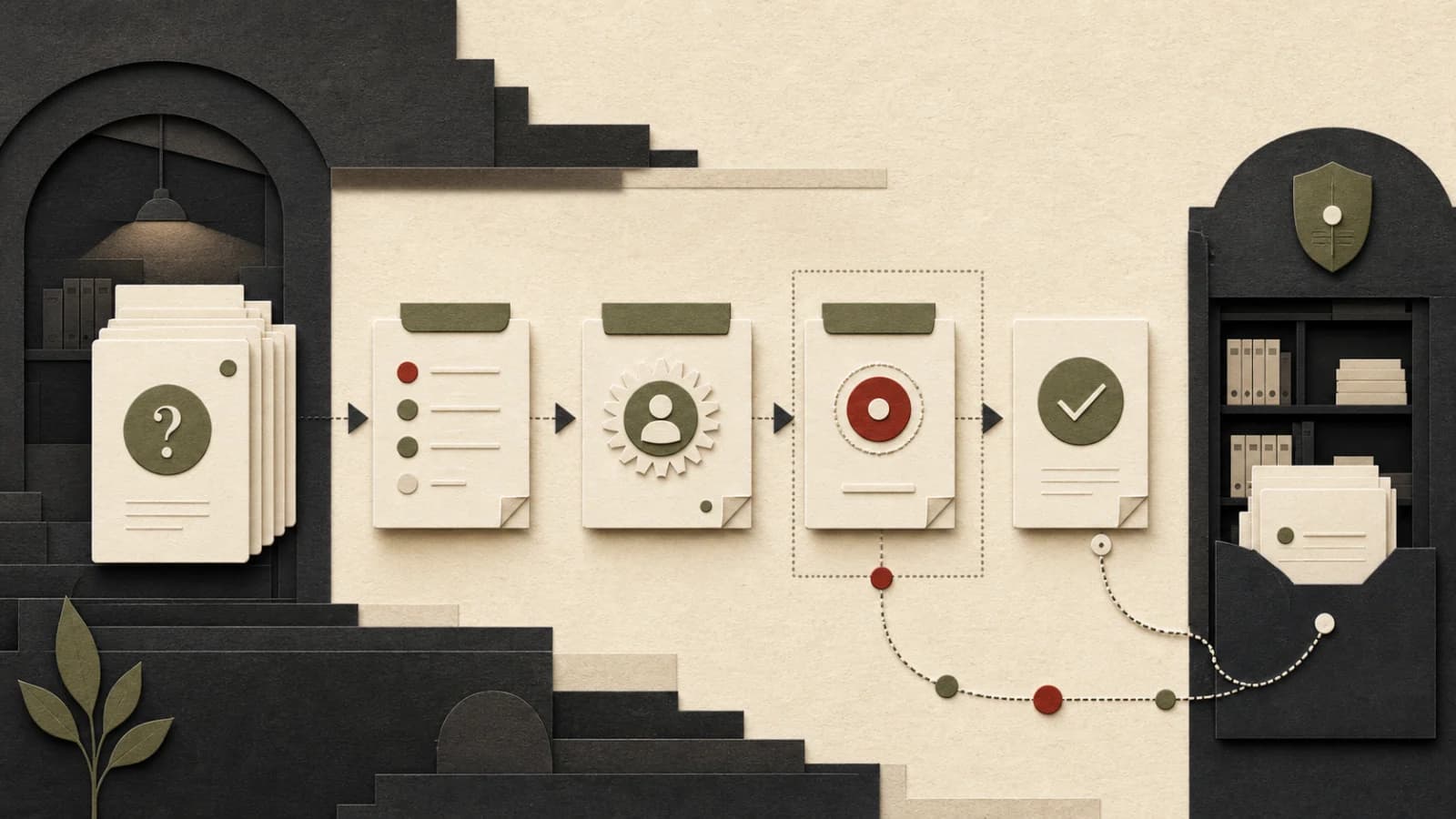
An M&A data room Q&A workflow is the controlled path from a buyer's diligence question to an approved, source-linked answer and a recorded closure decision. It should show who asked, which entity and period are in scope, who may see the request, who owns the response, which documents support it, who approved disclosure, and whether the answer changes a diligence finding.
This page owns the question-and-answer control. Use the complete India legal due diligence checklist to place that control within the wider path from scope and document intake to red flags, closing, and post-closing handoff.
The Q&A log is not a substitute for the virtual data room index. The virtual data room index controls the document population, versions and access. The Q&A workflow controls the conversation about gaps, ambiguities and consequences. Connecting the two prevents an answer from becoming an unsupported statement in a spreadsheet or email.
This distinction becomes important as deal pressure rises. A fast response can still be unsafe, incomplete or unusable if it was released to the wrong bidder group, refers to a superseded agreement, answers only one in-scope entity, or silently changes a finding that has already reached the draft report.
What should a data room Q&A workflow achieve?
The workflow should make four things observable at the same time:
- Demand: the exact question, business reason, priority and requesting group.
- Work: triage, assignment, evidence collection, drafting and approval.
- Disclosure: who may receive the answer and supporting documents, in what form.
- Impact: which review conclusion, risk, request or closing action changes as a result.
Virtual data room providers commonly implement coordinator and approver roles. Firmex's official Q&A product guidance, for example, describes question coordinators, answer-side coordinators and optional approvers. A deal team should treat those features as configuration options, not as a complete protocol. Counsel still needs to define the roles, access groups, approval boundaries and exceptions for the transaction.
A mature workflow also preserves negative outcomes. “Cannot be confirmed from the available record,” “not applicable for the stated entity,” “declined under the disclosure protocol,” and “answer pending specialist review” are meaningful states. Marking all four as “answered” creates false completeness.
Define the roles before opening the queue
Name roles in the protocol and assign people separately. This helps the process survive absence, turnover and changes in the bidder or adviser team.
| Role | Accountable work | Control question |
|---|---|---|
| Buyer question coordinator | Consolidates, scopes and submits questions | Is this question distinct, necessary and answerable? |
| Seller answer coordinator | Routes requests and controls the response queue | Who owns the facts and who must approve release? |
| Subject specialist | Drafts the factual response and identifies evidence | Does the answer cover every named entity, period and document? |
| Legal approver | Reviews wording, privilege, accuracy and disclosure | May this answer and its evidence be released to this group? |
| Data room administrator | Applies approved access and links room items | Do permissions reflect the recorded disclosure decision? |
| Workstream lead | Assesses diligence significance | Does the answer alter a finding, request or deal action? |
| Deal lead | Resolves priority and escalation conflicts | Which unresolved points matter to timetable or decision? |
Avoid assigning the room administrator responsibility for legal sufficiency. Technical ability to publish an answer does not establish authority to disclose it. Likewise, a subject specialist may know the operational facts but not the transaction-specific implications of the response.
For competitively sensitive information, the role map may need a clean-team route. The Competition Commission of India's current combination FAQs discuss caution around commercially sensitive information during due diligence and integration planning, including limited clean teams in relevant circumstances. Qualified competition counsel should decide whether and how those considerations apply. The question log should record the approved route, not attempt to determine it.
Write one scoped, decision-useful question per row
A good question can be assigned, answered and closed without guessing its scope. State the entity, subject, period, requested evidence and reason when that context is necessary. Avoid requests such as “please provide all tax documents” or “confirm compliance.” They hide the intended decision and make completeness impossible to judge.
Compare these forms:
| Weak request | Controlled request |
|---|---|
| Provide customer contracts | For Entity A, provide the executed master agreement, amendments and current orders for the ten customers listed in Schedule X |
| Confirm no data incidents | For the stated period and systems, identify recorded security incidents and link the approved incident register entries and closure evidence permitted for disclosure |
| Explain the dispute | Confirm current status as of the cut-off, identify the supporting pleadings or orders and state which requested documents remain unavailable |
One row should represent one independently closable question. If a response raises a new issue, create a linked follow-up rather than rewriting the original. Preserve both states so reviewers can reconstruct what was known when an earlier answer was approved.
The free due diligence question log template supplies a ready-to-use field set and sample status model. Teams can download the CSV or copy a tab-separated version without providing contact details.
Which fields belong in the question log?
Use stable identifiers and controlled values wherever possible. At minimum, record:
- question ID and parent question ID;
- requesting party or bidder group;
- workstream, entity, period and priority;
- exact question and submission time;
- question coordinator and answer coordinator;
- response owner and legal approver;
- current status and target response time;
- draft and approved answer as separate states;
- linked VDR item IDs and any new upload request;
- confidentiality class and disclosure decision;
- affected issue, request and report-finding IDs;
- final-answer time, closer and closure basis; and
- full action history when the platform supports it.
Do not paste sensitive source content into the log merely for convenience. Link to the controlled room item and use a concise description appropriate for the log's access group. If the answer itself contains restricted information, store it in the governed system rather than duplicating it across uncontrolled local trackers.
Dates need timezone and meaning. “Due 30 July” could refer to the specialist draft, legal approval or external response. Keep those milestones separate if the deal requires them. The target should support prioritisation, not be represented as a universal legal deadline.
How should triage, drafting and approval operate?
Run every submitted question through a short triage gate:
- Check whether the question duplicates an open or answered request.
- Confirm the entity, period, topic and requested evidence.
- Decide whether the question belongs in the shared queue or a restricted route.
- Assign a response owner, approver and target based on deal impact.
- Link existing VDR items or open a specific document request.
- Identify report findings that may need revalidation.
The response owner should draft against the source record. The answer should distinguish facts evidenced by documents, management explanations, estimates and unresolved points. If a document is missing or cannot be released, say so directly. An unqualified sentence can travel into the report long after its original caveat is forgotten.
Approval should cover both substance and disclosure. The approver asks whether the answer is accurate for the defined scope, whether the cited material is current, whether qualifications are visible, whether recipients are permitted and whether a redacted or aggregated form is required. Release only the approved version. Preserve the draft history according to the matter protocol rather than silently overwriting it.
For listed-company transactions, teams should consult the current SEBI Prohibition of Insider Trading Regulations and transaction counsel on unpublished price sensitive information, legitimate purpose, access and records. A generic Q&A workflow cannot decide whether a particular communication is permitted.
Connect every material answer to the evidence set
An approved answer should cite stable room IDs, not only filenames or folder paths. Filenames change and folders may be reorganised. The link should resolve to the reviewed item and, where needed, the page, clause, tab or record location that supports the statement.
Before approving an answer, ask:
- Is the supporting item executed, current and in scope?
- Does an amendment, schedule or later upload change it?
- Does the file answer the whole question or only one part?
- Is the cited item available to the intended recipient group?
- Does the response accurately label management statements or estimates?
- Will a later reviewer understand the qualification without private context?
If the answer depends on a contract family, reconcile versions before release. The M&A version-control checklist explains how to connect amendments, cut-offs and late uploads to prior review conclusions. For broad agreement sets, use the bulk contract review workflow to reconcile the population before treating the question as closed.
Control restricted, personal and security-sensitive material
Question content itself can reveal transaction strategy, identified weaknesses, personal data or security concerns. Classify the question and answer, not only the attached file. A bidder group that cannot access a restricted folder should not receive the same information through the Q&A export.
The protocol should define:
- permitted question and answer groups;
- clean-team or specialist-only routes;
- redaction, aggregation and staged-disclosure decisions;
- approval for new uploads;
- restrictions on exports and local working copies;
- access reviews when team membership changes; and
- retention, return or deletion after the process.
For cybersecurity operations and records, current official starting points include the CERT-In directions page and the underlying dated directions. Their application is fact-specific and should be assessed by appropriate specialists. Do not copy a changing regulatory requirement into a static workflow rule without source, scope and approval.
When an answer cannot be released, record who decided, the reason category, any alternative form offered and whether the unresolved gap affects diligence. “Declined” is not the same as “not applicable,” and neither is the same as “no responsive record exists.”
Manage follow-ups, late documents and changed answers
Create a new linked row for each follow-up. The parent-child relationship shows whether the original answer resolved the original scope and what new question emerged. Do not reopen the parent merely to erase its earlier closure.
Late documents require impact analysis. When a new item enters the room:
- connect it to the index and contract or document family;
- identify questions whose answers relied on the earlier record;
- identify findings based on those answers;
- route revalidation to the original reviewer where possible;
- issue a revised approved answer with a reason; and
- preserve the prior answer, timestamp and recipient scope.
The log should distinguish a corrected answer from an expanded answer. A correction changes something previously stated. An expansion adds newly available scope. Both may require recipients to be notified and the M&A red-flag report to be revalidated.
Near signing or closing, freeze a final question-log snapshot with its information cut-off. List open, declined, partially answered and late-change items explicitly. The snapshot does not prove that diligence was complete. It states what the workflow controlled and which exceptions remained visible.
Which metrics improve the process without creating false confidence?
Question counts alone reward volume. Average response time can also mislead if easy requests close quickly while material questions remain blocked. Use a balanced operating view:
| Measure | Useful interpretation |
|---|---|
| Open questions by priority and age | Where deal-impacting delay is accumulating |
| Time in each workflow state | Whether the bottleneck sits in assignment, evidence or approval |
| Duplicate or returned questions | Whether buyer-side scoping needs improvement |
| Answers without linked evidence | Where statements may be difficult to verify |
| Restricted-route volume | Whether access design and specialist capacity are adequate |
| Follow-ups per answered question | Whether first responses are resolving the defined scope |
| Findings awaiting revalidation | Whether Q&A changes have reached the report |
| Closed with unresolved gap | Which exceptions remain for decision makers |
Keep denominators and scope visible. “Ninety per cent answered” means little if the remaining ten per cent contains the transaction's most material uncertainty. The deal lead needs an exception view, not a celebratory completion percentage.
M&A Q&A readiness checklist
Before questions open:
- Approve coordinators, specialists, approvers and restricted routes.
- Define question fields, controlled statuses, priorities and timestamps.
- Connect the log to stable VDR item and diligence finding IDs.
- Set disclosure, clean-team, redaction, export and retention rules.
- Define how duplicates, follow-ups and late documents are handled.
Before an answer is released:
- Confirm the question's entity, period and requested evidence.
- Verify the answer against current, in-scope source material.
- Label qualifications, management statements and missing records.
- Obtain the required substantive and disclosure approvals.
- Release only to the approved group and record the final version.
Before reporting or closing:
- Revalidate findings affected by new answers or late uploads.
- Separate answered, partial, declined, not-applicable and open states.
- Record an information cut-off and preserve the approved snapshot.
- Carry material gaps into the report, deal action or closing plan.
- Apply the approved access, export and retention process.
A dependable Q&A process does not promise a frictionless deal. It gives the team a controlled way to ask, support, approve and close questions without losing who knew what, which source supported it and which conclusion changed. Download the question log template, explore Gotham's legal workflows, or contact Gotham to assess a source-linked diligence process on a bounded document set.