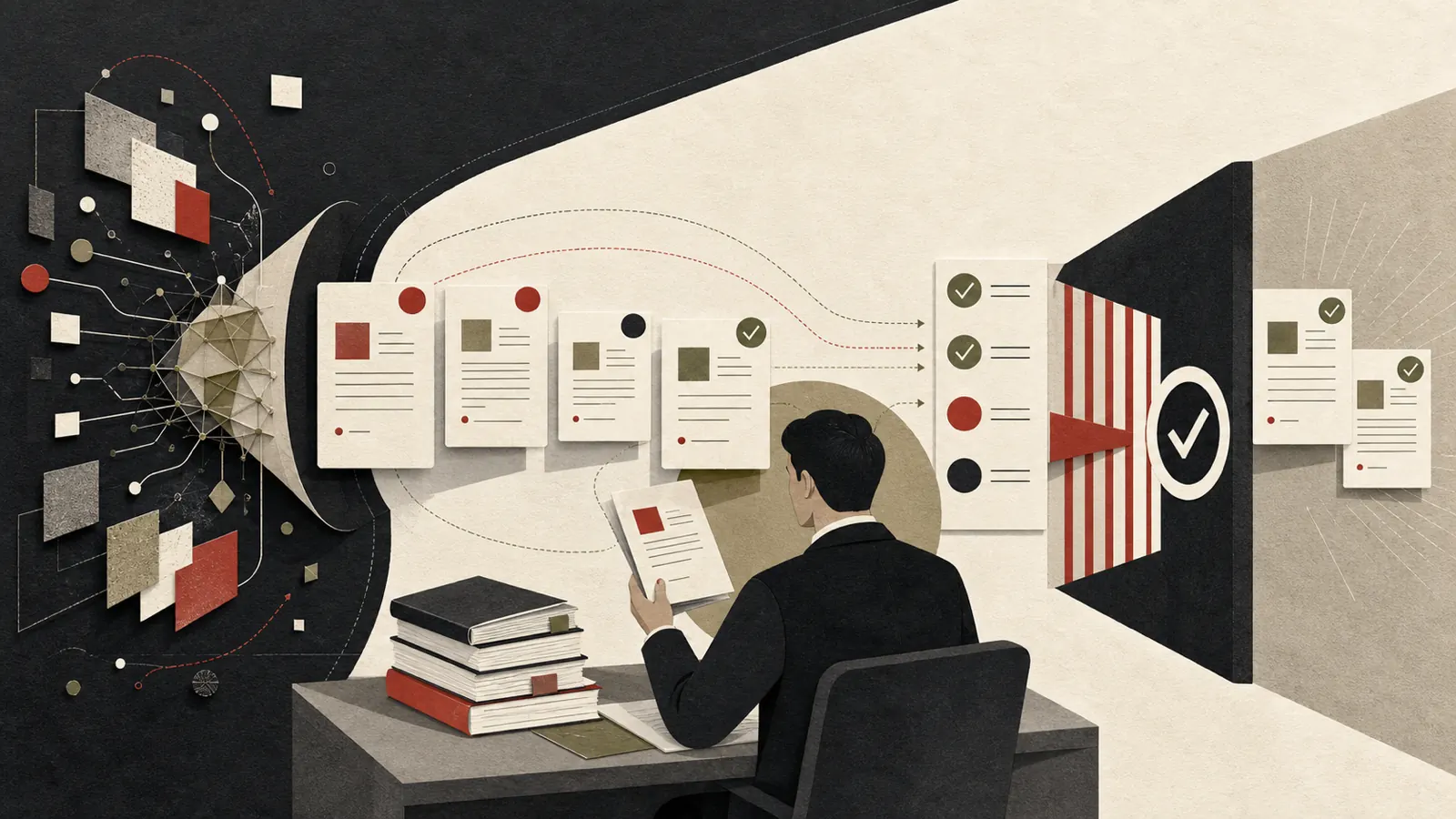
A legal AI data protection impact assessment should describe what happens to people and information in a real workflow. It is not a generic vendor questionnaire. The assessment should follow a matter from collection through model processing, review, delivery, retention, and deletion, then ask whether the purpose justifies each step and whether safeguards work in practice.
Indian organizations should consult current official materials from MeitY and legislation on India Code. The NIST Privacy Framework and ISO/IEC 27701 can help structure governance and evidence. None determines by itself whether an assessment is required, which legal role applies, or whether a proposed use is lawful.
When should a legal AI use receive an impact assessment?
Set screening triggers in the organization’s approval process. Relevant signals include confidential or personal records at scale, sensitive categories, children or vulnerable people, systematic evaluation, consequential recommendations, monitoring, new combinations of datasets, opaque model behavior, cross-border processing, or a system that acts in connected tools.
Do not screen solely by product. The same service may support a low-exposure public training exercise and a high-consequence employment investigation. Assess the defined purpose, data, configuration, users, affected people, and downstream decision.
Use a short triage record:
- purpose and business owner;
- users and affected groups;
- data categories and approximate scale;
- model, deployment, vendor, and integrations;
- output and decisions it may influence;
- special vulnerability or expectation factors;
- initial risk and reason for full assessment or documented screening-out; and
- approver and reassessment date.
Where uncertainty is material, perform the fuller assessment. The document can be proportionate without being superficial.
How should the processing and data flow be described?
Write a plain-language narrative before drawing boxes. Explain where information originates, why it enters the system, how it is prepared, which model and retrieval services receive it, what is generated, who reviews it, where output goes, and what remains afterward.
Inventory direct and derived data. Prompts, uploaded files, OCR text, embeddings, summaries, labels, feedback, usage logs, account records, and support tickets may have different purposes and retention. Include subprocessors, model providers, connected repositories, administrators, and support access.
| Stage | Questions to answer | Evidence |
|---|---|---|
| Collection | Was the source expected and authorised? | Intake record and notice |
| Preparation | Is redaction or minimisation possible? | Transformation log |
| Inference | Which provider, region, and settings apply? | Architecture and configuration |
| Review | Can a qualified person detect error or omission? | Review protocol |
| Disclosure | Who receives output and under what authority? | Permissions and delivery record |
| Retention | What remains, where, and for how long? | Schedule and deletion test |
Validate the map with engineering and an actual user. Policy descriptions often miss browser downloads, copied prompts, support tools, or exported reports.
How are purpose, necessity, and proportionality assessed?
State the specific outcome, not “use AI for efficiency.” Explain the existing process, the problem being addressed, and why each data category is needed. Consider a less intrusive method, smaller dataset, local processing, redaction, synthetic test data, or a tool without generative functions.
Ask five hard questions:
- Could the purpose be achieved without this personal data?
- Could fewer people, records, fields, or systems be involved?
- Is the model output necessary, or would deterministic search or rules suffice?
- Does the person reasonably expect this use in context?
- Can the organization explain and contest a consequential outcome?
Record rejected alternatives with reasons. A conclusion that the chosen design is convenient is not the same as necessity. Link the assessment to the organization’s notices, retention schedule, access model, processing terms, and matter governance.
Which risks to people should the team examine?
Go beyond breach risk. A fabricated citation can affect a client or litigant even if no data escapes. An incomplete summary can distort a decision. Biased classification can distribute scrutiny unfairly. Opaque output can make correction difficult, while excessive retention can expose a person long after the task ends.
Consider confidentiality loss, unauthorized reuse, identity or financial harm, professional consequences, discrimination, exclusion, inaccurate inference, loss of control, chilling effects, inability to exercise rights, and harm from automated or over-relied-upon decisions. Examine severity, likelihood, affected group, reversibility, and detectability.
Use scenario language: “A reviewer treats an incomplete extracted chronology as complete, causing relevant evidence to be missed.” This leads to better controls than “accuracy risk: medium.” Test important scenarios with the legal AI accuracy workflow.
What safeguards should be designed and tested?
Controls should attach to a stated risk and owner. Data minimisation may reduce exposure, but it does not fix hallucinated authority. Human review may catch errors, but only if reviewers see sources, have time, and can reject output.
Safeguard checklist:
- approved-use boundaries and prohibited actions;
- data classification, redaction, and purpose restrictions;
- tenant, workspace, matter, and role-based authorization;
- encryption, key management, secure transfer, and export controls;
- model-training and retention restrictions;
- source links, confidence limits, and independent verification;
- prompt-injection and unsafe-output testing;
- logging that supports investigation without excessive content capture;
- correction, deletion, objection, and escalation processes;
- incident response and a usable manual fallback; and
- training using realistic failure cases.
For each control, record design evidence, implementation evidence, test result, owner, and review trigger. Review Gotham’s security approach or any supplier statement as an entry point, then verify the offered configuration.
How should residual risk be scored and approved?
Use a consistent scale, but preserve narrative. Score inherent severity and likelihood, list controls, then score residual risk with reasons. Add uncertainty where evidence is incomplete. A numerical average should never conceal a severe impact on a smaller group.
| Rating | Practical decision |
|---|---|
| Low | Approve with routine ownership and monitoring |
| Moderate | Approve only with named conditions and test dates |
| High | Escalate to privacy, legal, security, and accountable leadership |
| Unacceptable | Redesign, narrow, or stop the use |
The approver should be independent enough to challenge the project owner. Capture conditions, due dates, evidence still required, pilot boundaries, stop triggers, and who may accept residual risk. Seek consultation with affected stakeholders or representatives where appropriate and safe.
How does the DPIA stay useful after approval?
Tie monitoring to change. Reassess when the purpose, data category, model, provider, region, retention, subprocessor, integration, user population, output recipient, or automation level changes. Incidents, complaints, unexpected bias, evaluation failures, and user workarounds should also reopen the decision.
Run a pre-launch control test, an early pilot review, and periodic checks based on risk. Sample real outputs lawfully, inspect access and deletion, confirm vendor facts, and ask users where they bypass the process. Keep versions so reviewers can see what changed and why.
Give the assessment an operational home. Store it with the approval record, control evidence, evaluation results, supplier notices, and remediation tasks. Name a deputy for each critical owner and put review dates into an accountable system rather than a calendar note held by one person. When a condition cannot be met, pause the affected use and document the decision. This makes the assessment useful during staff changes, incidents, audits, and urgent matter work.
Procurement teams can combine this workflow with the legal AI RFP template, security questionnaire, and DPA checklist. Explore Gotham’s legal workflows, read its privacy information, or contact Gotham. A good assessment makes an operational decision visible. It does not turn uncertainty into a ceremonial approval.