A law firm's legal AI governance policy should tell people what they may do on Monday morning. “Use AI responsibly” is not enough. Lawyers and staff need approved tools, prohibited inputs, review standards, escalation paths, recordkeeping rules, and a named person who can answer an awkward question before confidential material leaves the firm.
The policy must fit professional duties, client terms, contracts, information-security controls, and applicable law. The Advocates Act, 1961, applicable Bar Council rules, data-protection requirements, and engagement-specific obligations require professional analysis. This framework is an operating model, not a conclusion about those duties.
What should the policy cover at minimum?
Define scope before rules. State which people, offices, matters, devices, models, integrations, and AI-assisted features are covered. Include embedded AI in research, document management, email, conferencing, and office software. Users may not realise that a familiar product has gained a new model-powered function.
| Policy section | Operational question |
|---|---|
| Governance | Who approves tools, uses, exceptions, and policy changes? |
| Use classification | Which tasks are approved, conditional, or prohibited? |
| Information handling | What data may enter which system and under what controls? |
| Human review | What must a qualified reviewer verify before reliance or delivery? |
| Vendor assurance | Which deployment, retention, training, and access facts were checked? |
| Records | What prompts, sources, outputs, approvals, and versions are retained? |
| Incidents | How does a user report disclosure, error, bias, or unsafe behavior? |
| Monitoring | How are tools, laws, risks, and actual use reassessed? |
Connect the policy to an accuracy evaluation workflow. A policy without testing becomes paperwork; testing without an approval framework becomes an uncontrolled experiment.
How should AI use cases be classified?
Classify the task and information, not just the tool. The same approved system might be suitable for brainstorming a public training outline and unsuitable for uploading a restricted client record. Create three plain categories.
Approved uses have a documented tool, data class, review step, and owner. Conditional uses require matter-level approval or stronger controls. Prohibited uses should be specific, such as entering restricted material into an unapproved public service, fabricating citations, impersonating a person without authorisation, or allowing an output to make a final professional decision without required human judgment.
Use a decision record:
- Describe the task and intended output.
- Identify users and affected people.
- Classify input and output data.
- Record the model, deployment, integration, and vendor.
- Assess legal, professional, security, confidentiality, and quality risks.
- Define human review and fallback.
- Approve, condition, reject, or pilot the use.
- Set an owner, review date, and change triggers.
Avoid broad labels such as “low risk” without reasons. Record why the use fits the category and what would move it to another one.
What must human review actually involve?
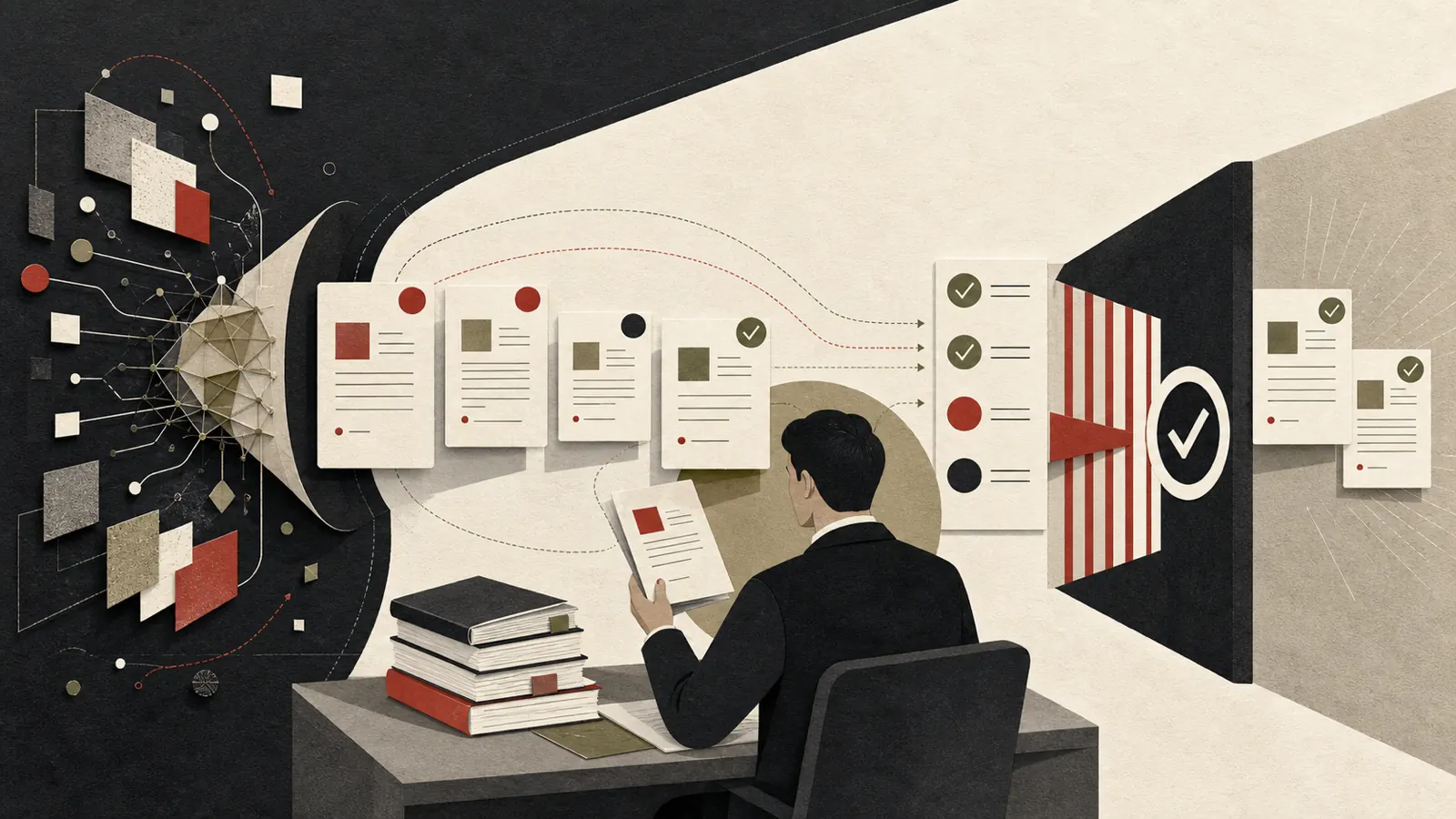
“Human in the loop” is meaningful only if the reviewer has competence, time, sources, and authority to reject the output. Require review proportional to the consequence. A qualified lawyer should independently verify legal propositions, citations, quotations, procedural steps, facts, calculations, and advice before professional reliance.
For research outputs, require links to inspectable sources and use the case-law citation verification checklist. For document analysis, compare important output against the source set and record coverage limits. For summaries, check omissions and attribution, not just obvious false sentences.
Review checklist:
- intended question and scope are clear;
- source corpus and known gaps are disclosed;
- every material fact traces to the underlying record;
- legal authorities are opened and independently checked;
- quotations and pinpoint references match the source;
- contradictory or adverse material has been considered;
- uncertainty is expressed without false confidence;
- privilege, confidentiality, and disclosure risks are reviewed; and
- the approving person and stable output version are recorded.
AI should not sign, file, send, or publish professional work merely because it produced a fluent draft. The firm's existing authority and supervision rules still apply.
How should confidential and personal data be controlled?
Begin with data classification and purpose. Decide whether public, internal, confidential, privileged, personal, sensitive, or ethically walled information may be processed in a given deployment. Apply data minimisation: if a task can be tested with a synthetic or redacted record, do not begin with a live client file.
For each system, document where data is processed, who can access it, how long it is retained, whether it is used for model training, what subprocessors are involved, how deletion works, and what logs administrators can see. Review transfer, backup, export, authentication, encryption, access-control, and incident terms.
The Ministry of Electronics and Information Technology publishes official policy and statutory materials within its remit. India's evolving AI policy discussion and responsible-AI work can inform governance, but a firm should not treat a strategy paper as a substitute for applicable law or professional obligations.
Review Gotham's security approach during product assessment, then verify the actual architecture, settings, contracts, and operating controls. A secure deployment still requires safe user behavior and matter-level decisions.
What should vendor and model due diligence test?
Do not approve “AI” as a category. Approve a specific product, feature, deployment, configuration, and intended use. A vendor can change a model, retention term, subprocessor, region, or feature after assessment. Contract for notice where appropriate and define which changes trigger reassessment.
| Due diligence area | Evidence to request |
|---|---|
| Data use | Contract terms and technical description of training and retention |
| Security | Architecture, access controls, testing, certifications, incident process |
| Model behavior | Evaluation method, limitations, change management, known failure modes |
| Tenant controls | Isolation, roles, logs, export, deletion, administrator access |
| Resilience | Availability design, backup, recovery, manual fallback |
| Legal terms | Confidentiality, audit, liability, subprocessors, termination support |
| Exit | Data export, deletion evidence, workflow continuity |
Run an evaluation with representative, authorised test material. Include adversarial prompts, incomplete sources, conflicting authorities, long documents, poor scans, and permission boundaries. A polished demo on easy questions is not sufficient evidence.
How should cybersecurity incidents involving AI be handled?
Extend the firm's incident process rather than creating an isolated AI mailbox. Potential events include unauthorised disclosure, prompt injection, malicious files, credential exposure, unexpected data retention, harmful automation, fabricated authority used in work, and a model or integration behaving outside its approved scope.
The Indian Computer Emergency Response Team publishes directions, advisories, and vulnerability information. Applicability, reporting duties, timelines, and evidence-preservation steps require advice based on the incident and current rules.
Give users an immediate response card:
- Stop the affected use without deleting evidence.
- Preserve the prompt, output, files, timestamps, account, and system messages.
- Notify the approved security and legal contacts through the incident channel.
- Do not investigate by repeatedly uploading the same material.
- Restrict access and follow authorised containment instructions.
- Let designated counsel and security leaders determine notification and remediation.
Protect people who report mistakes promptly. A culture of concealment makes technical and professional harm worse.
What records should the firm retain?
Retention should be purposeful and aligned with matter, legal, security, and client requirements. For material AI-assisted work, preserve the task, relevant prompt or instruction, source set, system and version where available, output, reviewer changes, approval, and delivered version. Do not retain sensitive prompts forever merely to prove governance.
Separate operational telemetry from matter content. Define who can access each, how long it remains, and how legal holds or client instructions apply. If the system cannot export an adequate record, decide whether the use is appropriate before deployment.
For client work, consider whether and how AI use should be disclosed or consented to under the engagement and applicable duties. The policy should route that decision to authorised counsel rather than impose a universal statement.
How does governance stay current after launch?
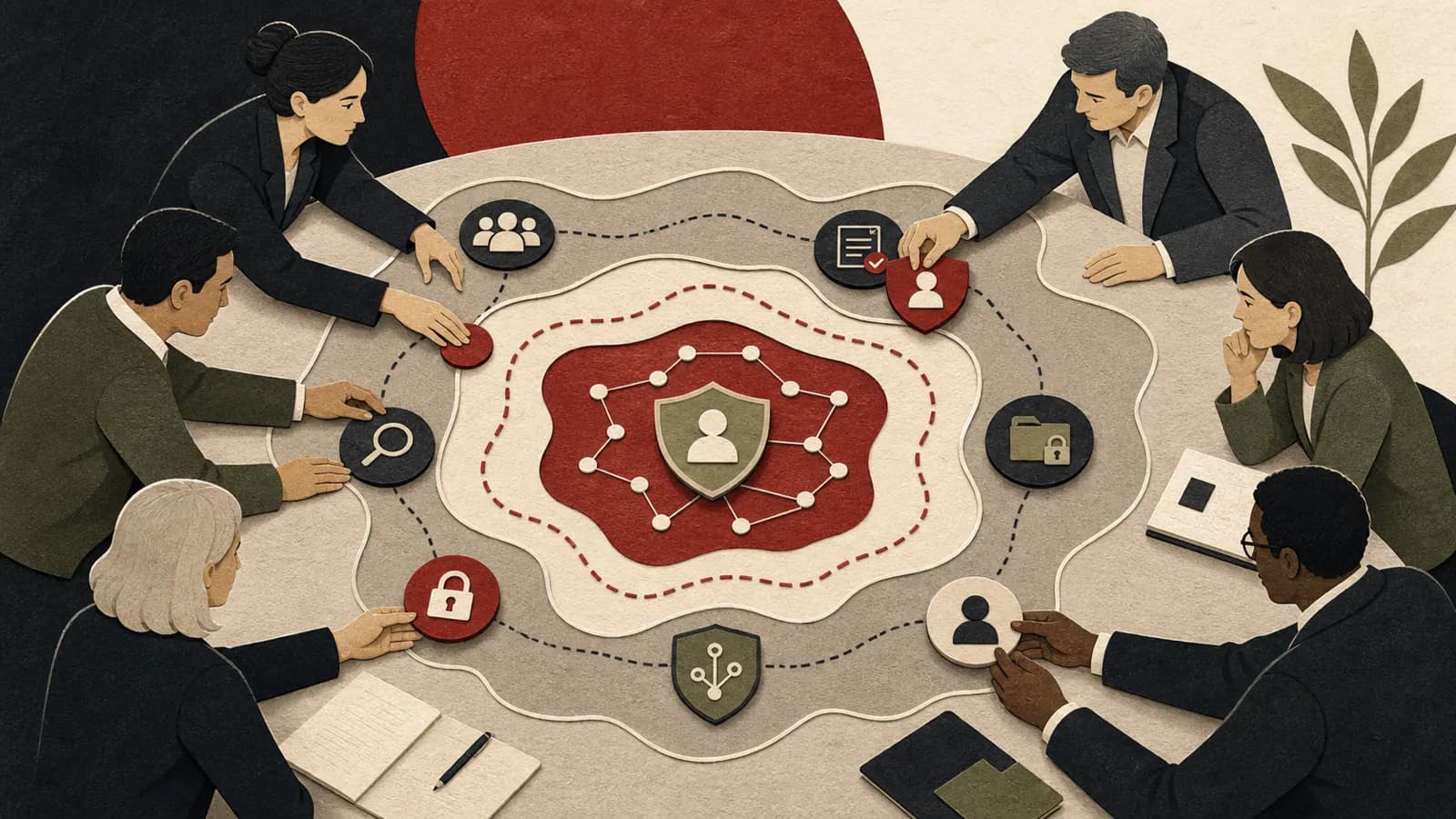
Create an AI governance group with legal, professional-responsibility, security, privacy, knowledge, operations, and practice representation. Name a chair and decision rights. Keep a register of approved systems and uses that staff can understand without reading committee minutes.
Review when a model, feature, deployment, vendor term, law, client requirement, or risk changes. Also review when incidents, near misses, evaluation failures, or user workarounds reveal that the written process does not match practice.
Quarterly review questions can include:
- Are people using unapproved tools because the approved path is impractical?
- Do high-consequence outputs receive evidenced independent review?
- Have vendor or integration facts changed?
- Are access rights and dormant accounts being reviewed?
- Do evaluations still represent actual work?
- Are incidents and near misses producing owned improvements?
- Can the firm stop a feature quickly and continue work manually?
Training should use concrete scenarios: a public chatbot, an embedded email assistant, an urgent filing, a client prohibition, and a suspicious document. Ask users to make decisions and practise escalation.
What is a practical rollout plan?
Inventory current use before drafting the policy. People may already rely on browser tools, meeting transcription, drafting aids, or vendor features. Offer a safe reporting route, classify the uses, and contain urgent risks without assuming every experiment was malicious.
Then select a narrow pilot with clear source material and reversible consequences. Define success and stop conditions, train reviewers, test permissions, run incident exercises, and gather evidence. Publish the approved-use register with the policy. Repeat evaluation before expansion.
Use the AI legal research guide for India to connect governance to a source-first research method. Teams can explore Gotham's legal workflows, review practice solutions, or talk to Gotham about a controlled legal AI deployment.
A credible policy does not claim to eliminate AI risk. It makes choices visible, keeps professional judgment with authorised people, and gives staff a practical route to pause when the facts no longer fit the approval.