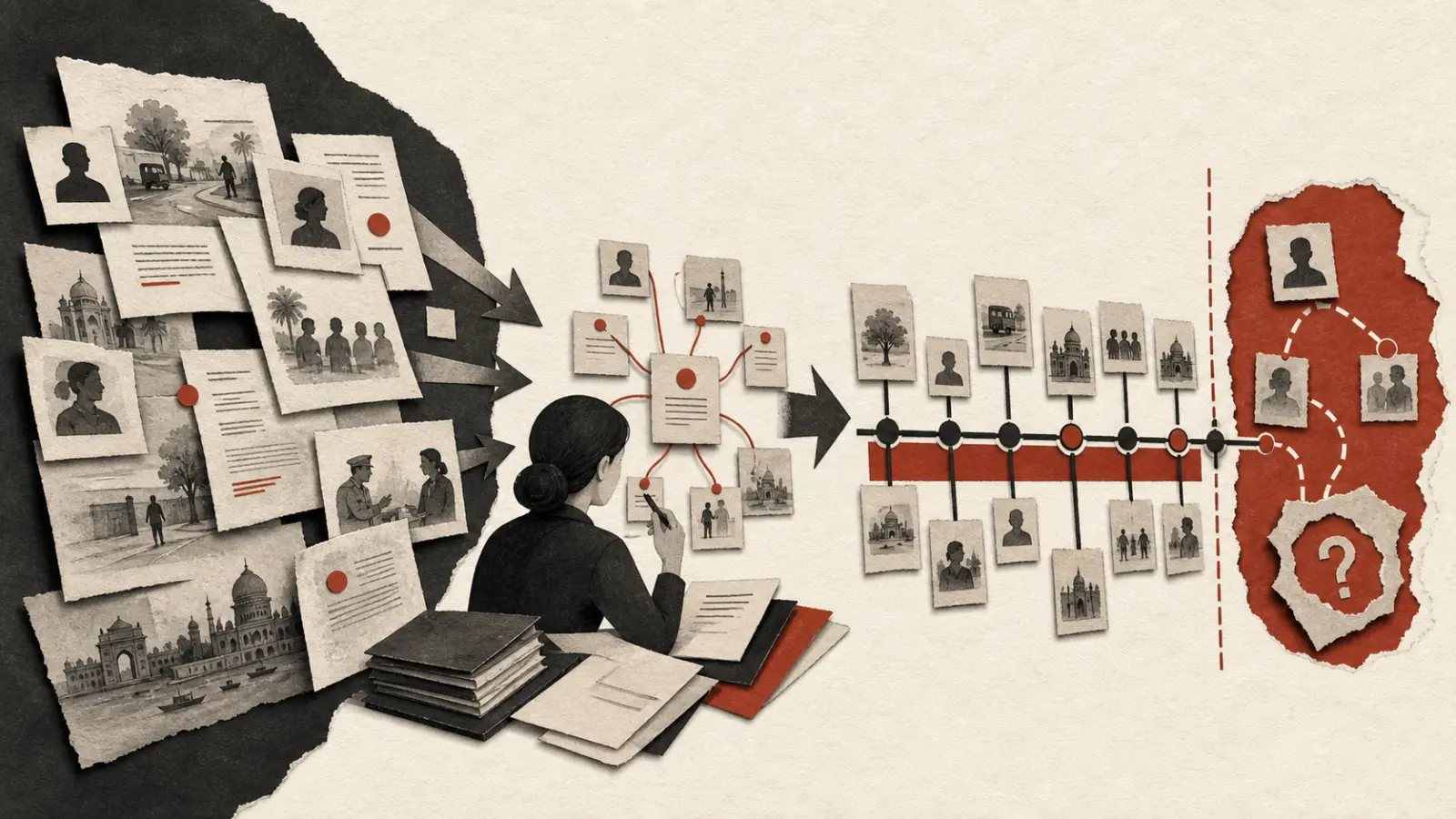
ITAT limitation and deadline tracking should never begin with someone typing a date into a shared calendar. It begins with evidence: the complete order, proof of communication or service, the proposed statutory route, and a documented professional decision about the triggering event and method of calculation. The calendar is an output of that analysis, not a substitute for it.
This workflow deliberately contains no universal deadline number. Different proceedings and facts may engage different provisions, rules, directions, exclusions, or condonation questions. A qualified professional must calculate and approve every operative date.
What evidence should be captured at intake?
Preserve every plausible service record without selecting a winner too early. An order may appear on a portal, arrive by email, be dispatched physically, or become known through another channel. The legal significance of each event requires professional analysis.
Open a service evidence table:
| Event | Date and time | Source | Native evidence | Legal status |
|---|---|---|---|---|
| Order made available | Exact timestamp if available | Portal | Download and activity record | Review required |
| Email received | Header and attachment details | Mail system | Native message | Review required |
| Physical delivery | Dispatch and receipt details | Courier or post | Envelope and proof | Review required |
| Client or adviser notice | Recorded communication | Approved system | Dated note | Context only until assessed |
Keep the order and evidence in their original state. Record time zone where timestamps matter. If a source cannot be exported, capture a responsible screenshot and a contemporaneous note explaining how it was obtained.
How should the statutory basis be researched?
Start with the current official text of the Income-tax Act, available through India Code, and the applicable Income Tax (Appellate Tribunal) Rules and official directions. Identify the exact proceeding: appeal, cross-objection, miscellaneous application, stay-related filing, defect response, paper book, or another event. Similar labels do not guarantee identical calculations.
Create a limitation research note with:
- the proposed governing provision and rule;
- the triggering event and supporting evidence;
- the counting convention being considered;
- any exclusion, court closure, extension, or special direction researched;
- alternative calculations and why they differ;
- current official sources and research cut-off date;
- the conclusion, confidence, and approving professional.
The ITAT website publishes institutional notices, while the e-Filing help page links procedural materials. Search for current notices instead of assuming a downloaded historical practice note controls today.
How do you calculate without hiding assumptions?
Use a calculation workpaper that exposes every step. The docketing system may calculate dates, but the workpaper should remain intelligible without the software.
| Input | Recorded value | Evidence | Reviewer note |
|---|---|---|---|
| Proceeding and provision | Matter-specific | Research note | Correct route confirmed? |
| Triggering event | Matter-specific | Service evidence | Alternatives considered? |
| Start convention | Approved interpretation | Statute, rule, authority | Current and applicable? |
| Excluded period | If any | Primary source and facts | Proof complete? |
| Candidate last date | System calculation | Workpaper | Independently reproduced? |
| Internal target | Earlier operational date | Team policy | Does not replace legal date |
Two people should calculate independently from the evidence, then reconcile. If they agree only because one copied the other's inputs, dual review has not occurred. Preserve both calculations and the resolution of any difference.
Which dates belong on the docket?
The docket should contain more than the proposed last filing date. Add internal milestones for evidence collection, counsel review, client instruction, drafting, signature, fee handling, upload preparation, second-person review, submission, acknowledgement verification, and defect monitoring.
Each entry needs:
- a precise event name, not “tax appeal due”;
- legal date and internal target shown separately;
- jurisdiction, proceeding, assessment year, and matter reference;
- owner, backup owner, and escalation recipient;
- source workpaper and approval status;
- reminders appropriate to risk; and
- completion evidence.
Do not close a filing deadline when the operator clicks submit. Close it only under the organisation's approved policy after the filing evidence has been reviewed and stored.
What happens when dates or service evidence conflict?
Treat conflict as a risk event. Do not average dates, choose the latest, or allow software to overwrite an older entry silently. Freeze the evidence, notify the responsible professional, and docket the earliest plausible date as a protective operational control unless counsel directs otherwise. That protective entry is not a legal conclusion.
Common conflicts include different communication timestamps, an incomplete order, a portal date that differs from an email, disputed recipient authority, an incorrect assessment year, or uncertainty about the proceeding. The resolution note should identify what was considered, the decision, the person approving it, and whether further evidence is needed.
The case chronology workflow offers a wider approach to disputed dates. Use Gotham's legal corpus for discovery where appropriate, while verifying governing law and authorities against primary sources.
How should a possible delay or condonation issue be handled?
Escalate immediately. Do not wait until the filing package is otherwise complete. Preserve a chronology of the order, service, instructions, attempted actions, technical events, illness or other asserted circumstances, discovery of the issue, and mitigation. Label assertions separately from documentary proof.
A controlled condonation evidence register can include:
- the fact said to explain each period;
- the witness or source able to support it;
- contemporaneous messages, records, receipts, or system logs;
- gaps and contradictions;
- draft affidavit or petition status;
- professional review and filing decision.
This is sensitive factual work. The operations team should not embellish explanations or convert an assumption into a fact. Counsel determines relevance, sufficiency, drafting, and legal position.
How can the team monitor filing and post-filing events?
Use the official ITAT e-Filing portal and its Appeal Dashboard for available filing details, defect handling, and later documents. Preserve acknowledgements and status evidence in the matter file. Assign one owner to monitor, plus a backup who can act during leave.
Run a recurring open-event report:
| Status | Meaning | Required action |
|---|---|---|
| Evidence incomplete | Trigger not proven | Obtain source and escalate |
| Calculation pending | No approved workpaper | Counsel or tax review |
| Ready to file | Package approved | Controlled submission |
| Submitted, unverified | Action taken, evidence unchecked | Validate acknowledgement |
| Defect open | Registry or portal response required | Docket response and owner |
| Closed | Completion evidence accepted | Archive audit trail |
Calendar alerts should point to the workpaper and matter, never contain unnecessary tax data in notification previews.
What does a defensible deadline file contain?
At closure, another reviewer should be able to reconstruct the decision from source to receipt. The file contains the complete order, service evidence, research note, calculation workpapers, approval, docket history, reminders, filing set, acknowledgement, defect correspondence, and closure decision.
Ask the closing reviewer to reproduce the approved candidate date from the stored inputs and confirm that each calendar event points to its completion evidence. Record any late-arriving service material even if it does not change the approved position. That small discipline prevents a tidy closed status from hiding evidence that matters to a later hearing, audit, or professional review.
The ITAT appeal workflow connects these controls to drafting and filing. Teams can assess Gotham's security approach, explore workflow design, or contact Gotham about auditable legal operations. Good docketing does not promise that uncertainty disappears. It makes uncertainty visible early enough for a qualified person to act.