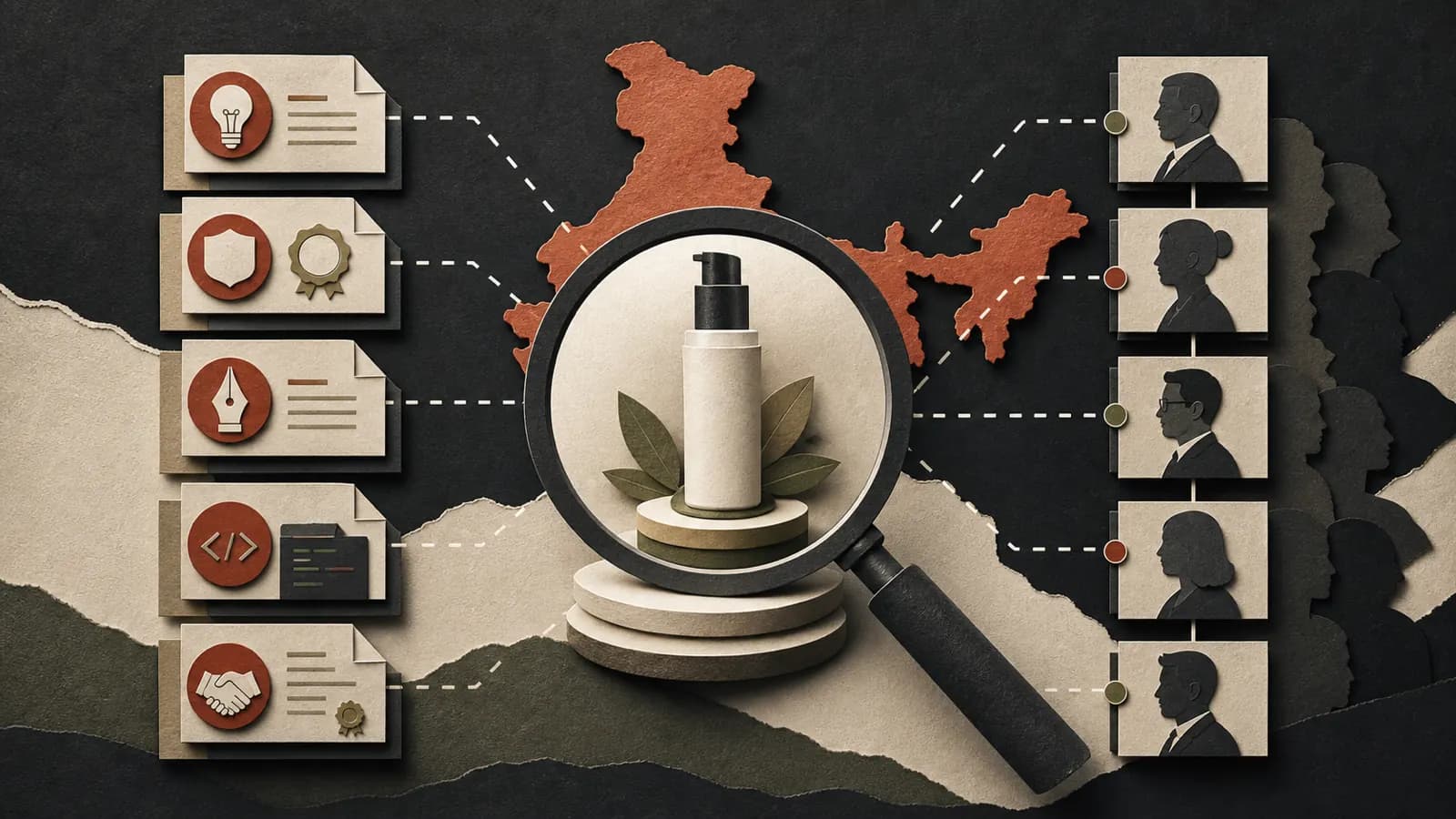
Intellectual property due diligence in an Indian M&A deal should answer a commercial question: can the target continue to make, use, sell, modify, and defend the products that support the valuation? A registration spreadsheet cannot answer that alone. The team needs to connect assets and know-how to creators, owners, licences, products, territories, renewals, disputes, and technical dependencies.
Use current official materials from IP India, the Copyright Office, and applicable statutes on India Code. Corporate approvals and ownership records may also require review under the Companies Act framework and the Ministry of Corporate Affairs. Databases have scope and timing limits, so preserve search parameters and dates and have qualified IP counsel interpret results.
What is the right starting inventory for IP diligence?
Start from products and revenue, then work back to rights. List each material product, service, platform, brand, content library, dataset, process, and planned launch. Identify which patents, applications, trademarks, domains, designs, copyright works, software, databases, trade secrets, licences, and third-party components support it.
| Product dependency | Evidence | Ownership question | Continuity question |
|---|---|---|---|
| Brand | Register data, use evidence, marketing files | Which entity owns each mark? | Are key territories and classes covered? |
| Software | Repositories, contributor history, assignments | Who wrote and transferred the code? | Can it be maintained after closing? |
| Patent or design | Official record, invention file, assignments | Is title chain complete? | Are renewals and territories aligned? |
| Content or data | Source records, licences, permissions | Is creation or acquisition documented? | May it be reused and transferred? |
| Know-how | Access logs, policies, contracts | Is it controlled as confidential? | Will key knowledge leave with people? |
Do not merge legal ownership, registered proprietor, beneficial interest, exclusive licence, and operational control into one “owner” field. The wider legal due diligence checklist helps align this inventory with corporate and contract evidence. Gotham's practice tools can organise the resulting records around one matter.
How should registrations and chain of title be verified?
For every registered or applied-for right, capture jurisdiction, office, type, number, title or mark, applicant, current recorded owner, status, relevant dates, classes or claims, agent, renewal evidence, security interest, opposition, and official-record retrieval date. Search name variants, former names, founders, acquired businesses, and relevant affiliates. Record database limitations rather than treating “no result” as proof that no right exists.
Build the title chain event by event. Connect creation or invention to employment or contractor terms, assignment instruments, consideration, corporate approval, recordal, merger or name-change documents, and current ownership. If a document covers future works or broad categories, quote the operative language and have counsel assess its effect.
The title checklist is practical:
- creator or inventor is identified;
- employment or engagement terms for the relevant period are retained;
- assignment scope, territory, duration, and rights are recorded;
- entity names and dates reconcile across instruments;
- official recordal status and pending requests are visible;
- liens, security interests, licences, and co-ownership are mapped; and
- missing evidence has an owner and deal consequence.
How are employee, founder, and contractor contributions tested?
Create a contributor population from HR, procurement, accounts payable, repository history, product records, and management interviews. Prioritise founders, early engineers, designers, researchers, agencies, consultants, and contributors in countries where the target develops material assets. A current template does not prove that historic contributors signed it.
Sample each high-risk contribution from work product back to the individual and governing agreement. Record employing or contracting entity, dates, work description, confidentiality terms, invention and copyright language, moral-rights treatment where relevant, further-assurance duties, open-source obligations, and any exception schedule. Compare invoice descriptions and repository commits with the agreement's scope.
Where a gap appears, report the evidence and ask counsel to determine the response. A confirmatory assignment may not solve every historical, insolvency, tax, employment, or jurisdictional question. Avoid promising that a single document “cleans up” title.
What should licence and commercial-contract review extract?
Build one family for each operative relationship: master agreement, order forms, amendments, schedules, statements of work, side letters, waivers, and notices. Extract grant, rights type, field, product, territory, term, exclusivity, sublicensing, transfer, assignment, change-of-control, improvements, derivative works, data, audit, royalties, warranties, indemnities, termination, transition, and survival.
Use the bulk contract review workflow to reconcile the population before extraction. The contract data extraction guide explains how to keep structured results connected to source clauses. Machine extraction can speed triage, but reviewers should validate every field that drives a deal decision.
| Licence question | Required output | Red flag signal |
|---|---|---|
| What may be used? | Asset, field, territory, rights, restrictions | Product use exceeds the grant |
| Who may use it? | Entities, customers, contractors, sublicensees | Group use is unsupported |
| Does the deal affect it? | Assignment, control, consent, notice | Critical right may terminate |
| What is paid? | Royalty base, minimum, audit, adjustment | Finance and contract records differ |
| What survives? | Exit, transition, deletion, escrow | Continuity depends on cooperation |
How should software and open-source dependencies be reviewed?
Combine legal and technical evidence. Request architecture maps, repository lists, build pipelines, software bills of materials if maintained, package manifests, scanning results, contribution history, release records, source-code escrow, security materials, and commercial component contracts. Determine which code is shipped, hosted, used in tooling, or incorporated into customer deliverables.
For each material component, record version, source, licence, use pattern, modifications, distribution, notices, source-offer or attribution process, approval, and remediation status. Automated scans produce leads, including false positives and missed custom code. A knowledgeable engineer and counsel should validate the high-risk results against the actual build and deployment.
Also examine access and continuity: privileged repository access, departed-user removal, branch protection, credential handling, backups, build reproducibility, key-person dependency, and the buyer's ability to operate after closing. These facts can matter even when ownership documents are complete.
How are trade secrets, data, and know-how evaluated?
Inventory the information the business considers secret and explain why it has value and remains controlled. Map repositories, authorised roles, contractual restrictions, labelling, sharing channels, exit procedures, incident history, and third-party access. A policy saying “all information is confidential” is weaker evidence than specific classification and access controls.
For datasets and training or analytical material, trace source, collection, licence or permission, permitted purpose, transformation, sharing, retention, and product use. Keep privacy, confidentiality, database, copyright, contract, and sector questions distinct and route them to the relevant specialists.
Sensitive source code and invention material should not enter an unrestricted data room. Apply staged access, clean-team arrangements where appropriate, logging, export controls, and deletion commitments. Review platform handling against Gotham's security overview.
What litigation, opposition, and freedom-to-operate evidence matters?
Collect oppositions, cancellations, infringement claims, cease-and-desist correspondence, settlement and coexistence agreements, licence disputes, employee or founder claims, office actions, opinions, searches, and management's threatened-matter list. Reconcile these with authorised official and court sources where appropriate.
Do not describe a database search as a freedom-to-operate opinion. Record query, classes or technical scope, territory, date, limitations, results selected for review, and counsel's role. For each dispute, separate allegation, verified procedural fact, management view, external counsel assessment, financial estimate, and operational impact.
How does the IP report become a closing and integration plan?
Write each finding as fact, uncertainty, deal relevance, action, owner, and status. Responses might include a focused title request, consent, recordal, renewal, licence amendment, disclosure, drafting protection, escrow, access control, open-source remediation, or key-person plan. Qualified advisers decide which response fits.
Before closing, rerun official searches, confirm material renewals, reconcile the final transaction perimeter, check required consents, and freeze the verified asset and licence schedules. After closing, transfer docketing, repository access, brand control, contract notices, remediation, and renewal tasks to named owners.
If your team needs traceable IP review across documents, research, and issue workflows, contact Gotham. Strong IP diligence does not merely count registrations. It shows how the business depends on rights, whether the evidence supports continued use, and exactly which uncertainty still needs a decision.