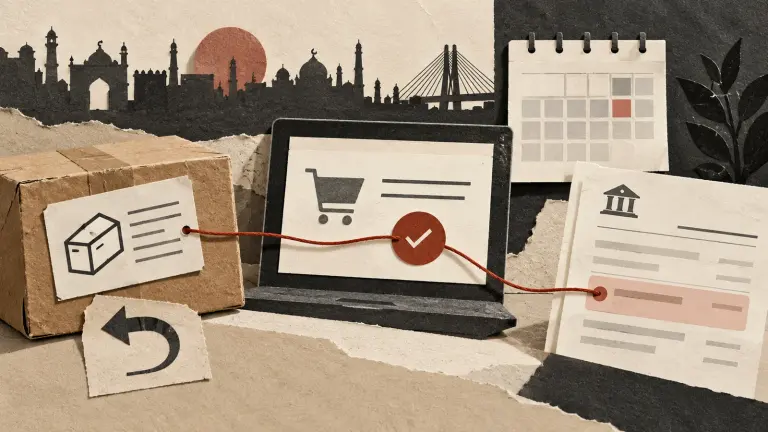
A wrong item and a return pickup that never happened are two different problems. For the first, compare what arrived with the product description and agreement. For the second, preserve the return request and every pickup or cancellation message. Neither a single support response nor an order-status label decides the legal result.
This guide covers Indian online purchases where the delivered goods appear materially different from what was advertised or agreed, and cases where a documented return request was cancelled after the pickup did not occur. It does not establish a general right to return conforming goods because you changed your mind. If the seller has already accepted your refund and the money has not arrived, use our separate guide to an approved online refund that has not been credited. If you need the broader complaint sequence, see how to prepare an online consumer complaint in India.
First identify which return problem you have
Check the order confirmation, invoice and listing saved around the purchase date. Record the seller's name and whether the documents identify a third-party marketplace seller or the platform itself as seller. Do not assume that the app, marketplace, brand and seller are the same legal entity.
| What happened | Keep | What to ask in writing |
|---|---|---|
| The product is materially different from the listing or agreement | Listing and variant, invoice, parcel label, delivery record, and photos or video you already have | Which seller supplied it, what return or replacement term applies, and why the request is refused or reduced |
| You requested a return within the displayed period, but pickup did not occur and the request was cancelled | Original return request and timestamp, pickup slots, missed-pickup logs, messages, cancellation reason and support ticket numbers | Why the request was cancelled, how the platform applied the displayed window, and whether it will review the request using the original date and pickup record |
| The return or refund was accepted, but the credit is pending | Approval message, refund reference, amount, payment method and bank statement | Whether the payment was submitted, when, and which reference the bank or issuer can trace |
Use accurate labels. A missed pickup does not prove that a seller refused a legally required return, and a support complaint does not itself establish a refund entitlement. Avoid altering the original order or chat records. If you send a copy to the seller, marketplace or helpline, include only relevant information and keep the original.
If the item does not match what you ordered
Save the product page, variant, description, seller identity, order confirmation and invoice. Keep the outer packaging and shipping label until the seller or platform explains what it needs. Photograph the item and any mismatch. If you already recorded the package opening, keep the original video with its date and context; do not treat a video as a universal requirement or proof of every disputed fact.
The Consumer Protection (E-Commerce) Rules, 2020 distinguish marketplace and inventory models. Rule 6(3) says a seller offering goods through a marketplace must not refuse to take back goods or refund consideration paid when the goods are defective, deficient, spurious, or do not match the characteristics or features advertised or agreed. Rule 7(4) sets a parallel restriction for an inventory e-commerce entity. Both provisions also address late delivery, with a force-majeure exception for that part of the rule.
The relevant comparison is the product and agreement for your own order. The Rules do not make every unwanted or conforming item returnable, and they do not decide a disputed listing, product condition, seller identity, consumer status or remedy without considering the evidence and applicable terms. Ask the seller to identify the term or evidence it relied on if it rejects the request.
If the return pickup did not happen
A return request and a completed return pickup are different recorded events. The E-Commerce Rules do not expressly say that a missed pickup automatically extends a platform's return window, makes a return complete, or guarantees a refund. The order terms, return policy displayed when you made the request, pickup record, communications and the reason for cancellation may matter.
Make a short timeline with the date you requested the return, the available pickup slots, any pickup attempt or failure message, the date the platform cancelled the request, and each support response. Save screenshots or exported messages in their original context. Then ask the seller and platform, through their official written channels:
- Was the return request received on the original date, and what request or ticket number identifies it?
- Was a pickup assigned or attempted? What do the logistics records show?
- What policy term and date were used to say the return period had expired?
- Will the request be reviewed against its original timestamp and the recorded pickup failure? If not, what is the written reason?
Do not claim an attempted pickup if the tracking record shows none. Do not assume that the platform's own logistics provider is legally the seller. For a gas-cylinder delivery that never occurred, see the separate guide to an LPG cylinder delivery complaint in India; the supplier and delivery rules differ from an online marketplace return.
Contact the seller and the marketplace
Write a factual complaint with the order number, seller name, problem type, key dates, and the resolution you are asking them to consider. Attach only the records needed to explain the mismatch or pickup history. Keep the sent message, acknowledgment, ticket number and written response.
An e-commerce entity must identify a grievance officer and provide a complaint channel under the current Rules. Rule 4(5) requires the grievance officer to acknowledge a consumer complaint within 48 hours and redress it within one month. A seller using a marketplace has its own grievance-officer duty under Rule 6(4)(b), with the same stated periods. These are complaint-handling timelines; they do not decide whether a particular return qualifies or mean a refund must reach your bank account within one month.
For the wrong-goods path, make clear how the item differs from the listing or agreed specifications. For the pickup path, attach the original return request and the platform's pickup/cancellation record. Ask the marketplace for the seller's contact details if you need them to communicate about the purchase. If it rejects the request, ask it to identify the policy and records on which it relied.
Consider a consumer grievance route
The Department of Consumer Affairs describes the National Consumer Helpline as a pre-litigation grievance channel. It lists phone, web, WhatsApp/SMS and other ways to register a grievance. Check the current official page for available channels. NCH can forward a grievance for action and provide a docket for tracking; it is not a Consumer Commission and does not guarantee a remedy.
A consumer may consider filing a complaint before the appropriate Consumer Commission. Section 35 of the Consumer Protection Act, 2019 addresses who may make such a complaint. The Act's definition of “consumer” excludes certain purchases for resale or commercial purposes and includes an exception for goods used exclusively to earn a livelihood by self-employment. Whether you qualify, who the proper opposite party is, which Commission has jurisdiction, the limitation period and what relief is available depend on your facts and current law. For current filing steps, use the Government's e-Jagriti help documents or filing portal; the help page requires JavaScript for some content. Our consumer complaint process guide explains the difference between a business complaint, an NCH grievance and a Consumer Commission filing.
If your order was a flight ticket cancelled by an airline, see the separate India flight-cancellation refund guide. If the payment was sent to the wrong UPI recipient rather than paid to a seller for an order, see what to do after a wrong UPI transfer. Different transaction types can have different processes.
Chargebacks are a separate process
A card or payment-issuer dispute is separate from a return complaint. If you ask your issuer to review a payment, use its verified support channel and ask for the applicable deadline, reason codes and documents. The checked E-Commerce Rules do not promise a chargeback or require an issuer to reverse every transaction. Do not describe a seller or marketplace dispute as an unauthorised transaction if you authorised the purchase.
The 2026 Consumer Protection (E-Commerce) (Amendment) Rules are scheduled to take effect on 1 January 2027, according to the Department of Consumer Affairs' official announcement. The amendment changes several disclosure and platform-practice provisions, but it does not change the specific non-refusal text in Rules 6(3) and 7(4). This guide describes the rules in effect on 4 November 2026; recheck official sources after the amendment's commencement date.
Before you close the complaint
- I saved the listing, order, invoice, seller identity and delivery record.
- I kept the original return-request timestamp, pickup logs, cancellation reason and ticket history if a pickup failed.
- I described whether the issue is a wrong item, a failed pickup, an approved refund awaiting credit, or a different payment problem.
- I sent a factual complaint through the seller's and platform's verified grievance channels and saved the references.
- I understand that grievance timelines do not decide the return's merits or guarantee payment.
- I checked NCH or current Consumer Commission filing guidance before choosing a formal route.
- I sought qualified advice if consumer status, seller responsibility, limitation or relief is disputed.
For consumer and legal teams handling repeated order disputes, Gotham's legal workflows describe ways to organize source-linked matter records and follow-up. Contact Gotham to discuss an appropriate document workflow.
Official sources
- Consumer Protection (E-Commerce) Rules, 2020, including Rules 4, 6 and 7.
- Consumer Protection Act, 2019 (India Code), including the consumer definition and section 35.
- National Consumer Helpline, Department of Consumer Affairs.
- Consumer Protection (E-Commerce) (Amendment) Rules, 2026, and Department of Consumer Affairs announcement on commencement.
Questions about a wrong item or failed return pickup
Can an online seller refuse a return for a wrong item in India?
The Consumer Protection (E-Commerce) Rules, 2020 restrict a marketplace seller or inventory entity from refusing to take back goods or refund consideration in specified cases, including goods that do not match their advertised or agreed characteristics. The seller model, evidence, consumer status, and facts matter; this is not a rule for every change-of-mind return.
Does a missed pickup automatically extend the return window?
The E-Commerce Rules do not expressly say that a failed pickup automatically extends a return window or makes a return complete. Keep the original request and pickup records, ask the seller or platform for its written reason, and check the terms shown when you ordered and requested the return.
Does the one-month grievance timeline mean my refund must reach my bank in one month?
No. The grievance officer's one-month period is for redressing a consumer complaint. It is not a universal bank-credit deadline or a decision that a particular refund is owed.
Should I complain to the seller or the marketplace?
For a marketplace purchase, identify the seller on the invoice or order record and send a written complaint to the seller and the platform's published grievance channel. Their legal roles differ, and the platform's response does not decide the seller's liability.
Can my card issuer guarantee a chargeback?
No guarantee is stated in the E-Commerce Rules. Ask your issuer for its current dispute process, deadline, and evidence requirements; a complaint to the seller, platform, or helpline does not guarantee a payment reversal.
General information for India, not legal advice. A return or refund depends on the transaction, seller or inventory model, product terms, evidence, consumer status, and applicable rules.
How Gotham researches and reviews field guides