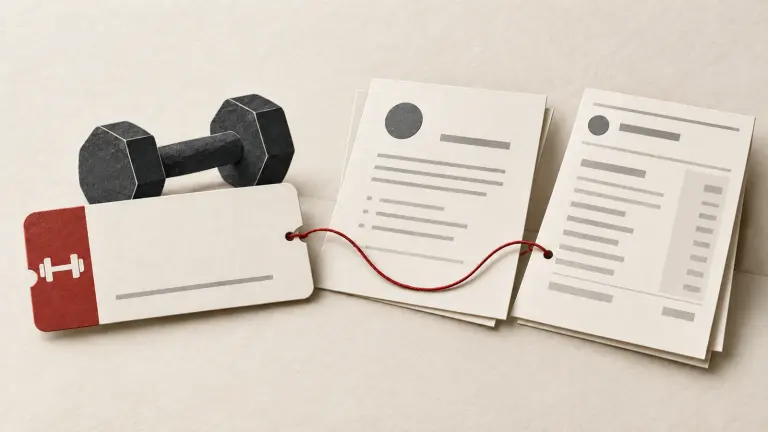
If you asked a gym to cancel your membership and another debit appeared, start by checking two separate records: the membership agreement and the recurring-payment instruction. One governs when the service ends and whether an amount remains due. The other authorises a bank, card issuer or payment provider to collect money. The dates and documents determine what the debit relates to; a debit after a cancellation request is not automatically a refund or fraud finding.
Put the dates and records in one place
Before contacting the gym or payment provider, make a short timeline. Save the original messages, confirmations and receipts, and note:
| Record | What to note | What it helps establish |
|---|---|---|
| Membership terms | Renewal date, minimum term, notice method and period, cancellation fee and refund terms | The terms the gym may rely on |
| Cancellation request | Date, channel, account reference, exact request and proof it reached the gym | What you asked for and when |
| Gym response | Confirmation, stated end date, final amount or reason for refusal | Whether the gym confirmed an effective date |
| Transaction | Date, amount, merchant descriptor, receipt and reference | Who collected the payment and when it posted |
| Mandate | Payment rail, mandate or UMR reference, status and cancellation confirmation | Which instruction authorised collection and whether it was withdrawn |
Keep a masked statement and share only the details needed to identify the matter. Do not send a full card number, CVV, PIN, UPI PIN, OTP or banking password to a gym or through an unverified channel.
Ask the gym to explain the charge
Write to the gym's published support or grievance channel. Identify your membership, cancellation request, debit date, amount and payment reference. Ask it to confirm:
- The date it says your membership ended, and the term that sets that date.
- What the debit covers, such as a notice period, an amount already accrued or a renewal.
- When it submitted the collection and the payment reference.
- Whether the service account is closed and future collections have been stopped.
- If it agrees the payment was not due, how much it will refund and when.
Ask for an itemised calculation if the gym says you owe a fee. If you cancelled online, save the confirmation screen and receipt. If you spoke by phone or at the front desk, send a follow-up message recording what was agreed. A sent email alone may not show that the request reached the gym, so keep any delivery or ticket confirmation.
Find the payment rail and check its status
Use your bank statement and payment history to identify whether the collection was made through a card recurring instruction, UPI AutoPay, NACH/eNACH or another arrangement. Contact the bank, issuer or app that holds the instruction. Ask for its reference, current status, effective withdrawal date and the process for disputing a later transaction. Keep the confirmation and support ticket.
UPI AutoPay. Check the app's AutoPay or mandate section for the gym, amount or frequency, next debit and mandate ID. NPCI's UPI AutoPay enhancement circular describes lifecycle management through participating payer PSPs and UPI apps, including viewing mandates and the available pause, revoke and modify operations. Follow the app's confirmation steps and save the status. A mandate action addresses payment authority; it does not by itself confirm that the membership ended or that no contractual amount remains due.
Card recurring instruction or PPI. The RBI's Digital Payments – E-mandate Framework, 2026 applies to recurring card, prepaid payment instrument and UPI transactions. It requires the issuer to provide a way to withdraw an e-mandate at any time; withdrawal is authenticated. The framework also requires a pre-transaction notice at least 24 hours before a covered debit and an authenticated option to opt out of a particular transaction or the mandate. If you dispute a scheduled debit, use the issuer's official option promptly and save its confirmation. Ask the issuer to trace the mandate status and transaction timing if a debit still appears.
The framework does not cover every gym collection or every payment rail. Its exception for auto-replenishment of FASTag and National Common Mobility Card balances concerns the pre-transaction notice; the framework still requires a post-transaction notification for covered e-mandate debits. Do not assume that a missing alert alone proves that a membership charge was not due.
NACH/eNACH. Use the online stop or cancellation channel published by the mandate-registering entity or your bank, and ask for written confirmation of the status and effective date. NPCI's NACH circulars include instructions for customer stop/cancel requests through electronic channels. The NACH Procedural Guidelines describe online mandate actions, with applicability depending on the relevant mandate category and participant. If one channel cannot locate the instruction, give the bank and gym the mandate reference or UMRN and ask each to confirm its own record. A NACH mandate is separate from the membership terms.
If the debit has already happened
Contact the payment provider as well as the gym. Identify the specific transaction by date, amount and reference, explain the cancellation and mandate timeline, and ask which transaction-dispute process and deadline apply. Ask what evidence it needs and whether it can stop or revoke future collections. A stop request or mandate revocation does not itself reverse a completed payment or decide the membership balance.
Use “unauthorised” only if that accurately describes the facts. A payment under a mandate you once approved may raise different questions from a later debit after a confirmed withdrawal, a charge outside the approved amount or frequency, or a transaction you never authorised. Tell the provider what happened and let it identify the dispute category. If a deadline may be running, do not wait for the gym's response before contacting the provider.
Compare the gym's explanation with the transaction and mandate records. If the gym says the charge was already in process, ask when it submitted it and for the payment reference. If the bank says it was a mandate debit, ask for the mandate reference, status at processing, available notice record and the rule or deadline it applied. Keep separate ticket numbers and written replies from each organisation.
Escalate through the organisation that can address the issue
For the gym's service or contract handling, use its grievance route and preserve the acknowledgement. The Department of Consumer Affairs' National Consumer Helpline lists 1915 and 1800 11 4000, available daily except national holidays from 8 a.m. to 8 p.m., along with online and other channels. NCH is a pre-litigation grievance route, not a decision that a refund is due. If the matter remains unresolved, check the current official Consumer Commission filing route and get advice about jurisdiction and limitation. Do not assume a helpline grievance pauses a legal deadline. See our guide to raising a consumer complaint online in India for the difference between a business complaint, an NCH grievance and a Consumer Commission case.
For a bank, card issuer or other payment provider, first complain through that entity's official channel and keep its acknowledgement and response. The RBI's Reserve Bank–Integrated Ombudsman Scheme, 2026 FAQ says the Scheme covers only specified categories of regulated entities and has maintainability requirements. Check its current coverage and filing conditions before using the RBI Complaint Management System. This route concerns a covered entity's service; it does not decide the gym contract or directly order the gym to refund a membership fee.
A concise message to the gym
Subject: Membership cancellation and recurring debit – [membership reference]
I requested cancellation on [date] through [channel]. The gym confirmed [effective date / has not yet confirmed]. A debit of ₹[amount] appeared on [date], reference [masked/reference]. Please confirm the membership end date, identify the period and contract term for which this amount was collected, state when the collection was submitted, and confirm whether future collections have been stopped. If the debit was not due under my membership terms, please explain the refund process and timeline. Please acknowledge this complaint with a ticket number. I have attached the cancellation record, relevant terms and a masked transaction entry.
Send a separate request to the bank, issuer or UPI provider through its official channel. Ask it to identify the mandate, confirm its status and effective withdrawal date, explain any transaction already in process, and open the appropriate dispute for the transaction you identify.
Before you close the matter
- Do I have the membership terms that applied and the gym's written cancellation end date?
- Can I identify the amount, merchant, payment rail, mandate reference and billing period?
- Have I asked the gym for the contract term and calculation supporting any further amount?
- Have I asked the payment provider to confirm the mandate's status and withdrawal date?
- If I dispute a completed debit, have I opened the provider's transaction-dispute case and recorded its deadline?
- Have I kept masked statements, cancellation receipts, messages and ticket references together?
- Have I checked whether a legal or complaint deadline could apply before waiting for another reply?
Related guidance
If the gym has already approved a refund, see what to check when an approved refund has not arrived. For a debit you did not authorise, read the separate guide to unauthorised bank transactions. You can also contact Gotham to discuss a document review.
Questions about gym membership cancellation and recurring charges
Does cancelling a gym membership automatically cancel its payment mandate?
Not necessarily. The membership contract and the instruction authorising recurring payments are separate records. Ask the gym to confirm the membership end date and ask the bank, issuer or payment app to confirm the mandate's status and effective withdrawal date.
If a gym debits me after I request cancellation, must it refund the payment?
A request date alone does not decide that. Check the contract's notice period, billing date, cancellation confirmation, payment submission time and mandate status. Ask the gym for the contract term and calculation supporting the charge, then use the payment provider's dispute process if you contest the completed transaction.
How do I stop a gym's UPI AutoPay debit?
Open the UPI app or bank channel that holds the mandate, review its details and use the available pause or revoke option. Keep the confirmation and ask the bank or app to confirm the effective status. Contact the gym separately about the membership and any amount it says remains due.
Can I complain to the RBI Ombudsman about a gym debit?
The Reserve Bank–Integrated Ombudsman Scheme, 2026 applies to specified categories of regulated entities and their service deficiencies, subject to maintainability rules. It is not a route for deciding the gym's membership contract. First complain to the relevant covered bank or other regulated entity, then check the current RBI FAQ's coverage and filing requirements.
General information, not legal advice. Whether a membership ended, a payment was due or a debit can be reversed depends on the contract, cancellation record, payment instrument, mandate status and dates. Confirm current rules and the relevant documents with a qualified Indian consumer or payments lawyer.
How Gotham researches and reviews field guides