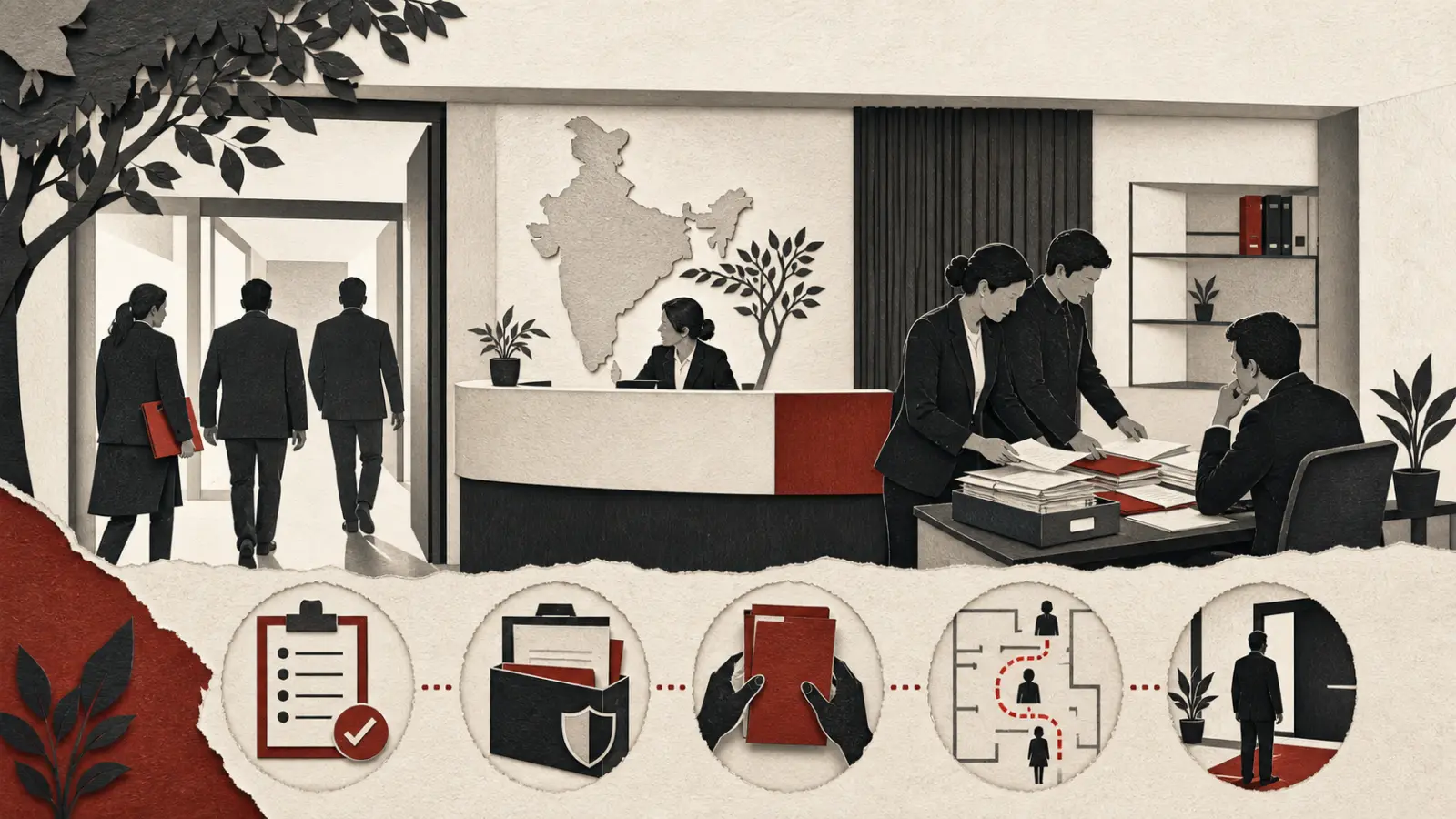
A competition law dawn raid playbook is useful only if the first people at the door can follow it under pressure. It should help employees remain calm, contact qualified counsel, preserve lawful cooperation, protect safety and business continuity, and create an accurate record. It must never encourage obstruction, concealment, deletion, coaching, or argument with officials.
Anchor the playbook in the current Competition Act, 2002 on India Code, the Competition Commission of India's legal framework and regulations, and current official investigation material. Powers, procedure, authorisations, and privilege issues require case-specific advice. The authority's documents and counsel's directions control during a real visit, not this operational guide.
What should reception and security do in the first minutes?
Give front-desk teams a one-page card. They should be courteous, avoid substantive discussion, notify the named internal response contacts and external counsel, and arrange an appropriate waiting or meeting area if permitted. They should not block entry, destroy material, sign unfamiliar substantive statements, or broadcast the visit across the company.
Record objective arrival details without confrontation:
| Capture | Purpose |
|---|---|
| Time, location, and officials' names or credentials as presented | Establishes the response chronology |
| Authority documents received | Lets counsel assess scope and procedure |
| Areas or people initially requested | Helps deploy escorts and custodians |
| Internal notifications and response times | Shows who took responsibility |
| Immediate safety or access issue | Enables prompt, respectful resolution |
Keep the card free of legal conclusions. Include primary and backup contacts, after-hours routes, language support, building access information, and a clear instruction to follow the officials' lawful directions and counsel's advice.
How should the response team establish roles without slowing the visit?
Assign roles before an incident. The response lead coordinates. Competition counsel advises on authority and procedure. A liaison communicates with officials. A separate note-taker maintains the chronology. IT supports systems and records actions. Facilities manages physical access. HR or employee support may assist where appropriate. Business custodians explain systems and files without speculating.
Use a live role board that does not contain investigation theories:
- response lead and authorised deputy;
- external and internal counsel contacts;
- official liaison and note-taker;
- IT, security, facilities, and HR leads;
- site escorts and relevant system owners; and
- controlled executive and communications contacts.
Conflicts and absences need alternates. Do not route every question to one executive who may be unavailable or personally involved. Test whether the contact list works from reception, a mobile phone, and outside normal hours.
Run the exercise against ordinary constraints rather than a perfect conference room. Ask what happens when the primary lawyer is travelling, a system administrator cannot be reached, or officials arrive at more than one office. Record the point at which each handoff failed, who noticed it, and how long recovery took. The exercise record belongs in the readiness workspace, separate from any live investigation file. Its purpose is to improve contact coverage and access arrangements, not to script substantive answers.
How can the team understand and track the authorised scope?
Counsel should review the documents presented and advise the team. Operationally, preserve copies as received, assign a stable reference, and maintain a scope log of locations, entities, subjects, systems, devices, custodians, periods, and categories discussed or requested. Record clarification questions and answers accurately.
The log is not a licence to resist or reinterpret. It is a coordination tool that helps IT and escorts locate material, helps counsel identify questions, and prevents different teams from working from inconsistent assumptions.
Use this workflow:
Authority documents preserved → counsel review → response roles activated → scope log opened → custodians and systems mapped → collection activity logged → copies and acknowledgements reconciled → follow-up preserved
Any disagreement, privilege issue, sealed material, or disputed category should be handled by qualified counsel through the procedure available in the circumstances. Employees should not improvise.
What should happen around interviews and employee requests?
Train employees to stay truthful, concise, and calm. They should not guess, coordinate stories, delete messages, hide devices, or discuss the visit in group chats. If they do not understand a question, they can ask for clarification. Questions about representation, attendance, documents, or procedure should be referred to counsel in line with the current situation.
The company note-taker, where permitted and directed, should distinguish the question, answer, document shown, follow-up requested, participants, start and end time, and any correction made at the time. Do not turn rough notes into a polished quotation that the speaker never approved.
Provide practical support without influencing substance. This can include locating an accessible room, interpreter, device owner, system specialist, or emergency contact. Employment and safeguarding concerns should go to the authorised specialist without compromising the investigation response.
How should IT support collection without altering evidence?
IT needs a system map before a visit: identity providers, email, chat, file stores, document systems, endpoints, mobile management, backups, archives, cloud services, business applications, and key administrators. For each system, record ownership, access method, logging, export capabilities, retention, and vendor dependency.
During collection, follow counsel's directions and preserve an activity ledger:
| Event | Details to record |
|---|---|
| Access | Account, system, operator, time, and authority request |
| Search | Parameters, scope, result count, and limitations |
| Export or copy | Tool, source, destination, format, and available integrity data |
| Transformation | Decompression, OCR, conversion, or decryption performed |
| Failure | Error, affected scope, retry, and escalation |
| Handover | Items, recipient, time, and acknowledgement |
Never run cleanup, retention, device-replacement, or auto-delete processes that could affect relevant material without authorised advice. Do not secretly move material to make it harder to find. Preserve originals and keep any working copy or conversion distinct.
How can confidentiality and privilege questions be managed safely?
Privilege and confidentiality are legal questions for counsel. The workflow should make rapid review possible without assuming that a label decides the issue. Maintain a restricted channel for potentially privileged or especially sensitive material, with source, custodian, document family, basis raised, reviewer, action, and resulting treatment recorded.
Commercial secrets, personal data, unrelated investigations, and employee information may need controlled handling. Counsel should address them through the available procedure. Do not use sensitivity as a pretext to conceal responsive material.
Review Gotham's security information and privacy approach when assessing a response workspace. Validate actual access control, audit logs, exports, backups, support access, and retention. A secure-looking interface cannot replace verified configuration.
What should happen after officials leave?
Do not dismantle the response room immediately. Reconcile authority documents, copies taken or provided, devices or materials retained, acknowledgements, outstanding requests, disputed items, interview notes, technical logs, and deadlines identified by counsel. Preserve the chronology as written and add corrections transparently.
Counsel should direct legal holds, internal fact work, notifications, employee communications, public statements, and engagement with the authority. Separate confirmed facts from assumptions and rumours. Limit internal distribution to the authorised group.
Run a lessons review without altering the matter record:
- Reception and backup contacts worked.
- Counsel received the authority documents promptly.
- Escorts and note-takers covered all active areas.
- System owners could explain and access relevant platforms.
- Collection actions and handovers can be reconstructed.
- Potential privilege or confidentiality issues reached counsel.
- Business continuity and employee support gaps have owners.
- Remediation is tracked outside the protected response record.
For preventive transaction work, read the competition-law merger control diligence guide. Teams can also explore Gotham workflows, examine deployment options, and contact Gotham about controlled matter coordination. Rehearsal improves readiness. It does not determine the lawful response to an actual visit.