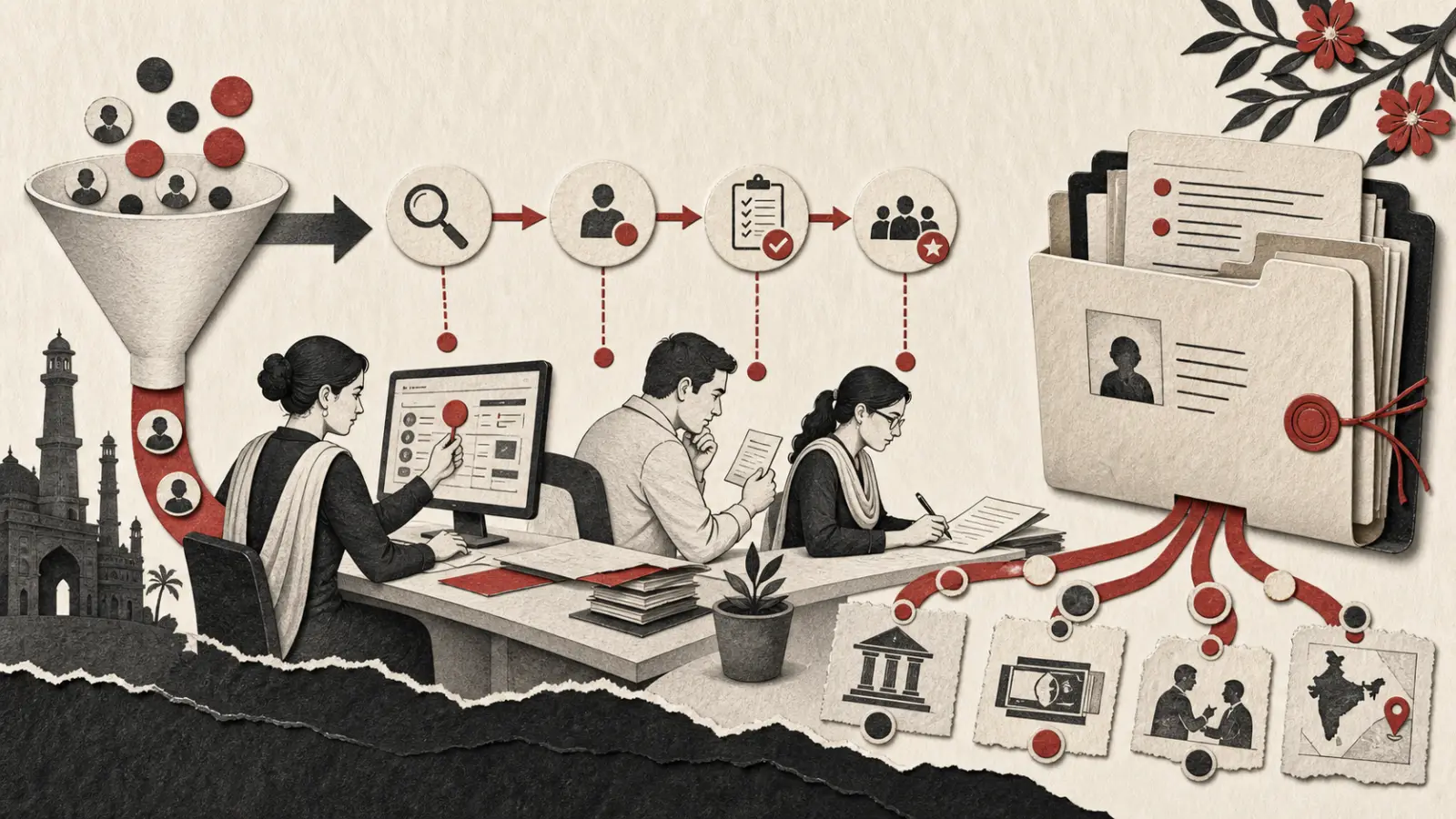
An AML alert is a question produced by a rule, model, list, review, or human observation. It is not a conclusion. An effective AML alert-to-case workflow preserves that distinction while giving analysts enough context to investigate, supervisors enough evidence to challenge, and the authorised reporting function a reliable decision record.
The source stack varies by reporting entity. Start with the Prevention of Money-Laundering Act, 2002 on India Code, current rules and notifications, FIU-IND, the RBI's current Master Direction on KYC, and applicable SEBI AML/CFT materials. Confirm the controlling version, entity category, regulator, and FIU reporting process. This guide does not tell a team whether activity is suspicious or whether a report must be filed.
When should an alert become a managed AML case?
Define promotion criteria before analysts face a busy queue. Some alerts can be resolved through a documented first-level review. Others need a case because they require multiple data sources, linked customers or transactions, specialist review, enhanced restrictions, or a reporting decision. Human referrals and law-enforcement or sanctions-related information may enter directly as cases under a separate approved route.
Keep the alert, case, and report as distinct objects:
| Object | Core question | Required history |
|---|---|---|
| Alert | Why did a control produce this signal? | Rule version, inputs, threshold, timestamp, and raw result |
| Case | What does an authorised investigation establish? | Scope, queries, evidence, analysis, reviews, and decisions |
| Report or other action | What must the authorised function do? | Basis, approver, channel, submission or action evidence |
Generate a stable case ID and link every contributing alert without copying data into uncontrolled notes. Record why separate alerts were combined or kept apart. Do not let closure of one alert erase its connection to a later pattern.
What information should triage collect before investigation?
Give the analyst a time-bounded snapshot of the information that existed when the alert fired. Include the customer and relationship profile, risk classification history, relevant transactions, counterparties, products, channels, locations, device or access signals where lawfully available, prior alerts and cases, due-diligence records, and the exact alert logic.
Triage should answer practical questions:
- Is the data complete enough to assess the alert?
- Does the activity match the expected purpose and profile on record?
- Are connected alerts or entities already under review?
- Is there an immediate escalation condition under the approved procedure?
- Which missing fact can be obtained internally without contacting the customer?
- Which conflicts, access restrictions, or confidentiality controls apply?
Use “unable to determine” as a legitimate state. It should trigger a defined evidence or escalation path, not an invented explanation. If customer contact is considered, require authorised review of purpose, wording, channel, and tipping-off risk under the applicable procedure.
How should analysts build a reproducible investigation?
An investigation should be rerunnable by an authorised reviewer. Save query parameters, system, run time, result location, coverage period, limitations, and the analyst responsible. Preserve source extracts in controlled storage and link them to the case. A screenshot of a dashboard without filters or provenance rarely proves what was reviewed.
Organise analysis around a hypothesis and alternatives rather than a narrative written backwards from the desired closure:
Alert signal → known context → open questions → approved queries → source results → competing explanations → unresolved gaps → analyst recommendation → independent review
For transaction analysis, use a consistent ledger:
| Field | Why it matters |
|---|---|
| Source transaction ID | Reconnects analysis to the official record |
| Parties and relationship | Surfaces direct and indirect connections |
| Date, channel, amount, and currency | Supports sequencing and aggregation |
| Expected-purpose comparison | Tests the recorded customer context |
| Source and destination indicators | Makes geographic and counterparty review visible |
| Analyst observation | Separates interpretation from source fact |
Keep adverse information and screening results attached to their source, retrieval date, match logic, and resolution. A name similarity is not an identity conclusion. A missing public result is not proof that risk is absent.
How should escalation and reporting decisions be governed?
Map the case route to named roles, including analyst, quality reviewer, investigator, Principal Officer or other designated authority, specialist functions, and any committee permitted by the entity's framework. The person authorised to decide should receive the source evidence, unresolved gaps, contrary indicators, and prior review comments, not only a closure label.
Use a decision record that captures:
- the activity and connected parties considered;
- material facts, sources, and data limitations;
- reasons supporting and cutting against escalation;
- applicable internal and regulatory sources reviewed;
- decision, authorised owner, and date;
- reporting or other action route, where applicable; and
- quality review, corrections, and later supplemental information.
Do not encode a public article's timeline or threshold as a universal rule. Maintain those elements in a version-controlled obligation register approved for the entity. FIU, RBI, and SEBI materials should be monitored for amendments, and changes should trigger an assessment of open cases, scenarios, procedures, and training.
What confidentiality controls prevent harmful disclosure?
Case access should be narrower than ordinary customer-service access. Segment investigation notes, reporting decisions, submitted materials, legal analysis, and technical administration. Use neutral notifications. Prevent unauthorised bulk export. Review service-provider and support access. Log reads as well as edits where the risk model calls for it.
The ordinary relationship team may need an operational instruction without the reason behind it. Build task views that communicate only the authorised action. Do not place report status or investigation theory in customer-facing CRM fields. Customer communications should use approved language and must not be improvised from case notes.
Review Gotham's security information and privacy information when assessing workflow technology. Validate actual permissions, encryption, logging, retention, model-provider routing, backups, and incident procedures for the chosen deployment.
How can quality assurance improve detection rather than just closure speed?
Sample cases across outcomes, analysts, products, risk levels, scenarios, and age. Review whether the alert data was complete, relevant systems were queried, facts and inferences were separated, contradictions were addressed, the decision authority was correct, and confidentiality controls held. A case completed quickly but investigated poorly is not a quality success.
Run thematic reviews when alerts expose repeated gaps. Examples include stale expected-activity data, missing counterparty fields, fragmented customer identifiers, scenario duplication, unexplained false positives, inaccessible archived transactions, or inconsistent decisions. Assign each defect to a control owner outside the individual case.
An operational checklist can keep review concrete:
- The alert rule and version can be reconstructed.
- All linked alerts and prior cases are visible to authorised reviewers.
- Queries identify systems, parameters, dates, and limitations.
- Customer contact, if any, passed the approved control.
- The recommendation addresses contrary evidence.
- The authorised decision and reporting route are recorded.
- Submitted or actioned material has acknowledgement evidence.
- Access, retention, and later-information triggers are assigned.
How should the workflow handle late information and control changes?
A closed case may need to be reopened or linked to a new case when new transactions, corrected identity data, another alert, a regulator request, or a control defect appears. Preserve the original decision as it stood. Add the later information, reopening basis, new scope, and fresh authorisation rather than rewriting history.
When a monitoring rule changes, record the reason, data fields, validation, approvals, release date, affected populations, and rollback plan. Analyse whether the change reveals missed coverage in earlier periods. The result may require a separate lookback approved by the appropriate functions.
For a related evidence-governance model, read the SEBI cyber resilience evidence workflow. Teams can explore Gotham workflows, examine security and deployment information, or contact Gotham about controlled investigations. The platform should preserve provenance and help authorised people work consistently. It cannot determine suspicion, reporting obligations, or the lawful treatment of a customer.