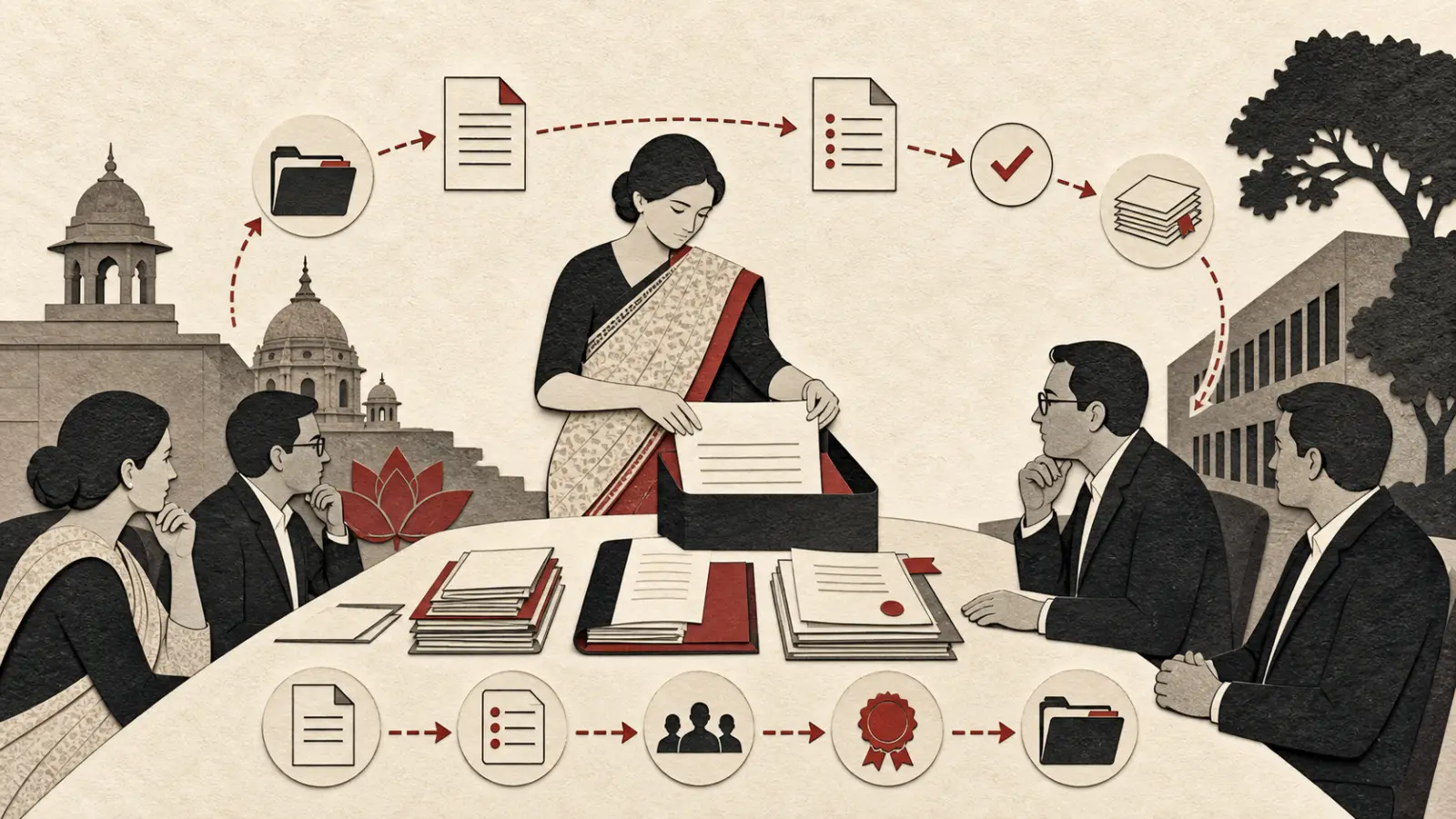
A board pack often looks like a folder of PDFs. Operationally, it is a chain of decisions: a business owner raises an item, the secretarial team checks authority and timing, reviewers settle the paper, directors receive an approved version, and the company preserves what was considered and decided. When those stages live in email, the final record becomes difficult to explain.
This board meeting document workflow for India focuses on provenance, controlled access, review, and closure. It does not interpret a meeting requirement or determine whether a particular item needs board approval.
What should start a board meeting document workflow?
Start with an item request, not with an agenda document. A structured request makes the proposed decision visible before drafting begins. It should identify the sponsoring function, proposed outcome, background materials, requested meeting, confidentiality needs, dependencies, and the person accountable for factual accuracy.
| Intake field | Why it belongs in the record | Evidence to link |
|---|---|---|
| Proposed item | Creates a stable identity | Request form or instruction |
| Decision sought | Distinguishes noting, discussion, and approval | Draft proposal |
| Business owner | Locates factual accountability | Named sponsor |
| Legal basis flagged | Routes specialist review without deciding it | Counsel or secretary note |
| Conflicts and access | Supports restricted handling | Disclosure or access decision |
| Supporting material | Prevents detached attachments | Source files and data owner |
| Meeting target | Enables coordination | Approved calendar entry |
The company secretary or other authorised professional can then decide how the item should be handled under the organisation's governance framework. The Companies Act, 2013 on India Code is an official legislative source. The Ministry of Corporate Affairs publishes rules, notifications, circulars, and filing services within its remit. Teams should use current official material and entity-specific records rather than a copied checklist.
How should an agenda item move from request to approved paper?
Give each item its own workflow. A single board-pack status hides whether one paper is ready while another is awaiting figures or legal review.
- Register: create an item ID, sponsor, target meeting, and access class.
- Scope: record the decision sought and the reviewers required.
- Draft: assemble the paper from identified sources using the current template.
- Review: collect comments in a controlled version and resolve them visibly.
- Approve: capture the authorised release decision for the exact file.
- Publish: place the released paper in the director-facing pack.
- Close: link the item to attendance, discussion record, decision, action, and minute.
Do not treat a filename containing “final” as approval. Record who approved which version, for what meeting, and when. Gotham's guide to legal document naming and version control offers a fuller pattern for stable names, states, and issued copies.
Which sources and standards should the secretarial team map?
The source map depends on the company. Keep it in the workspace as a maintained register rather than embedding legal conclusions into automation.
| Source class | Operational use | Verification question |
|---|---|---|
| Companies Act and rules | Identify provisions for professional assessment | Is the text current and applicable? |
| Articles of association | Capture entity-specific governance | Is this the adopted version? |
| Secretarial Standards | Inform meeting and minute controls where applicable | Has the current text and guidance been checked? |
| SEBI material | Route listed-entity requirements | Is the entity and event within scope? |
| Board or committee charters | Define internal authority and reporting | Has the charter been amended? |
| Prior decisions | Identify continuing actions and delegated authority | Is the relied-on record approved? |
The Institute of Company Secretaries of India publishes Secretarial Standards and related professional resources. Listed entities can consult the SEBI legal portal for regulations, circulars, and other official material. A workflow should store the source, retrieval date, and reviewer conclusion. It should not convert a source register into an automated legal answer.
How should the board pack be assembled and released?
Assemble by reference. Each paper remains an independently controlled record with its own owner, version, approval, and access class. The pack manifest then points to those records in the agreed order. This avoids rebuilding an opaque PDF whenever one item changes.
A release checklist can ask:
- Is every item tied to an approved agenda entry?
- Does each paper show its owner, version, status, and relevant date?
- Are factual assertions traceable to a source or accountable owner?
- Have legal, finance, compliance, or specialist reviews been completed where routed?
- Are annexures present, readable, and correctly ordered?
- Are conflicts and restricted items reflected in access controls?
- Does the manifest identify the exact files released?
- Has the authorised releaser approved this edition?
Late changes should create a new pack edition with a reason and notification record. Do not silently replace a director's copy. Preserve the prior edition, show what changed, and record who received the update.
How can sensitive papers be shared without losing control?
Board material may contain personal data, price-sensitive information, privileged communications, transaction terms, or security details. Apply least-privilege access at item level where needed. Separate drafting access from director distribution, and separate ordinary items from conflict-restricted material.
Useful controls include authenticated access, named recipients, time-bound guest access, download policy, watermarking where appropriate, encryption, access logs, and a documented revocation path. The organisation's legal and security teams should decide the design based on the information and applicable obligations. Gotham's security overview explains the product's security posture, while practice workspaces show how matter documents and tasks can be kept together.
Email may remain a notification channel, but it should not be the authoritative pack. A notification should lead to the controlled record and state the edition. If offline distribution is necessary, record the exported file, recipient, method, and later withdrawal or replacement.
What should happen during the meeting?
The meeting workspace should make current material easy to identify without encouraging informal alteration. Record attendance and participation through the approved secretarial process. Keep declarations, recusals, restricted access events, presentations, tabled documents, and changes to proposed wording linked to the relevant agenda item.
Use a live decision log as working evidence, clearly labelled as unapproved. It can capture:
| Event | Working record | Later destination |
|---|---|---|
| Item taken up | Sequence and time note | Meeting record |
| Additional paper tabled | File identity and source | Pack supplement |
| Conflict handled | Restricted attendance note | Approved minute as appropriate |
| Decision reached | Neutral decision text | Resolution and minute workflow |
| Action assigned | Owner and dependency | Action register |
The working log is not the approved minutes. Its value is continuity: the drafter can reconcile what happened against the agenda, tabled material, and decisions without relying on memory.
How should resolutions, minutes, and action items connect?
Create linked but distinct records. A resolution records the approved decision text. Minutes document the meeting through the applicable professional process. An action item records follow-through. Combining all three into one editable document makes ownership and status unclear.
The closure workflow should move from working note to draft, professional review, circulation or comment handling where applicable, approval or entry, and controlled preservation. Preserve comments and changes in a restricted audit trail. Only the issued record should appear as approved.
For each action, capture the decision source, owner, expected evidence, dependencies, status, and closure approval. Avoid reducing substantive judgment to a green tick. The action owner should attach the resulting filing, contract, communication, report, or other evidence. A reusable knowledge management system can help teams preserve approved records without letting drafts contaminate precedent collections.
What should an audit trail prove?
An audit trail should answer a practical narrative: who requested the item, what sources informed it, who reviewed the paper, which edition directors received, what changed, what was considered, what was decided, and how the resulting action closed.
| Audit test | Strong record | Weak signal |
|---|---|---|
| Item provenance | Request, sponsor, and source links | Attachment with no owner |
| Version control | Immutable editions and release approval | Replaced “final” file |
| Access | Recipient and restricted-item logs | Shared mailbox trail |
| Decision chain | Paper, meeting event, resolution, minute | Decision copied into chat |
| Follow-through | Linked action and closure evidence | Manually changed status |
| Preservation | Approved record under retention control | Personal drive archive |
Retention, inspection, access, and production decisions require professional assessment under current requirements and company policy. The system should execute approved classifications and holds, preserve superseded records where required, and prevent routine deletion from bypassing an active hold.
How can a team introduce the workflow without disrupting the board cycle?
Begin with the document map. Identify the real artifacts used from item request through action closure, then assign an owner and status vocabulary to each. Configure one representative board or committee cycle with synthetic material. Test late papers, recusals, restricted items, an unavailable approver, and a replacement pack edition.
After the test, publish a concise operating guide and support route. The useful question is not whether every screen was used. It is whether an authorised colleague can reconstruct the record without searching personal inboxes.
Teams considering an evidence-linked workspace can explore Gotham's legal workflows, review corporate practice capabilities, read the security overview, or contact Gotham. Gotham supports document and workflow coordination; the company and its qualified advisers remain responsible for governance decisions and the legal effect of every record.