Short answer
AI can assist a patent team with organizing invention disclosures, comparing technical materials, preparing draft text, and checking consistency. It cannot replace the people responsible for deciding what the invention is, who conceived it, what can safely be shared with a tool, what the application should say, or whether a filing is ready.
For U.S. inventorship, use the USPTO’s November 2025 revised guidance: the same legal standard applies whether or not AI was used. Only natural persons may be named as inventors. The 2025 guidance superseded the 2024 AI-specific significant-human-contribution analysis, including applying the Pannu factors to assess AI-assisted inventorship. It retains Pannu for ordinary joint-inventorship analysis among multiple natural persons. Do not rely on the superseded AI-specific analysis as the current test. The question for a human inventor remains whether that person conceived the claimed invention under the traditional conception standard. Where multiple people contributed, ordinary joint-inventorship principles apply among the human contributors. USPTO, revised inventorship guidance (Nov. 2025); Federal Register notice, 90 FR 54636
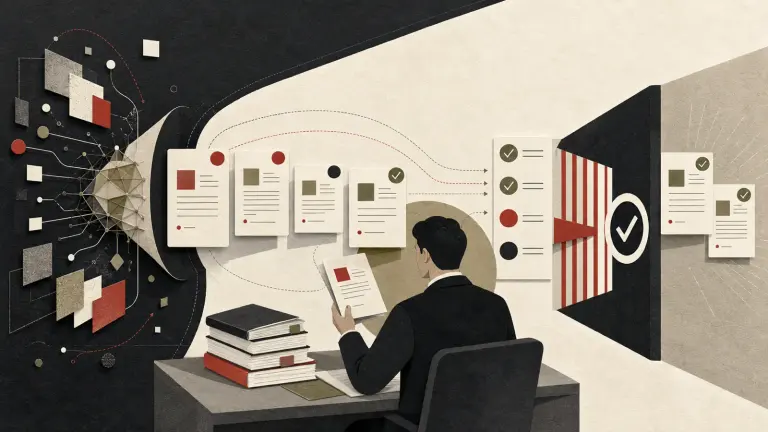
A practical firm workflow therefore puts AI inside a controlled, reviewable process: first establish client authority and information boundaries; then capture human technical contributions; use tools only for bounded support; verify every technical, factual, legal, and citation-dependent statement; and require a responsible practitioner to approve and sign filings after reasonable inquiry. The operational checklists and documentation practices below are recommended firm controls, not procedures specifically mandated by the USPTO. For a broader framework to evaluate legal AI accuracy and govern legal AI data, see the linked guides; neither substitutes for patent counsel’s matter-specific review.
1. Set the matter’s information boundary before using a tool
At intake, identify the client, matter, relevant inventors and contributors, ownership or assignment questions, known public disclosures, and the business decision the client is considering. Ask about planned demonstrations, offers for sale, publications, standards submissions, investor materials, and any foreign filing plans. Route potential deadline or foreign-rights issues to patent counsel promptly. Do not use a general-purpose chatbot as an intake channel for confidential invention details.
Recommended firm control: Before any matter information is entered into an AI service, the responsible team should review the service’s data handling, retention, access, model-training, and deletion terms; the firm’s approved-tool policy; client instructions; and any applicable engagement or protective-order restrictions. Use an approved environment and the minimum information needed. If the service’s protections or the client’s authorization are unclear, do not submit the confidential material; ask counsel to choose a safe alternative. De-identification can reduce exposure but does not itself guarantee confidentiality or remove all identifying details. A legal AI data-processing agreement checklist can help structure review of the service’s written terms.
The USPTO’s AI practice guidance specifically warns that use of AI systems can expose client-sensitive or confidential information to third parties. It also points practitioners to existing competence, diligence, communication, supervision, and confidentiality duties. Those practitioner-duty discussions remain useful. However, inventorship-specific examples in the 2024 notice use the then-current 2024 inventorship framework, including significant-contribution language; read those examples subject to the November 2025 revised guidance, which rescinded that framework. They do not establish a current AI-specific inventorship test. The relevant analysis depends on the tool and matter; a generic disclaimer or vendor label is not a substitute for checking the actual data flow. USPTO, AI tools in practice before the USPTO, 89 FR 25609
Recommended firm control: Record the tool, approved use, data category, reviewer, and any client authorization required by firm policy. Keep invention materials and AI interaction records in the matter’s authorized system, with access limited to the team that needs them. These specific recordkeeping and access steps are suggested controls, not a USPTO-prescribed checklist.
2. Build a source-backed invention record
Recommended firm control: Interview each potential inventor separately where appropriate, then reconcile the accounts with the team. Capture dated, specific evidence of the problem, proposed solution, alternatives considered, experiments, prototype behavior, and the point at which the invention became a definite and workable idea. Distinguish what a person contributed from what a tool suggested, what another person contributed, and what was already known or routine. This interview and evidence-building process is a recommended practice, not a USPTO-mandated procedure.
Recommended firm control: For each material technical proposition, link to its source: inventor notes, lab records, code or design history, test data, drawings, or other contemporaneous evidence. Preserve versions and dates under the firm’s normal records policy. Do not edit or “improve” original records to make them align with a draft. If AI-assisted work generated an idea later adopted by a human, document the human’s own understanding, selection, adaptation, and development rather than assuming that prompt history alone answers inventorship. These provenance practices support review but are not a separate evidentiary test or specific USPTO recordkeeping mandate. For broader controls on preserving and reviewing AI event records, see our legal AI audit logging guide.
The revised 2025 guidance centers inventorship on conception: a specific, settled idea of the complete and operative invention, rather than only a goal or research plan. That question is fact-intensive. A tool’s output may be useful evidence about the process, but it does not decide who conceived a claimed invention. Federal Register, Revised Inventorship Guidance for AI-Assisted Inventions
Legal review gate: A patent practitioner evaluates the human contributions and evidence relevant to conception and resolves gaps or disagreements before naming inventors. Counsel should apply the ordinary conception standard and, where multiple natural persons are involved, ordinary joint-inventorship principles, including Pannu; do not add an AI-specific significant-contribution-per-claim test. Counsel should separately assess whether the particular facts trigger an existing disclosure duty under those current rules. AI use alone does not create a new inventorship or disclosure test.
3. Use AI for bounded support, with traceable inputs and outputs
Once the matter boundary is set, a team may use an approved tool for discrete tasks such as organizing interview notes, generating a list of questions for an inventor, comparing a draft against source documents, identifying inconsistent terminology, or proposing alternative ways to explain a mechanism. Ask the system to label uncertainty and point to the source for each extracted fact. Keep generated material clearly marked as unverified working text.
Do not treat a generated description, embodiment, result, citation, claim limitation, or prior-art summary as established fact. A model can invent details, silently combine embodiments, omit limiting conditions, or transform a possibility into a claimed result. Do not ask it to fill in missing experimental data or technical implementation detail. Do not treat an AI-generated claim set as an inventorship determination, patentability opinion, claim-scope strategy, or filing instruction.
For each generated technical statement, a qualified reviewer should compare it with the inventor’s source material and ask: Is this actually disclosed? Does it add a feature the inventor did not conceive? Is the feature necessary, optional, or merely a suggested variant? Does the language preserve the inventor’s meaning? Is there support for the full range of what the draft says? For computer-implemented inventions, the disclosure and claim language need technical review for the applicable written-description, enablement, and other requirements; AI fluency is not proof of support.
Recommended firm control: Maintain provenance from source to draft: source item, generated passage or suggestion, human edits, verification performed, and final disposition. If the firm cannot explain where a substantive statement came from, remove it or obtain and verify the missing support. This traceability practice is recommended for quality control, not specifically mandated by USPTO guidance.
4. Draft and review the application as a legal and technical document
A practitioner may use AI-assisted drafting, but the USPTO says submitted papers remain subject to existing signature and certification requirements. The party presenting or submitting the paper must review and verify it; relying on a tool’s accuracy alone is not a reasonable inquiry. Check facts, claims, cited authorities, quotations, reference identifiers, procedural statements, and consistency with the client’s evidence. Confirm that arguments have a basis in law and fact, and that the description and drawings accurately disclose what the inventors can support. USPTO, 89 FR 25609, section III
Use independent source checking for every legal authority and patent reference. Open the authority itself and verify the proposition, current status, jurisdiction, pin cite, and whether later authority changes the result. Review every claim limitation against the application’s disclosure and the inventorship record. Check that an AI-produced alternative embodiment has not slipped into the specification as if it came from the inventors. If the tool contributes a statement or information about an inventor’s interaction with AI, counsel should assess whether the facts trigger an existing disclosure duty, applying the current conception and ordinary joint-inventorship rules. The 2024 practice notice’s examples that refer to significant human contribution reflect superseded inventorship guidance and must be read subject to the November 2025 revision. AI use alone does not create a new inventorship or disclosure test.
For applications, separately confirm the selected filing route, application type, inventor information, applicant/ownership details, required documents, fees, signatures, priority claims, and any foreign-filing or export-control issue with counsel. Do not assume a provisional filing is a complete placeholder: the later-claimed subject matter must be supported by the provisional disclosure to receive its benefit. The USPTO states that a provisional generally has a 12-month pendency and does not itself mature into a patent; dates and available options require matter-specific review. USPTO, Provisional Application for Patent
Checkpoint: The responsible registered practitioner performs and records a final review against the evidence and filing instructions, resolves all open questions, and personally authorizes the submission. A fluent draft is not a filing-ready draft.
5. Protect the record, monitor the matter, and learn from corrections
Recommended firm control: Preserve the final filed version, source set, inventor-confirmed facts, material tool outputs, reviewer decisions, and submission receipt under the firm’s retention and access rules. Keep AI logs only as permitted by client instructions, law, and firm policy; logs may themselves contain confidential information. Apply the team’s ordinary docketing and independent deadline checks. An AI-generated calendar entry is not a docketing control.
If a filed statement is later found to be inaccurate, incomplete, or inconsistent, escalate it to the responsible practitioner immediately. The USPTO guidance explains that existing duties include candor and good faith and may require correction or disclosure; counsel must assess the facts and appropriate action. Do not quietly overwrite the internal record or let a tool draft a correction without legal review.
| Stage | AI may assist with | Human approval gate | Stop and escalate when |
|---|---|---|---|
| Intake | Organizing non-sensitive intake fields | Client/matter authority and data boundary | Confidentiality, ownership, disclosure, or deadline facts are unclear |
| Invention record | Summarizing approved notes; identifying gaps | Inventor confirmation and counsel’s conception analysis | The source does not support a proposed feature or inventors disagree |
| Drafting | Editing, consistency checks, candidate wording | Technical review, claim-to-disclosure check, legal review | A tool adds facts, results, embodiments, citations, or legal conclusions |
| Filing | Checklist preparation; clerical comparison | Practitioner’s reasonable inquiry, signature, and submission approval | Any factual, legal, inventorship, priority, or filing requirement remains unresolved |
| After filing | Organizing approved records and docket inputs | Independent docket control and practitioner review | A possible error, missed date, new material information, or unauthorized disclosure arises |
Final review checklist
- Matter authority, client instructions, confidentiality, data handling, and approved-tool status are confirmed.
- Potential inventors and their contributions are tied to dated source evidence; no AI system is named as inventor.
- The current November 2025 inventorship guidance is used; the rescinded 2024 AI inventorship framework is not presented as current law.
- Every substantive technical statement, embodiment, claim limitation, result, citation, and legal proposition is independently checked.
- The application’s disclosure supports the proposed claims; generated content has not been attributed to inventors without evidence.
- Counsel has evaluated existing candor, disclosure, signature, competence, communication, supervision, confidentiality, and filing duties.
- Filing route, priority, applicant/inventor data, signatures, fees, disclosure and foreign-filing questions, and dates receive matter-specific review.
- A responsible practitioner has completed and recorded a reasonable inquiry and approved the final paper.
- Original and final records are preserved under the firm’s policy, with restricted access and independent docket controls.
Questions
Can an AI system be named as a U.S. patent inventor?
No. The current USPTO guidance says only natural persons may be named. AI can be a tool used in the inventive process, but it is not an inventor. For a human-assisted invention, apply the ordinary conception standard to the human contributors. The 2025 guidance rescinded the separate February 2024 AI inventorship framework.
Does using AI require a special inventorship test or a blanket disclosure to the USPTO?
The 2025 guidance creates no separate inventorship test. Separately, the USPTO’s AI practice guidance says there is no general requirement to tell the Office that AI was used to draft a paper. Existing duties still apply, including disclosure of information material to patentability and compliance with signature certifications. Counsel should assess whether the specific facts trigger an existing disclosure duty under the current conception and ordinary joint-inventorship rules; AI use alone creates no new inventorship or disclosure test.
May a patent firm use generative AI to draft an application or Office Action response?
The USPTO has not prohibited AI-assisted drafting, and it does not impose a general duty to disclose tool use. But the person presenting the paper remains responsible for reviewing and verifying its contents and making the required certifications after reasonable inquiry. The tool does not assume the practitioner’s duties of competence, diligence, communication, confidentiality, or supervision.
Is it safe to paste an invention disclosure into a public AI chatbot?
Do not assume so. The answer depends on the service’s actual terms and data handling, the matter’s confidentiality obligations, client authorization, and firm policy. Review those conditions before sharing anything, minimize the data, and use only an approved route. If the protections are unclear, keep the information out of the service and ask counsel. The USPTO specifically flags confidentiality risks from disclosure to third parties through AI systems.
Does filing a provisional application secure everything the AI or inventors later describe?
No. A provisional is not examined and does not itself become a patent. To obtain the provisional’s benefit for later-claimed subject matter, that subject matter must have support in the provisional. The USPTO describes a general 12-month pendency, but filing choices and deadlines are fact-specific; have patent counsel review the actual disclosure, dates, foreign plans, and required follow-on filings.
This is general information, not legal advice or a substitute for a registered patent practitioner’s judgment. It does not decide inventorship, patentability, claim scope, ownership, confidentiality, export controls, foreign rights, filing strategy, or deadlines in any matter. Verify current primary sources and matter facts with qualified counsel.
How Gotham researches and reviews field guides