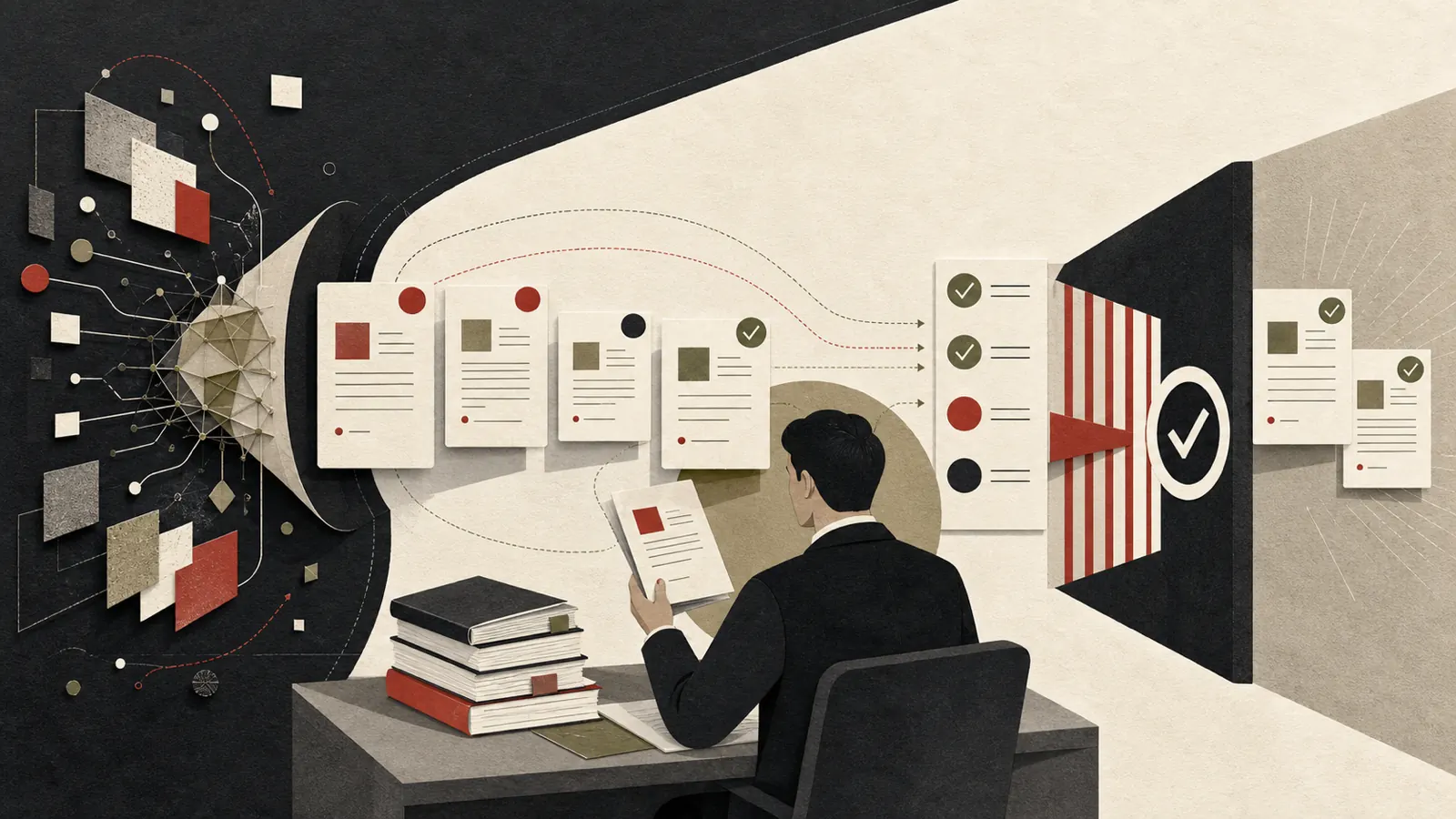
A legal AI pilot should produce a decision, not a demo. It should show whether a clearly defined system, configuration, data flow, and workflow can help an identified user group under controlled conditions. The pilot must also expose the review effort, failure modes, security boundaries, and operational work that a polished answer tends to hide.
The pilot sits inside the legal AI build-versus-buy framework. Test internal and vendor options against the same bounded workflow, evidence set, mandatory gates, and acceptance criteria so that polish or organisational preference does not decide the outcome.
The NIST AI Risk Management Framework offers Govern, Map, Measure, and Manage functions for organising risk work. ISO/IEC 42001 provides an AI management-system structure, and NIST Cybersecurity Framework 2.0 connects governance with protection, detection, response, and recovery outcomes. MeitY is an official starting point for Indian digital policy materials. These frameworks inform a pilot; they do not determine the obligations for a particular deployment.
Which use case makes a sound first pilot?
Choose a task that is frequent enough to observe, narrow enough to evaluate, and reversible when the system fails. Good candidates have known source material, a qualified reviewer, and a clear handoff. Avoid beginning with autonomous external communication, final professional decisions, or a workflow whose errors cannot be detected before harm.
Write a one-page use-case charter:
| Charter item | Required detail |
|---|---|
| User | Named role, skill, supervision, and access boundary |
| Task | Exact starting point and expected work product |
| Sources | Authorised corpus, jurisdiction, versions, known gaps |
| System | Product, deployment, model route, configuration, integrations |
| Review | Who verifies what, using which source evidence |
| Boundaries | Prohibited data, actions, users, and external delivery |
| Decision | Pilot owner, stage gates, stop conditions, change triggers |
Do not charter “use AI for research.” A better scope is “prepare an internal first-pass authority list for a defined question using a specified source collection, with every proposition independently verified before inclusion in work product.” The narrower wording makes tests, reviewer effort, and access needs visible.
What should be true before any user test begins?
Complete a readiness gate before live matter information enters the system. Map the data flow, identify system and use-case owners, review vendor and model terms, configure identity and access, set retention and deletion, define logs, and create an incident route. Use synthetic or public data to verify the controls.
Readiness checklist:
- The approved use, users, data classes, and deployment are documented.
- User and administrator permissions are tested, including denials.
- Processing locations, providers, subprocessors, retention, and training use are understood.
- Test sources are authorised and separated from hidden evaluation material.
- Prompt, output, citation, and reviewer records have defined treatment.
- Support, security, privacy, legal, and matter escalations have named contacts.
- Manual fallback is available if the system is paused.
- Material changes require reassessment before continued use.
Review the provider’s security information, but validate selected settings and contracts rather than relying on general assurances. The intended legal workflow should be mapped end to end, including intake, source selection, generation, review, export, approval, and retention.
How should the evaluation set be built?
Build representative tasks from appropriately authorised or sanitised completed work. Include ordinary examples and difficult cases: ambiguous questions, conflicting sources, recent changes, poor scans, tables, cross-references, incomplete records, false premises, and requests outside scope. Keep a holdout set that is not used to tune prompts or demonstrate the system.
Qualified reviewers should define expected propositions, acceptable sources, material omissions, disqualifying errors, and reasonable variation. For extraction tasks, establish field-level truth and source locations. For research, record jurisdiction, cut-off date, authority hierarchy, contrary material, and the limits of the expected answer.
Score dimensions separately:
- Source validity and correct citation metadata.
- Support between each proposition and cited passage.
- Jurisdiction, currency, and authority treatment.
- Completeness, including exceptions and adverse material.
- Extraction and calculation accuracy where relevant.
- Calibration when information is missing or ambiguous.
- Permission adherence and absence of restricted leakage.
- Reviewer time, corrections, and unusable outputs.
The deeper legal AI accuracy evaluation provides a test-set and severity method. Do not average a fabricated authority into a high aggregate score. Define workflow-specific disqualifying and material failures before seeing the results.
What stage gates should control expansion?
A stage gate is a decision supported by evidence, not a meeting date. Each gate should name the accountable decision-maker, required artefacts, permitted next scope, and stop conditions.
| Gate | Evidence | Allowed next step |
|---|---|---|
| Charter | Use case, owners, scope, consequences | Prepare controlled environment |
| Readiness | Architecture, controls, terms, runbooks | Run benchmark set |
| Benchmark | Results by task and severity, defect register | Supervised internal pilot |
| Supervised use | Reviewer effort, incidents, workflow feedback | Bounded production trial |
| Production decision | Residual risk, operations plan, approvals | Named production scope only |
Stop conditions might include restricted data crossing a boundary, fabricated authority reaching a reviewer without warning, inability to reconstruct output sources, unresolved privileged access, deletion failure, or a model/configuration change that invalidates results. A stop is a designed control, not an admission that the pilot failed.
Avoid expanding users, matters, jurisdictions, or integrations simultaneously. Change one dimension where possible, then confirm whether evaluation and controls still represent the new scope.
How should people work during the supervised pilot?
Train participants with scenarios, not feature tours. Show approved and prohibited data, how to select sources, how to challenge output, which facts and authorities require independent checking, how to record a decision, and when to stop. Give reviewers enough time. Adding an approval button does not give a rushed lawyer the conditions for meaningful oversight.
Use a review card for every material output:
- Is the task and jurisdiction correctly framed?
- Can every material statement be traced to a source passage?
- Were citations opened and independently checked?
- Are missing sources, uncertainty, and limitations visible?
- Did the output remain inside matter and user permissions?
- Was restricted information excluded from unapproved destinations?
- Is the approving person qualified and authorised?
- Is the delivered version distinguishable from the machine draft?
Observe shadow work. Participants may move text into personal notes, public tools, or email when the pilot workflow is awkward. Ask why. Fixing usability and process friction can be as important as tuning prompts.
How are security, privacy, and incident handling tested?
Run planned exercises instead of waiting for a real event. Test a wrongly shared matter, malicious instruction inside an uploaded document, lost device or session, former user, bulk export, suspicious connector, model-provider outage, and accidental sensitive submission. Verify detection, containment, evidence preservation, decision authority, and recovery.
During an exercise, participants should stop the affected workflow without deleting evidence, preserve relevant identifiers and timestamps, notify the approved channel, restrict access through authorised steps, and document the decision. The organisation’s authorised legal and security leaders determine any notification or reporting response.
The pilot should also verify data minimisation and lifecycle. Delete a synthetic record and trace originals, parsed text, embeddings, prompts, outputs, logs, caches, and backups according to the documented design. Test export and exit before production; portability discovered only after termination is too late.
Which measures support a production decision?
Use a balanced evidence set. Quality results, severity distribution, reviewer effort, adoption, unresolved issues, control performance, support burden, and workflow cycle observations all matter. Avoid product claims or universal benchmarks. Pilot evidence is local to the tested configuration and scope.
Report results by task type, source type, jurisdiction, user role, and difficulty. Show sample size and uncertainty. Separate model failures from retrieval, parsing, permission, integration, and training failures. A single “accuracy” or “time saved” figure hides the work needed to manage risk.
The production decision record should state:
- What exact scope was tested.
- Which evidence passed and which remains limited.
- What controls and human review are mandatory.
- Which users, data, matters, and actions remain prohibited.
- What defects are accepted temporarily and by whom.
- Which changes invalidate the decision.
- When the owner will review actual use and evidence again.
If evidence is mixed, approve a narrower scope, extend the pilot, redesign the workflow, or stop. Procurement momentum should not decide technical readiness.
What turns a pilot into a sustainable operating process?
Handoff ownership before the pilot team disbands. Operations need user administration, model and configuration change control, evaluation regression tests, access reviews, source-quality checks, deletion jobs, incident exercises, support triage, and a current approved-use register.
Maintain a compact evidence pack: charter, architecture, risk and control register, test set, results, issues, training, approvals, runbooks, data-lifecycle map, and decision history. Schedule review based on risk and change. Trigger early review for a new model, connector, data class, jurisdiction, external delivery path, or material incident.
Teams can explore practice use cases, compare the design with legal workflows, and talk to Gotham about planning a bounded evaluation. A strong pilot does not promise that AI is generally safe or useful. It proves what happened in a specific test and defines the conditions under which the organisation is prepared to proceed.