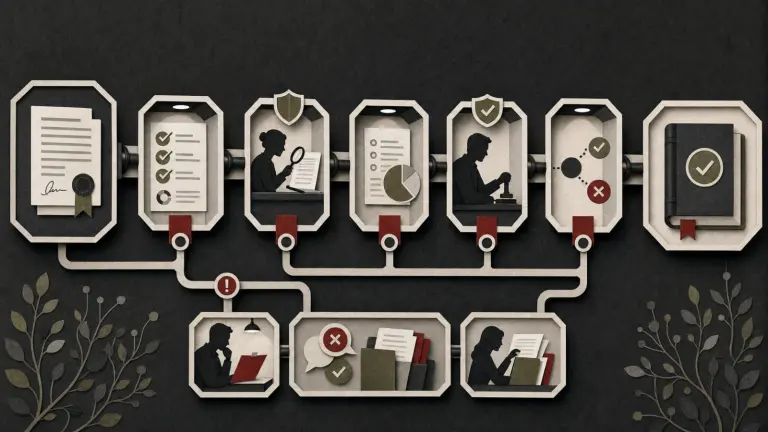
When a Japanese client pays late, start by building a reliable record of the assignment, agreed price and payment date, work performed, acceptance, invoice and follow-up. A signed paper contract is useful, but it is not the only document that may help show what the parties agreed. Chat logs, email, purchase orders, delivery records and a part-payment acknowledgment can fit together into a coherent chronology.
Do not begin by assuming every independent contractor is covered by the same law as an employee. Japan’s Act on Ensuring Proper Transactions Involving Specified Entrusted Business Operators, commonly called the Freelance Act, came into force on 1 November 2024. It regulates qualifying transactions and imposes different duties depending on statutory definitions and the engagement. The Ministry of Health, Labour and Welfare’s freelance information page describes written or electronic transaction terms and the general requirement to set and pay compensation within 60 days. The Government of Japan overview explains the rule and a defined re-subcontract exception. The Act itself is the primary source; check its current text and definitions before relying on an administrative remedy.
First identify the relationship and the transaction
The label “freelancer,” “consultant,” “業務委託” or “contractor” on an invoice does not settle legal status by itself. If the practical relationship looks like employment, control, working arrangements and the full facts may matter. Keep a separate question open: even if you are genuinely independent, does this particular commission fall within the Freelance Act?
Record the parties’ legal names, where each is established, what service or goods were ordered, when the order was placed, whether you subcontracted, and whether the commissioning party has employees or fits another statutory category. Use this first-pass eligibility matrix, then check the Act and current official guidance for the specific duty:
| Screen | Statutory starting point | Why it matters |
|---|---|---|
| Provider side: “specified entrusted business operator” | Generally an individual business operator who does not use employees, or a corporation with one representative, no other officers and no employees. The Act's employee definition has its own threshold; do not substitute a casual headcount. | A provider who does not meet this definition may fall outside this Act even if commonly called a freelancer. An employee in one job can still qualify for a separate side business. |
| Commissioning side: “business operator” | The transaction-terms disclosure duty can apply to a business operator that entrusts qualifying work to a specified entrusted business operator. | Do not infer that the client must be a large company for every statutory duty. |
| Commissioning side: “specified entrusting business operator” | Generally includes an individual business operator that uses employees, or a corporation with two or more officers or that uses employees. | Further payment, prohibited-act, work-environment and termination-related duties can depend on this client category and on the duration/type of the commission. |
| Engagement and timing | Check the commissioned activity, date, any re-entrustment, duration and which specific statutory article is invoked. | Some additional rules use duration thresholds, including one-month or six-month periods; one blanket yes/no answer can misstate coverage. |
The Ministry's official guide explains that the statutory meaning of “uses employees” includes a defined working-hours and expected-duration test and some special treatment of dispatched workers and co-resident relatives. See the MHLW Freelance Act page, the JFTC Act and guidance page, and the Act itself. The Act’s transaction-terms disclosure duties can apply more broadly than some prohibited-act rules. Map each duty to the actual parties and transaction rather than saying simply “the Act applies” or “it does not.”
The general 60-day rule is not a grace period that always begins when a freelancer sends an invoice. The statute describes a payment date within 60 days from receipt of the goods or services, and its treatment of certain re-subcontracts can differ where prescribed information is provided. Contract terms, delivery and acceptance mechanics, and whether the relevant service was received can affect the analysis. Do not advise a contractor to calculate a final deadline from an invoice date alone.
Build one evidence file before writing again
Create a dated timeline and preserve originals. Do not crop away surrounding messages or silently edit a spreadsheet of dates. Keep a working copy for annotations and retain source files in their original form.
| Issue to establish | Useful records | What to note |
|---|---|---|
| Who ordered the work | Purchase order, service agreement, scope email, chat export | Correct legal entity, contact person, order date and authority |
| What was promised | Scope, specifications, milestones, rate card, revisions | Hourly, fixed-fee or milestone basis; expenses and change requests |
| What you delivered | Versioned files, repository history, delivery message, meeting notes | Delivery date, version identifier and method |
| Whether it was accepted | Acceptance email, test results, use in production, requested revisions | Separate acceptance from silence; record objections and responses |
| What is unpaid | Invoice, statement, bank entries, credit notes | Principal, currency, tax treatment, due date and partial payments |
| What the client said | Original email/chat, payment promises, dispute reasons | Preserve full thread, sender identity and timestamps |
Use a clear naming convention such as 2026-04-03_order-email.pdf, and keep a separate index that links each item to a timeline event. For chat, use the platform’s export where available and retain a copy of the device or account record. Screenshots can be useful, but they may omit sender details, dates or context. Preserve the conversation in a form that makes those details visible.
If the client disputes quality or says payment depends on a further change, do not overwrite the delivered version. Preserve the version sent, the specification that applied, the feedback, and any revision offered. A demand that says only “you owe me” is weaker operationally than a reconciliation that explains each invoice line against the order and delivery.
Choose the next route based on the dispute
If no one disputes the amount and the only issue is delay, a concise reconciliation and payment request may resolve it. State the invoice number, amount, currency, due date, work, relevant order, payment already received, and a reasonable response date. Ask the client to identify any disputed line item and its basis. Avoid accusations or threats that exceed the record.
If the client disputes scope, acceptance, quality or authority, first separate what is admitted from what is contested. A written reply can ask the client to identify the specific requirement, version or amount in dispute. For a genuine Freelance Act issue, consult the official MHLW information and the agency responsible for the relevant provisions. The MHLW notes that transaction-properness rules are chiefly administered by the Japan Fair Trade Commission and Small and Medium Enterprise Agency, while employment-environment provisions are chiefly handled by MHLW. Agency complaint procedures are not a substitute for deciding whether to bring a civil claim.
For a civil recovery, the route depends on the debtor, claim amount, contract terms, location, limitation period and evidence. A lawyer can assess whether a demand, negotiation, mediation or court process is proportionate. A payment demand does not guarantee payment or automatically resolve questions of governing law, jurisdiction or limitation. If the client is in financial distress, confirm who the debtor is and whether a parent company or end customer actually owes the money; do not assume group affiliation makes another entity liable.
Example: delayed QA fees
Imagine Aki, a Tokyo-based independent QA tester, receives a chat request from a Japanese software company to test a release for ¥180,000. Aki replies with the deliverables and deadline; the project manager confirms. Aki sends a test report on 10 June, and the company responds with a list of fixes. Aki resubmits on 14 June, the company deploys the release, but an invoice remains unpaid.
Aki should keep the original chat export, the revised scope, both report versions, delivery records, the client’s response, evidence of deployment if legitimately available, invoice and bank statement. Aki should not declare the work “accepted” solely because of silence; deployment and communications are facts to assess. A factual reconciliation can ask whether the company disputes a specific deliverable, amount, or due date. Aki should then assess whether the Freelance Act applies to the parties and order, and separately obtain advice on any civil route. The example does not establish what a court or regulator would decide.
Common mistakes to avoid
- Treating a late invoice as proof that the client agreed to every term.
- Relying on one cropped screenshot while discarding the original thread.
- Applying employee wage rules to a true independent contractor without checking status.
- Assuming the Freelance Act covers every arrangement or every commissioning party.
- Counting the statutory payment period from invoice issuance without checking receipt and any exception.
- Threatening criminal action or public disclosure to pressure payment.
- Sending multiple inconsistent demands with different balances.
- Missing limitation or cross-border questions while waiting for informal promises.
A practical checklist
- Identify the contracting parties and the person who placed the order.
- Assemble the agreement, work order, scope messages, rate, milestones and change approvals.
- Preserve the delivered files and proof of when and how they were sent.
- Record acceptance, objections, requested corrections and any use of the work.
- Reconcile invoices, credits, partial payments, taxes, currency and due dates.
- Check whether the relationship is employment or independent contracting on the facts.
- Test the Freelance Act’s definitions and transaction-specific duties against current official text.
- Send one accurate written reconciliation and ask for a specific response.
- Escalate to the correct regulator or Japanese lawyer if the legal basis, debtor or amount is contested.
Questions freelancers ask
Is a written contract required before a freelancer can claim payment in Japan?
Not necessarily. A contract can arise from agreement and conduct, but proving its terms may be more difficult without a signed document. The Freelance Act also requires qualifying commissioning businesses to disclose specified transaction terms in writing or by electronic means; that statutory duty is distinct from whether a contract exists.
Can Line or email messages prove the agreed fee?
They can form part of the evidence. Preserve the complete thread, participant identity, timestamps, attachments, and any later changes. Pair messages with the order, delivery, invoice and payment record; a message in isolation may not show the full agreement.
Does the 60-day Freelance Act deadline run from my invoice date?
Do not assume so. The general rule is framed around receipt of the goods or services, while qualifying re-subcontract transactions have a specific alternative mechanism. Check the actual transaction and current statutory text.
What if I am called a freelancer but work under close company control?
The title used in a contract or invoice is not conclusive. If the relationship may be employment, obtain advice on worker classification before choosing a remedy. Employment-related protections and the Freelance Act address different legal questions.
Can I contact a government office instead of filing a claim?
Possibly, depending on the duty and the office’s remit. MHLW’s page identifies the government bodies involved in enforcement. A report may lead to administrative attention but is not the same as a judgment ordering payment to you.
Should I keep doing work while invoices are overdue?
That depends on the contract, current scope, consequences of suspension and business relationship. Before stopping, check notice and termination clauses and document the unpaid amount. A Japanese lawyer can assess the safest response where the sums are material.
What if the client promises to pay in installments?
Write down the amount, dates, allocation to invoices and what happens if an installment is missed. Ask an authorized representative to confirm. Preserve the original debt documents; an informal promise should not replace a carefully reviewed settlement if the claim is substantial.
Do I need to translate my chat records?
For internal review, create a faithful translation while retaining the Japanese original and identifying who prepared the translation. For a formal procedure, ask counsel or the receiving authority about translation and certification requirements.
For related Japan-specific evidence questions, see the guides to contractor software and IP and electronic contract evidence. For document workflow support, explore Gotham workflows or contact the team. These resources provide operational context, not Japanese legal rules.
Keep a payment ledger that can be reconciled to the source documents. For each milestone, record the agreed amount, completion or delivery date, acceptance status, invoice date, contractual due date, amount received and balance. If a partial payment arrives, show how you applied it and ask the client to confirm any remaining disputed item. Do not rewrite the original invoice to hide a disagreement; issue a clearly dated credit note or revised invoice only when appropriate under the contract and accounting rules. A clean ledger helps counsel, a mediator or a court understand the amount claimed without mistaking a running balance for proof that every component is admitted.
Questions about late freelance payments in Japan
Does Japan's Freelance Act apply to every freelancer?
No. The Act uses statutory definitions of a freelancer and commissioning business and covers qualifying transactions. Check the current Act and guidance against the parties and work arrangement.
Does the 60-day rule run from my invoice date?
The general rule concerns payment within 60 days from receipt of the goods or services, with a statutory exception for certain re-subcontracted work. Do not assume the invoice date resets the legal clock.
Can chat messages prove a freelance contract?
They may help show the terms and course of dealing, but their weight depends on the full record. Preserve original exports and context alongside work and payment evidence.
Should I send another invoice or a demand?
First reconcile the amount, work, due date and prior payments. Then send a calm written notice that identifies the supporting records and asks for a response by a reasonable date.
Can I report a late payment instead of suing?
Depending on the transaction, the Freelance Act may provide administrative reporting routes. That is distinct from a civil claim to recover a disputed debt; confirm the correct agency and route.
This article is general information about Japanese freelance payment records, not legal advice. The Freelance Act and other rules apply only when their definitions and conditions are met. Consult qualified Japanese counsel or the relevant authority about a live dispute.
How Gotham researches and reviews field guides