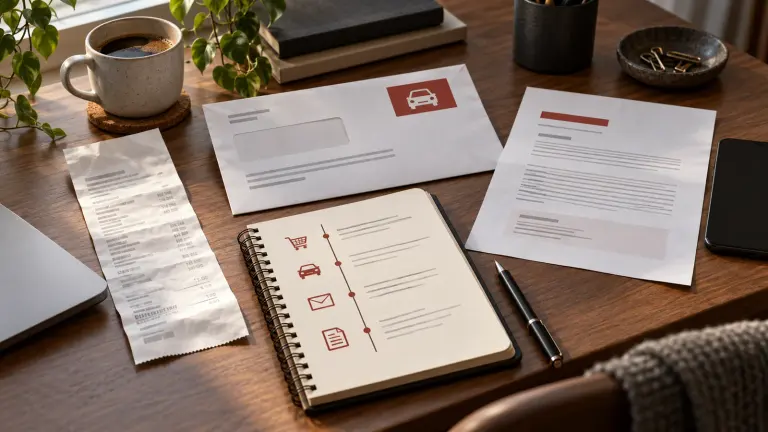
If a retailer tells you a private parking charge will be cancelled and a later letter arrives from a recovery agent, keep the two events separate while you check the paperwork. A receipt or complaint reference may support what you were told, but it does not by itself prove that the parking operator received or accepted an instruction to cancel. The next step is to identify who issued the parking notice, who made the assurance, what the later letter actually is, and whether any deadline is running.
This guide is for England and Wales. It does not determine whether a particular parking charge is owed or whether a retailer’s statement changed the agreement. Start with the original notice and the alleged cancellation message, not the wording on a later demand alone.
Build a dated record before replying
Make a short timeline with the parking date, the date on each notice, the retailer visit, the conversation or complaint, and each later letter. Keep the original receipt and any online complaint confirmation. If the assurance was verbal, write down when it happened, the store location, the department or role of the person you spoke to, the words you remember, and any reference number. Label recollection as recollection; do not convert it into a written confirmation you never received.
Keep separate copies of:
- the parking notice and any photographs or site information supplied with it;
- the receipt, transaction record or proof that you were a customer;
- the retailer’s complaint reply, reference number, or call notes;
- every letter or email from the parking operator and any recovery agent;
- the envelope or message header showing when correspondence arrived.
Do not discard a later notice just because a retailer said it would be cancelled. Ask the retailer, in writing, to confirm the exact parking event and registration, whether it instructed the named operator to cancel, when it sent that instruction, and whether the operator acknowledged it. Send only information needed to identify the event and keep a copy of your request.
Identify who can change the parking record
The retailer, parking operator, landholder and recovery agent may be different organisations. Read the notice and correspondence to identify the creditor, operator, landholder if named, and the role of the sender. A store employee may be able to raise a complaint or ask a contractor to review a charge, but you should not assume that every employee can cancel a charge or bind the operator.
The Consumer Rights Act 2015 section 50 addresses statements made by a trader about a service that a consumer takes into account when deciding to enter a contract or make a decision about the service afterwards. Whether a particular statement is within that rule, who made it, and what remedy follows depend on the facts. The statute is not a promise that a store’s comment will automatically cancel a separate parking operator’s charge. Preserve the words and ask the retailer to clarify its position.
If the operator confirms cancellation, save that confirmation with the notice. If the retailer says it has asked the operator to review the case but cannot confirm an outcome, note that distinction. If the operator says it has no cancellation instruction, send the retailer’s reply and your evidence through the operator’s stated process, observing the deadline on the notice. A retailer complaint and a parking appeal can be related, but one should not be assumed to replace the other unless the operator confirms that in writing.
Check whether a letter is from a recovery agent or a court
Read the sender, document title, claim number, response address and instructions. A private recovery demand is correspondence from a company seeking payment. It is not the same thing as a court-issued claim form, a court order or a judgment. Do not ignore it simply because it is not a court document; instead, record its date and check it against the original notice and any retailer or operator response.
If a court claim is actually issued, use the claim form’s response date and method. The GOV.UK guide to responding to a money claim says the recipient must respond by the date on the claim and follow the instructions provided. That is a separate procedural stage from a debt-recovery letter. If you are unsure whether a document is a claim form, get advice promptly rather than relying on the label used in an email or text.
Check the keeper notice against the statute
The Protection of Freedoms Act 2012, Schedule 4, paragraph 4 provides a route for recovering certain unpaid private parking charges from a vehicle’s keeper only when the applicable conditions in the Schedule are met. It does not make every registered keeper automatically liable for every parking notice. The relevant details depend on whether a notice was placed on the vehicle or sent later, the land, timing, required information, and any applicable hire-vehicle rules.
Compare the notice with the statutory provisions that apply to its type. Check the vehicle, parking period, location, creditor, dates and wording. If you were not driving, do not name another driver without understanding the consequences and your position. If the notice appears incomplete or late, that may be a question to raise through the appropriate process, not a conclusion that the charge is void. The statute and a case-specific review matter more than a generic online checklist.
Treat the new code according to its stated start date
The Ministry of Housing, Communities and Local Government laid a new Private Parking Code of Practice before Parliament on 20 October 2026. Its official collection page says it is subject to a 40-day parliamentary scrutiny period and is planned to be issued on 30 November if there are no objections; the code then comes into force 21 days after issue. On 26 October it was not operative. Check the official collection for any change to that timetable.
The code’s publication may be relevant to future parking disputes, but it does not decide whether an earlier assurance was made, whether an operator received it, or what a particular notice requires. Check the code’s commencement and any official updates before relying on it later. For the current dispute, read the notice, existing law, and the operator’s own stated appeal process. For a practical way to assemble a chronology, see Gotham’s legal case-intake workflow; for comparing documents and disputed terms, see the vendor contract review checklist.
Ask a focused follow-up
Write to the retailer and operator separately if their roles are unclear. Keep the tone factual. You can ask the retailer to confirm whether it sent an instruction to cancel and to whom. You can ask the operator to confirm whether the charge remains active, what response route is available, and whether the reply pauses any deadline. Do not assume that a complaint pauses a deadline unless the sender confirms it.
If you dispute the charge, explain the point you can support: for example, the retailer’s dated assurance, a mismatch in the notice, or a specific statutory condition you believe is missing. Attach copies rather than originals. Avoid asserting that the other party acted unlawfully unless you have evidence and advice to support that conclusion. Keep proof of delivery or submission.
If the matter cannot be resolved and you receive a court claim, respond within the stated time. For a substantial sum, unclear keeper-liability issue, or approaching court deadline, consult a qualified adviser. A general article cannot decide whether the retailer had authority, whether a statement became part of a contract, or whether a particular parking charge is enforceable.
Checklist
- Preserve the parking notice, retailer receipt, complaint reference and all later letters.
- Record dates and distinguish a written cancellation confirmation from a request for review.
- Identify the parking operator, creditor, landholder and recovery agent from the documents.
- Ask the retailer whether it sent a cancellation instruction and ask the operator whether the charge is still active.
- Check any keeper notice against the applicable parts of Schedule 4 and the stated appeal deadline.
- Distinguish a recovery demand from a court claim; follow the court form’s date and instructions if one arrives.
- Do not rely on the October 2026 code as operative before its stated commencement date.
Gotham helps teams organize records and review document workflows. It does not contact parking operators, cancel a charge, provide legal advice or determine a court outcome. To discuss a document workflow, contact Gotham, or see the general document workflow overview.
Questions about a retailer’s parking-charge assurance
Does a retailer’s promise to cancel a parking charge automatically end the operator’s claim?
Not automatically. Record who made the statement, what they said, when they said it, and whether the parking operator or landholder confirmed it. The effect depends on the facts and any contract or authority involved.
Can a parking operator pursue the registered keeper?
The Protection of Freedoms Act 2012 Schedule 4 allows keeper recovery only where its applicable statutory conditions are met. A keeper should check the notice, dates, land and required information rather than assume liability simply because they received a letter.
Is a debt-recovery letter the same as a court claim?
No. A debt-recovery demand is not itself a court-issued claim form or judgment. If a court claim arrives, use the instructions and response date on that document; GOV.UK explains the separate process for responding to a money claim.
What evidence should I keep after a retailer says it will cancel the charge?
Keep the receipt, the original parking notice, the retailer’s message or complaint reference, the date and name of any person spoken to, and later letters from the operator or recovery agent. Save originals and make a dated timeline.
Is the 2026 Private Parking Code already in force?
The code was laid before Parliament on 20 October 2026, not issued for commencement on that date. GOV.UK says it is subject to parliamentary scrutiny and will come into force 21 days after issue; on 26 October it was not operative. Check the official collection for any updated timetable.
General information for private parking disputes in England and Wales. It is not legal advice and cannot decide whether a charge or retailer assurance is enforceable. Follow the deadline and instructions on any actual court claim and get case-specific advice when needed.
How Gotham researches and reviews field guides